From mob lynchings to police encounters: A grim picture of multifaceted violence against Muslims in India
When a country ignores the core spirit of its constitution, it traps a community in a vicious cycle of fear, violence and deprivation only because of its religious identity. The threat then does not stay inside that community. It becomes dangerous for the whole republic. As an Indian citizen and a Muslim, I find it deeply frightening to watch people of my community beaten to death by extremist mobs. It is just as frightening to watch justice crushed by the very people who are responsible for protecting the law.
Recently, the South Asia Justice Campaign (SAJC) published a detailed report under its “India Persecution Tracker” (IPT 2026/3) project. The report is titled “Serious human rights violations against Muslims in India: August to October 2026”.
The report shows the cruel reality that India’s largest minority community faces. It finds that violence against Muslims is no longer isolated or sudden. It has become a many sided, organized and institutional system. In this system, extremist mobs on the streets and the machinery of the state work as two sides of the same coin.
The bloodiest year for mob lynching since 2022
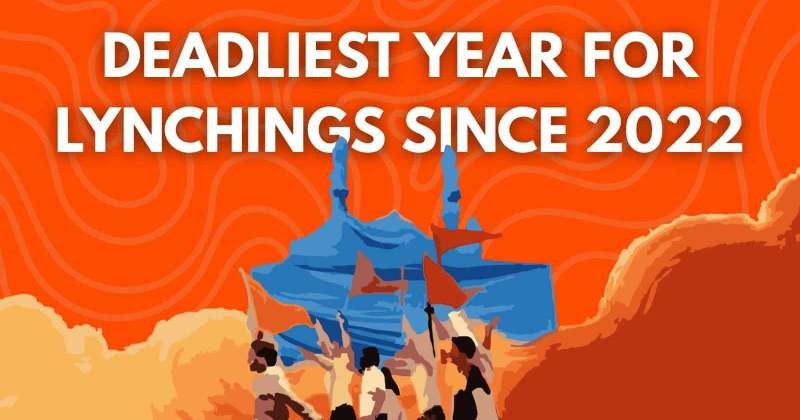
According to the latest data from the SAJC tracker, 2026 has proved to be the deadliest year for targeted violence against Muslims since the record of hate violence began in 2022. In the first ten months of this year, from January to October 2026, Hindutva extremists and self declared cow vigilantes beat at least 33 Muslims to death.
In the three months from August to October alone, at least eight Muslims were killed in hate crimes and in the name of cow protection. Four of these killings took place on the basis of mere allegations and rumors of cow theft or smuggling.
The so called cow vigilante groups now work as a parallel system of violence. Muslim traders, drivers and villagers face attacks over alleged activities linked to cows or beef, with no legal process at all. The attackers often spread videos of the torture on social media to celebrate. They do this because they know political shelter and patronage will protect them from any legal consequences.
“Half encounters” and police shootings
State violence is even more worrying, because it is carried out in the name of the law. The SAJC report records the deaths of eight Muslims at the hands of state forces between August and October 2026. Three of them died in police “encounters”, and five died in police custody or in prison. This brings the number of Muslims killed by state agencies in 2026 to at least 27.
The most shocking finding of the report is the use of “half encounters”. Between August and October 2026, police across the country shot at least 118 Muslim men in the leg or knee.
This has become a routine police tactic. Police use it to cripple suspects without a legal process, sometimes even before a formal arrest. After every incident, police tell the same set story. They say the accused tried to escape, snatched a police weapon and fired, and that police had to fire back in self defense.
The SAJC cited an investigation by the news agency Associated Press (AP). It found that since 2020, about 650 people have been wounded by Uttar Pradesh police gunfire in cow smuggling cases, and 93 percent of them were Muslims. Government data also show that police encounters in the state have killed 316 people since March 2017. Of them, 110, or about 35 percent, were Muslims. Muslims make up only about 19 percent of the state’s population.
The report also notes that after a police shooting on 13 August, the Allahabad High Court ordered a central investigation. The court observed that all 23 police officers involved in the incident had been rewarded for their “commendable work”. When officers involved in such incidents receive promotions and rewards, serious questions arise about accountability and justice.
Other forms of violence
The ongoing oppression of Muslims is not limited to physical killings. SAJC Tracker 2026/3 shows in detail how many forms of violence combine to cripple the existence of this minority community.
In September 2026, authorities fully or partly demolished at least six mosques in Uttar Pradesh, Madhya Pradesh, Delhi and Haryana. In Assam, forest eviction drives displaced more than 1,100 families, and most of them were Bengali speaking Muslims. Locals say more than 10 mosques were demolished there. In Uttarakhand, authorities ordered 179 of the 452 listed madrasas to close. In West Bengal, they issued orders to close 252 madrasas. These steps pose a serious threat to the religious freedom, education and cultural identity of the community.
The report also points to the third phase of the Election Commission’s “Special Intensive Revision”. It removed 61.6 million names from the draft voter lists of 18 states and union territories. Objections raised against Muslim dominated areas and Bengali speaking Muslims were far higher than their share of the population.
In Chhattisgarh, authorities detained migrant workers from West Bengal and labeled them “suspected Bangladeshis”. They did this only because of the workers’ language and religious identity.
Provocative statements by political leaders are making the situation worse. Between August and October, the SAJC’s “Election Watch” recorded at least 29 incidents of anti Muslim hate speech in Uttar Pradesh. The state’s Chief Minister made 13 of them. Some of the remarks referred to the Babri Masjid and Lord Ram to polarize society. Others linked madrasa education to a “terrorist mindset”. In Assam, a speaker called Muslims “biryani eating creatures”. Such remarks send the message that it is acceptable to persecute minorities.
Social and psychological impact
This many sided violence against Muslims is not limited to statistics. It controls their daily lives and creates a culture of fear. For Muslim men who work in the cattle trade or in transport, leaving home for work means taking a risk. They may face an attack from cow vigilantes. They may also face a police “half encounter” over false cow smuggling charges.
Under the excuse of stopping “love jihad” and “land jihad” and enforcing cow protection laws, the livelihoods and business activities of Muslims are increasingly under watch and being treated as crimes. Victims go to the police hoping for justice. Instead, police turn them into accused persons, send them to prison or shoot them in the leg. People then lose trust in the state system. The judicial system is slow, but bulldozers demolish homes at once, and punishment happens in public on the streets. This culture has further weakened people’s faith in constitutional protection.
The Indian constitution guarantees every citizen fundamental rights. Article 14 protects the right to equality. Article 19 protects freedom of speech and the right to livelihood. Article 21 protects the right to life and personal liberty. These rights do not depend on religion, color or language.
The SAJC report shows that this violence is not an isolated exception. It has become an institutional practice. Hate has gained social and political normality, and the justice system is failing to respond.