Govt maintains foreign policy shift brought by July Revolution
Mobayedur Rahman
My entry into Daily Inqilab came through an article published on January 12, 1990, titled “Siraj Sikder’s Famous Remark: I’ve Left Pindi, I Won’t Go to Delhi.” Thirty-six years have passed since then. Thirty-four years after that article was published, that same call echoed — in a somewhat different form — across Dhaka and every corner of Bangladesh. In the July Revolution, we heard a slightly altered version of the same slogan: “Not Delhi, but Dhaka/Dhaka, Dhaka.” Last June 4, Daily Inqilab completed 40 years. Throughout these 40 years, Daily Inqilab has continuously wielded its pen against Indian hegemonism, for which it repeatedly fell under the furious gaze of Sheikh Hasina and the Awami League.
When writing the history of Bangladesh, many recall the celebrated remark of the renowned Indian leader Gopal Krishna Gokhale: “What Bengal thinks today, India thinks tomorrow.” Mr. Gokhale made this remark in his presidential address at the Congress session held in Benares in 1905. His statement was made against the Partition of Bengal, in favor of an undivided Bengal. The Partition of Bengal was reversed due to the Hindu community’s movement. Yet that same Hindu community fiercely opposed the United Bengal movement of Suhrawardy, Abul Hashim, Sarat Chandra Bose, and Kiran Shankar Roy in 1946. The United Bengal movement of Suhrawardy and Abul Hashim was firmly supported by Muslim League President Mohammad Ali Jinnah, Mawlana Akram Khan, Khwaja Nazimuddin, and others. With British assistance, Nehru and Sardar Patel ultimately succeeded in dividing Bengal.
Following the thread of Gokhale’s remark, I would say: “What Inqilab thinks today, the whole nation thinks tomorrow.” Since its founding, Inqilab has maintained that India did not fight Pakistan in order to grant Bangladesh independence. Indira Gandhi fought against Pakistan in 1971 — but what was the real reason behind her involvement in that war? That was revealed by her highly educated granddaughter, Lok Sabha member Priyanka Gandhi. Campaigning in Amethi for the 2024 Lok Sabha election, Priyanka Gandhi said that Narendra Modi was questioning Indira Gandhi’s nationalism, even though it was during Indira Gandhi’s tenure as Prime Minister that Pakistan was split into two in 1971 — a summary of her remarks as reported by NDTV.
In even more explicit language, at a 2025 election rally in Delhi, Priyanka said she was the granddaughter of Indira Gandhi and had seen her break Pakistan into two parts. After the surrender of Pakistani forces on December 16, 1971, Prime Minister Indira Gandhi had said, “Hum hazar saal ka badla liya” — meaning, “We have taken the revenge of a thousand years.” She also said they had drowned the two-nation theory in the Bay of Bengal. Thus, what was a war of liberation and struggle for independence for Bangladeshis was, for Indians, revenge for a thousand years and the breaking of Pakistan. Why were they so determined to break Pakistan? Because if East Bengal separated from Pakistan, India would first become a regional power and later a world power like America, China, and Russia — an ambition dating back to Nehru’s era.
Two
Pandit Jawaharlal Nehru nurtured throughout his life the dream that India would one day become a world power. Not just concerning Bangladesh and Pakistan, but including Afghanistan too, the Rashtriya Swayamsevak Sangh (RSS) has dreamed of an undivided India for the past 100 years. Narendra Modi, Amit Shah, and Yogi Adityanath share that same dream. They did not help Bangladesh’s Liberation War in order to create an independent, sovereign, self-respecting nation; rather, they wanted to separate Bangladesh from Pakistan and keep it as a subordinate tributary state under their control. In his three-and-a-half years of rule, Sheikh Mujibur Rahman bound Bangladesh to India through a 25-year treaty of subjugation.
Whatever is said — that Sheikh Mujibur Rahman simply asked Indian troops to leave and they duly left Bangladeshi soil — the matter was not so simple. Rather, Sheikh Mujib wanted Indian troops to remain in Bangladesh for another 6 months to a year. Indira Gandhi did not want a 25-year treaty of subjugation. During Indira Gandhi’s Dhaka visit, aboard the pleasure boat “Merry Anderson,” Sheikh Mujibur Rahman repeatedly requested and persuaded Indira to sign this treaty. If anyone wishes to challenge me on this, I am prepared to provide the appropriate documentation.
During Sheikh Mujib’s rule, India was made an appendage of the Indo-Soviet axis power in global politics. From the change of power in 1975 until Sheikh Hasina’s assumption of power in 2009, Bangladesh emerged from the chains of Indian subjugation. But after taking power in 2009, for the subsequent fifteen-and-a-half years until the July Revolution, Bangladesh remained independent in name only. There was effectively no foreign policy of Bangladesh’s own; hence it was said, at home and abroad, that Bangladesh’s foreign policy was “Indo-Centric.”
The July Revolution of 2024 did not merely remove the fascist autocrat from power in Bangladesh — it completely reversed the direction of Bangladesh’s foreign policy, one might almost say from the North Pole to the South Pole. The slogan of this reversal was: “Not Delhi, but Dhaka/Dhaka, Dhaka.” The shift in foreign policy direction initiated by Dr. Yunus has been maintained — indeed, firmly held onto — by the current government. While writing this column Sunday evening, I came across a remark by State Minister for Foreign Affairs Humayun Kabir. A national daily’s online edition carried a lead headline to the effect of: “Stop obsessing over India day and night — think about your own country: State Minister for Foreign Affairs.” Speaking at a press conference on Sunday about the country’s foreign policy and various contemporary issues, the State Minister emphasized maintaining an effective, bilateral relationship with neighboring India, while advising against constantly chanting “India, India.” He said the people of the country should think of their own interests and their own country first. The State Minister said India is simply another country with which Bangladesh wants to maintain an effective, bilateral relationship — but if every day, from breakfast to lunch to dinner, all anyone can talk about is India, then when will people ever get around to their own country’s affairs? He urged people to think about their own country instead of constantly focusing only on India.
Three
The July Revolution has ushered in a dramatic shift in Bangladesh’s defense and foreign policy — a shift that has upheld independence and sovereignty. This shift was initiated by Dr. Muhammad Yunus’s interim government. It was meant to be a revolutionary or national government; why it did not become one is a separate discussion. But whether or not it became a national or revolutionary government, the July Revolution shattered the fortress of subjugation.
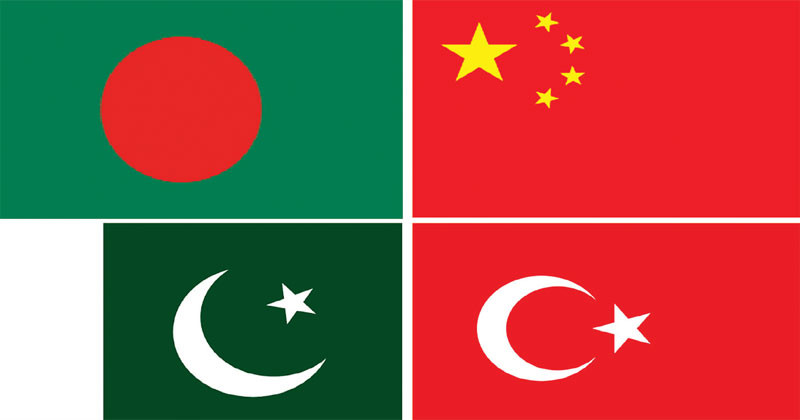
The direction of defense and foreign policy has shifted by 180 degrees. Friendship with China has been consolidated. Sheikh Hasina claims her downfall was the result of an American conspiracy — this is not at all true. Alongside strengthening sovereignty, efforts are being made to build good relations with America as well as China. Whether Bangladesh will join the Mecca agreement is being weighed carefully. Among the countries party to that agreement, Pakistan was a forbidden country as far as Sheikh Hasina’s government was concerned; friendly relations have now been established with that country, just as they had been established during the era of Desh Netri Begum Khaleda Zia.
In the military sphere, Turkey has acquired cutting-edge technology, a portion of which will be transferred to Bangladesh (transfer of technology). A dramatic change has occurred in the country’s defense policy, with a new dimension added to arms procurement.
I intend to discuss in detail next Tuesday the new direction that has emerged in Bangladesh’s defense and foreign policy and arms procurement. Barring any major new political development in the meantime, next Tuesday I will discuss the military strength of India, Pakistan, Afghanistan, Myanmar, and Bangladesh, and what Bangladesh plans to do in the coming days to strengthen its military capability.