

Waterlogging becomes Khulna’s curse
- Nearly 80 of 298 Water Bodies Completely Vanished
- Rivers Re-Silted and Canals Re-Filled by Illegal Encroachment Despite Crore-Taka Re-Excavation
Abu Hena Mukti
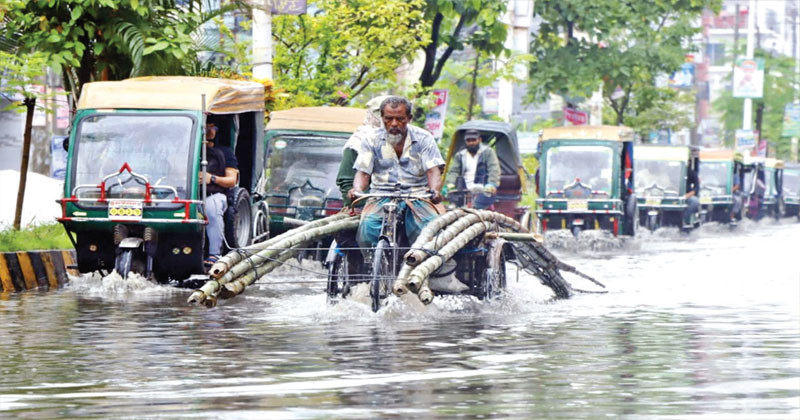
Waterlogging across the Khulna region has now become a permanent and severe public ordeal. Despite years of spending crores of taka on drainage system development and re-excavation of rivers and canals, vast areas of Khulna are being flooded by even light rainfall. This problem becomes extreme during the monsoon season, bringing ordinary people’s lives to a standstill.
According to experts, the primary cause of this severe waterlogging is the rapid disappearance of natural water bodies. Khulna city once had 298 water bodies, of which about 80 have completely vanished. Even though rivers have been re-excavated at a cost of crores of taka, waterways and canals are being re-filled due to silt accumulation or illegal encroachment. Unplanned housing construction and drains built without proper water-discharge routes mean rainwater cannot flow into rivers.
In low-lying areas like Dumuria and Phultala upazilas, waterlogging submerges thousands of fish enclosures and hundreds of hectares of farmland, causing farmers hundreds of crores of taka in financial losses. Continuous rain floods homes and businesses across various parts of Khulna, leaving thousands of people marooned. With roads submerged, the transportation system collapses, and local trade and commerce suffer a severe setback.
According to sources, the filling of water bodies and the shrinking of green spaces have plunged Khulna city into a severe environmental crisis, whose direct impact is seen through severe waterlogging during the monsoon season.
According to a survey by the Khulna Development Authority (KDA) and data from urban planners, this problem has taken a permanent form in recent years due to the lack of planned urbanization and the destruction of natural water bodies. Of the 298 identified water bodies in Khulna city, 80 have completely disappeared and at least 27 have been partially filled. Even where there were once about 3,600 government and private water bodies, the vast majority have now turned into multi-story buildings, roads, or commercial establishments. Twenty-two natural canals near the city, including the Moyur river, have lost their natural water flow due to illegal encroachment and garbage, turning into dead drains. As a result, rainwater cannot quickly flow into the rivers or the main river channels. Over the past 30 years, Khulna’s built-up or concrete area has increased by about 44%, while green vegetation or trees have decreased by about 38%. As a result, nearly a quarter of the city’s area is experiencing excess heat, or an “urban heat island” effect, which is warming the overall climate. Additionally, although Khulna City Corporation (KCC) has implemented drainage projects worth 750 to 823 crore taka to address waterlogging, citizens are not reaping the benefits due to a lack of integrated planning, unplanned drain construction, and the ineffectiveness of sluice gates and pump houses.
The problem of long-term waterlogging across the Khulna region, with vast areas submerged by even light rainfall, has taken a severe turn in recent times. The recent incident of the entire city being flooded three times within just 10 days makes clear the depth of this crisis.
According to a Khulna Development Authority survey, of the metropolitan area’s 298 natural water bodies, 80 have completely disappeared and 27 have been partially filled. Additionally, most of the city’s 21 canals are nearly dead due to encroachment and garbage.
Meanwhile, although drains and culverts have been built, they are not systematically connected to rivers or main water bodies, blocking the natural path of water discharge. From Kharnia to Baroaria in Dumuria, silt accumulation in the Teligati river is filling up a 28-kilometer upstream stretch. During high tide, water from the Rupsha and Bhairab rivers is flowing backward through drains into the city. Recent satellite data analysis shows that Khulna’s soft soil is gradually subsiding, further increasing the risk of waterlogging and salinity.
In the low-lying areas of Dumuria and Phultala upazilas, recent waterlogging has submerged about 8,250 fish enclosures and hundreds of hectares of farmland, causing an estimated financial loss of more than 100 crore taka. Heavy rainfall submerges the city’s main roads, the KUET campus, and homes in Doulatpur and Khalishpur in knee-to-waist-deep water. Due to standing water, the incidence of dengue has risen alarmingly across Khulna division in recent times.
City residents say that with the Moyur river and about 22 canals, along with various drainage routes, being encroached upon and constricted, rainwater cannot drain normally. Over the past three decades, paved structures and roads in the city have increased by about 44%, while trees and green spaces have decreased by about 38%. As a result, rainwater, instead of being absorbed into the soil, is accumulating directly on roads. Tidal water from the Rupsha and Bhairab rivers often enters the city through drainage canals. Additionally, hundreds of crores of taka worth of drainage projects, or unplanned small drains, are failing to prevent waterlogging due to a lack of an integrated system.
Director of the Department of Environment’s divisional office, Mr. Khondaker Md. Fazlul Haque, said many people still do not know that filling in a water body is a major offense. He said that when they receive complaints, they halt the activity, but much of this filling happens secretly and such news does not reach them. He said monitoring has now been increased, and they try to take action as soon as they receive information.
Bangladesh Paribesh Andolan (BAPA) Khulna coordinator Mr. Babul Haolader said there is a lack of coordination among KDA, KCC, the district administration, and the Department of Environment. He said this lack of coordination, negligence, and, in many cases, silence on the part of government offices has allowed one water body after another to be filled in.