India Conspiring by Refusing to Extradite Autocrat Hasina: Ruhul Kabir Rizvi
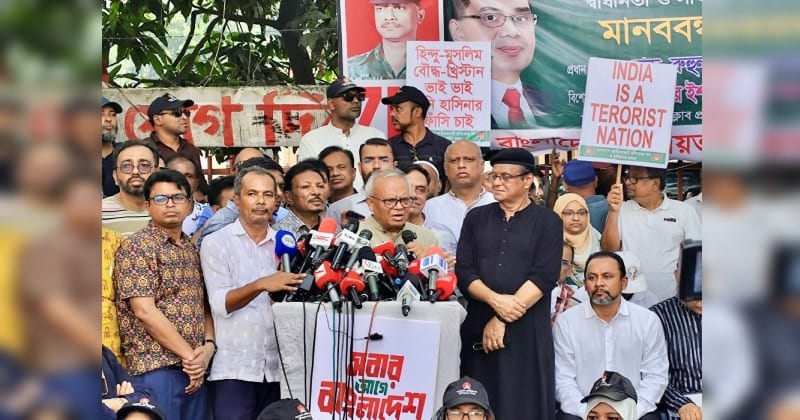
Bangladesh Nationalist Party Acting Secretary General Mr. Ruhul Kabir Rizvi has accused India of hatching a deep conspiracy against Bangladesh by granting political asylum to fallen autocrat Ms. Sheikh Hasina and her associates. Speaking on Wednesday morning as the chief guest at a demonstration organized by the Bangladesh Jatiyatabadi Muktijoddha Dal and Projonmo Dal in front of the National Press Club, he questioned New Delhi’s friendship. Mr. Rizvi stated that despite formal extradition requests and court warrants regarding Hasina, whom he alleged killed 1,400 youths during the 2024 uprising, India has continuously ignored them.
Drawing a comparison, Mr. Rizvi questioned why India previously extradited a convicted former major involved in Mr. Sheikh Mujibur Rahman’s assassination, yet refuses to return Ms. Hasina. He further linked Bangladesh’s refusal to participate in the BRICS summit to an abrupt power disruption from India’s Adani power plant. Mr. Rizvi asserted that declining the BRICS invitation was a matter of national dignity because Bangladesh was invited merely as the BIMSTEC chair rather than an independent head of state. He claimed that right after this rejection, Adani announced a technical fault, calling it political pressure applied directly from Jharkhand.
Sharp criticism was leveled at the former Awami League government for its sixteen-year tenure marked by boundless looting, money laundering, enforced disappearances, and extrajudicial killings. Mr. Rizvi recalled the gruesome sights of corpses floating in the Shitalakhya, Padma, and Buriganga rivers before the country was freed on August 5, 2024, through a historic mass uprising. He emphasized that Bangladesh has now transitioned into a practicing democracy where opposition political voices can freely express criticism day and night without facing abduction or execution, reflecting the nation’s primary commitment to civil liberties and the rule of law.
Addressing the ongoing energy shortages across the nation, Mr. Rizvi clarified that the current gas crisis is an international issue driven by global market conditions and supply chain disruptions rather than internal failure. He assured the public that the government is working continuously to normalize supply lines for both industrial units and domestic households. Strategic initiatives are currently underway to secure alternative gas imports from East Asian countries, specifically Malaysia, Indonesia, and Myanmar. Despite global economic headwinds, he highlighted that remittance flows have increased and foreign exchange reserves have grown significantly due to planned economic management.
Turning to cultural heritage, Mr. Rizvi expressed deep outrage over recent controversies surrounding Dhaka University’s historic Madhur Canteen, warning that conscious citizens will not tolerate attempts to erase the Liberation War’s bloody achievements. He strongly condemned misguided efforts at DUCSU and elsewhere to rename or transform ‘Madhur Canteen’ into ‘Bishram Manzil,’ calling it an extreme insult to the supreme sacrifice of Martyr Mr. Madhu. Mr. Rizvi warned that if defeated forces from 1971 attempt to seek revenge in a different guise, freedom-loving students, veterans, and the public will resist them with an iron fist to safeguard national history.
The human chain demonstration brought together various central leaders, activists, and freedom fighters dedicated to upholding national sovereignty and democratic values. Prominent figures attending the event alongside Mr. Rizvi included Muktijoddha Dal Vice President Colonel (retired) Zainul Abedin, Mr. Anisuzzaman Khokon, and Major (retired) Mizan, among other key organizers from both the Muktijoddha Dal and Projonmo Dal. The leaders collectively reaffirmed their commitment to maintaining state independence, protecting public freedom of speech, ensuring justice for victims of past atrocities, and firmly resisting any external or internal conspiracies targeted against the sovereignty of Bangladesh.