Disinformation Campaign Deterring Tourists and Investors from Cox’s Bazar
Shamsul Haque Sharek
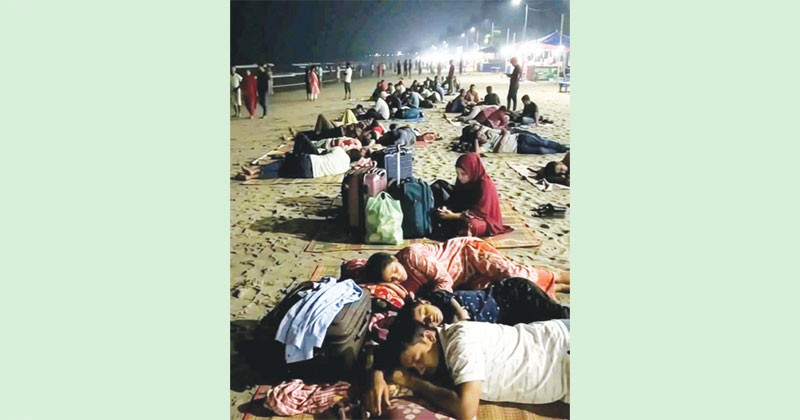
Worry has grown over misleading pictures and negative campaigns spreading on social media about the tourism industry in Cox’s Bazar. A picture is being shared to show a shortage of lodging for tourists. It shows countless tourists, including women and children, spending the night on the sandy beach. People claim the picture was made with artificial intelligence (AI).
Several events have come up for discussion recently. These include the deadly fire at the Tup Tup Resort in Patuartek of Inani, a fire near the generator of the star hotel The Sea Princess in the city, and a fire lit for barbecue. Reports about the safety of tourists in several hotels in Cox’s Bazar have also worried the public. Some people in tourism circles are reportedly unhappy with these events and the way the news was published.
One section of concerned people says it is the duty of journalism to report any accident. But they say it is worrying if one off events, unchecked pictures or exaggerated presentation create a negative idea about the whole tourism industry of Cox’s Bazar. They fear such campaigns may hurt tourists’ interest and possible investment. But they say it must be checked whether there is any planned aim behind these campaigns to stop tourists and investment.
At a time when the potential for local and foreign investment in Cox’s Bazar tourism is in the news again, the need to guard the sector’s image has also come up. Last month in Kuala Lumpur, Malaysia, a memorandum of understanding was signed. The signers were Malaysian tourism entrepreneur Mr. Tan Sri Syed Yusof Jojo, former Maldives Vice President and Tourism Minister Mr. Ahmed Adeeb, and Dr. Kamrul Ahsan, Chairman of Bangladesh’s Versatilo Group.
It is about a plan to build an international standard, eco friendly resort on the Cox’s Bazar and Teknaf coast. The proposed project is said to have a possible investment of about 500 million US dollars. Last week, Japanese investors said they plan to invest 1.2 billion US dollars at first in Bangladesh’s tourism and hospitality sector. Cox’s Bazar and other tourist spots in the country have come up as possible places for this investment. But this investment plan is also to move forward through formal proposals and later steps.
These foreign investment moves have brought the potential of the Cox’s Bazar tourism industry into the spotlight again. In this situation, concerned people say that spreading confusion about the real condition of the tourist spot through false information or artificial pictures can affect the view of possible investors too.
Hotels, motels, restaurants, transport, tourism services, small businesses and a huge number of jobs are tied to the Cox’s Bazar tourism industry. So the safety of tourists, fire safety in hotels, emergency exits and the lodging shortage are no doubt important issues. Any irregularity or mismanagement in these areas must be investigated and reported.
The deadly fire at Tup Tup Resort in particular gives a fair reason to question the safety systems, fire fighting equipment, approvals and monitoring of such places. In the same way, if a fire breaks out in any other hotel, publishing its cause and damage is part of public interest. But no one should give a firm verdict on the cause of an event before an investigation. No one should show the whole tourism industry as unsafe based on a single event.
When an AI made picture spreads on social media as a real event, ordinary people may be confused. So before publishing or sharing any picture, it is important to check its source, time, place and truth. If there is a complaint about a lodging shortage, it should also be shown with reliable data. This includes the number of hotel rooms available, the number of tourists, rents and the real situation.
People in tourism circles say the duty to protect Cox’s Bazar’s image does not lie only with the media or businesses. It also lies with the administration, hotel owners, tourism service providers and social media users. Along with ensuring tourists’ safety, preventing fires, improving lodging services and giving quick fixes to complaints, effective steps are needed against false information.
At the same time, if people allege that some planned interest is behind the negative campaign against Cox’s Bazar, it should be probed on facts and proof, not on emotion. Exposing real irregularities and identifying motivated false propaganda are both important for the public interest.
To move the Cox’s Bazar tourism industry forward, we need a mix of truthful journalism, responsible promotion, a safe tourism system and an investment friendly climate. Hiding an accident is not desirable, and spreading confusion with artificial pictures or unchecked information cannot be accepted either. Let the truth come out and let false information stop. Everyone wants Cox’s Bazar to grow as a safe and prosperous tourist city.