Dhaka-Tokyo Summit Secures $6.3 Billion in Investment for Bangladesh
Faruk Hossain, from Tokyo
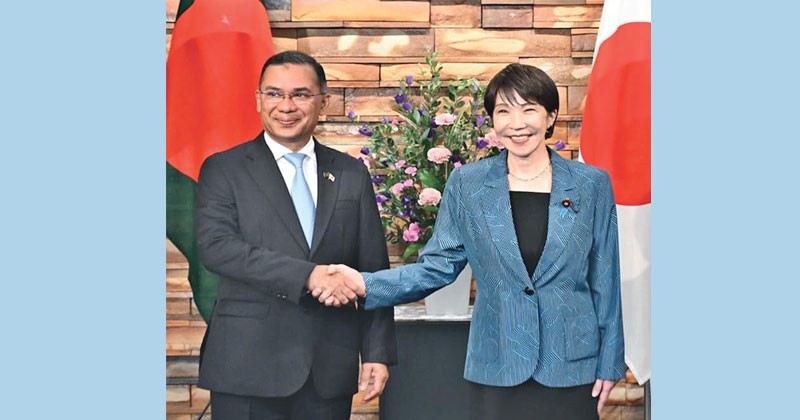
Prime Minister Mr. Tarique Rahman and Japanese Prime Minister Ms. Sanae Takaichi have announced a plan to take five decades of tested friendship and strategic partnership between Bangladesh and Japan to a historic level. The two countries have finalized a framework to raise Dhaka and Tokyo relations to a new height in trade, investment, defense and energy security.
Japan’s private sector will invest 1 trillion yen (6.3 billion US dollars) in Bangladesh over the next five years. This will create at least 200,000 new jobs in the country. Yesterday in Tokyo, the two prime ministers held a bilateral summit and signed a historic Economic Partnership Agreement (EPA) and an agreement on the transfer of defense equipment and technology.
A 14 point joint statement was released after the meeting. It includes the “Big B for Common Prosperity” initiative around the Matarbari deep sea port, an emergency loan of 50 billion yen for the energy sector, six patrol vessels for maritime security, and Tokyo’s active role in the quick and dignified return of the Rohingya. Mr. Tarique Rahman also proposed a tech park in Bangladesh, a high speed rail network linking six divisional cities, and a ministerial level joint commission.
Earlier, Mr. Tarique Rahman arrived at the Japanese Prime Minister’s Office at 11:30 am. Ms. Takaichi welcomed him, and he was given a guard of honor. During the meeting, Ms. Takaichi praised the vibrant democracy in Bangladesh. She welcomed the credible and peaceful general election held last February, which a Japanese government observer team had witnessed, and she warmly congratulated Mr. Rahman on taking office.
Mr. Rahman thanked Japan for its steady support during Bangladesh’s five decades of development since independence. He also praised Japan’s role in global peace and stability. The two leaders reaffirmed shared values such as democracy, freedom and the rule of law. They also stressed the importance of the “Free and Open Indo-Pacific (FOIP)” initiative.
Big B for Common Prosperity and infrastructure development
Considering the changing global situation and supply chain risks, the two prime ministers decided to upgrade the flagship Japan and Bangladesh initiative “Big B” into “Big B for Common Prosperity.” Under it, the Matarbari and Moheshkhali region will be developed into a major hub for logistics, energy and industry, centered on the Matarbari deep sea port.
Both countries also agreed to move forward with preparatory work for the quick opening of the third terminal at Hazrat Shahjalal International Airport. They agreed to speed up construction of the MRT metro rail lines in Dhaka and to work on the operation and management of Matarbari port. The leaders stressed more cooperation in trade and investment, energy security, technology and space research, infrastructure, and regional and international issues.
Mr. Tarique Rahman at the bilateral summit
Mr. Rahman said his government is working on a plan to make Bangladesh a hub for economy, technology and manufacturing. He said Bangladesh could become the ninth largest consumer economy in the world by 2030. He also said the country’s GDP could pass one trillion US dollars by 2034.
He said Japan holds a special place in the hearts of the people of Bangladesh. Japan was one of the first countries to recognize Bangladesh after independence in 1971, and it has been one of the most important development partners since then. He said the relationship rests on mutual respect, trust, and a shared wish for peace, prosperity and stability.
He recalled the two visits to Japan by his father, Shaheed President Mr. Ziaur Rahman. He also recalled the contribution of his mother, the late former Prime Minister Ms. Khaleda Zia, to strengthening the relationship. He promised to follow in their footsteps and take the ties to a new height.
Mr. Rahman put special stress on ensuring energy security for Bangladesh. He said reliable and affordable energy supply is essential to keep the economy growing. He thanked Japan for its long support and mentioned the recent emergency loan of 50 billion yen under the “Partnership for Power Asia” initiative. He also called for more Japanese investment and participation in LNG infrastructure, efficient power generation and renewable energy.
He proposed a Bangladesh Japan Tech Park to build a technology based economy. He said it would connect Japanese companies, universities and investors with the young talent, entrepreneurs and skilled workers of Bangladesh. He said the proposed park would give priority to areas such as artificial intelligence (AI), cloud computing, robotics and electronics manufacturing. He also showed interest in expanding cooperation with Japan in space science, satellite engineering and related technology.
To speed up economic growth, the Prime Minister described a plan for modern and connected transport infrastructure. This includes a high speed rail network linking six main divisional cities and flyovers across the country. He asked for Japan’s help in planning, technical support, investment and financing for such large projects.
He welcomed new investment by Japanese businesses in Bangladesh. He said his government is committed to making the investment climate better by bringing transparency, predictability and efficiency to regulation, tax policy, customs clearance and money transfer. He hoped the Bangladesh Japan EPA would come into force soon, and said both sides must work together so that people in both countries benefit from it.
United Nations, Indo-Pacific and the Rohingya crisis
On regional and international issues, Mr. Rahman stressed the shared commitment of the two countries to multilateralism, international peace and international law. He thanked Japan for supporting the election of Foreign Minister Dr. Khalilur Rahman as President of the 81st session of the UN General Assembly. He hoped to work closely with Japan under his presidency to strengthen multilateral cooperation and face global challenges.
He repeated the shared vision of a free, open, peaceful and inclusive Indo-Pacific region. He stressed more cooperation between the two countries for regional connectivity, free flow of trade and economic growth. He expressed deep concern over the worsening situation in Myanmar and the Rohingya displacement crisis it has caused. He called for an end to all violence, safe and smooth humanitarian aid, and talks among all parties.
He praised Japan’s support for Bangladesh’s humanitarian efforts for the Rohingya who were forcibly displaced from Rakhine State and have taken shelter in Bangladesh. He asked Japan to keep its active engagement with all sides to bring peace and stability to Rakhine. He said the lasting solution to this crisis lies in Myanmar itself, and that the Rohingya must return home quickly, willingly, safely and with dignity.
Resolve to take relations to a new height
In his closing remarks, Mr. Rahman said the summit will open a new chapter in the relationship, along with keeping its historic continuity. He hoped this chapter will rest on deeper trust, wider economic cooperation, a stronger investment relationship, and a shared commitment to peace, stability and prosperity. He proposed a ministerial level joint commission to identify priority sectors, speed up their delivery and turn opportunities for cooperation into real action. He also stressed closer contact and cooperation between the business communities of the two countries.
He said the constructive talks had strengthened the shared wish for inclusive economic growth and sustainable development. He invited Ms. Takaichi to visit Bangladesh at a mutually convenient time.
EPA signing and better business climate
The two prime ministers welcomed the signing of the Japan Bangladesh Economic Partnership Agreement (EPA), which aims to support Bangladesh’s smooth and sustainable graduation from the list of least developed countries (LDC). Japan also gave assurance of positive talks on Bangladesh’s request to join the Regional Comprehensive Economic Partnership (RCEP). Mr. Rahman promised more transparency in tax, customs clearance, remittance and licensing processes to improve the investment climate.
Three separate Memorandums of Understanding (MoU) were signed between Japan’s relevant ministries and Bangladesh’s Economic Relations Division (ERD), the Ministry of Agriculture, and the Ministry of Fisheries and Livestock. The two sides also announced joint work on digital transformation (DX) in the ICT sector, building skilled ICT professionals, and safe digital connectivity.
50 billion yen energy loan and climate cooperation
Mr. Rahman thanked Japan for giving Bangladesh an emergency assistance loan of 50 billion yen. It is the first yen loan project under Japan’s “Power Asia” initiative, meant to face the instability of the global energy market. A Letter of Intent (LOI) was also signed between the environment ministries of the two countries to tackle climate change and promote renewable energy.
Bangladesh Japan joint statement
The statement covers stronger strategic and economic ties, 1 trillion yen in investment, cooperation in defense and energy, and key decisions on regional and international issues. It says that during an official visit to Japan, Prime Minister Mr. Tarique Rahman met Prime Minister Ms. Sanae Takaichi at a bilateral summit in Tokyo.
Point 2: Both prime ministers highly praised the long friendly relationship since Bangladesh’s independence. They also praised progress in economic cooperation under the “strategic partnership” in areas such as infrastructure, energy, human resource development, trade and investment. They reaffirmed their commitment to shared values such as democracy, freedom and the rule of law. Mr. Rahman sincerely thanked Japan for its steady support, including development aid, over the past five decades. He praised Japan’s steady role as a peace loving country and valued its constructive role for global peace, stability and prosperity. Ms. Takaichi highly praised the vibrant democracy in Bangladesh and welcomed the credible and peaceful general election of February 2026, witnessed by the observer team sent by the Japanese government. She congratulated Mr. Rahman on taking office.
Both prime ministers reaffirmed their commitment to uphold an international order that is free, open and based on the rule of law. In this context, Mr. Rahman noted the importance of Ms. Takaichi’s “Free and Open Indo-Pacific” initiative for ensuring peace, stability and prosperity for all.
On connectivity, both prime ministers reaffirmed their commitment to keep cooperating to strengthen connectivity in the region and sustain fast economic growth. In particular, they agreed to move forward with preparatory work for the quick opening of the third terminal at Hazrat Shahjalal International Airport in Dhaka. They agreed to push ahead with the quick construction of Dhaka’s MRT (metro rail) lines. They also hoped to discuss future cooperation, including the operation and management of Matarbari deep sea port.
On geopolitical uncertainty and building resilience against risks, both prime ministers recognized the growing instability of the global energy market and rising energy prices. They stressed again the importance of international cooperation to strengthen oil reserves through Japan’s “Partnership on Wide Energy and Resources Resilience Asia” and of close coordination on energy between producing and consuming countries.
Both prime ministers also recognized the need to strengthen global efforts to tackle climate change. They stressed deeper cooperation on a long term low emission development strategy, energy efficiency and capacity building, and the spread of renewable energy.
On economic growth and policy partnership, Ms. Takaichi praised the efforts of Mr. Rahman’s administration to encourage foreign direct investment. She welcomed the forecast of up to 1 trillion yen in private investment from Japan to Bangladesh over the next five years, creating 200,000 jobs. Both prime ministers welcomed the major investments to be announced on this occasion. They agreed on building complementary and resilient supply chains in sectors such as manufacturing, food and agriculture, ICT and pharmaceuticals.
Building on past bilateral cooperation in the ICT sector, including IT and IT enabled services, human resource development and digital cooperation, they agreed on the importance of exploring more ways to speed up digital transformation, build highly skilled ICT professionals and secure safe and reliable digital connectivity.
To increase economic exchange, Ms. Takaichi stressed the need to improve Bangladesh’s investment climate further. Mr. Rahman described recent steps by his government. He promised to make investment easier by increasing policy clarity, transparency and predictability in tax, customs clearance, remittance and licensing. Both prime ministers welcomed the signing of an MoU between Japan’s Ministry of Economy, Trade and Industry and the Economic Relations Division of Bangladesh’s Ministry of Finance to improve economic relations and the business climate. They also welcomed the signing of two separate MoUs between Japan’s Ministry of Agriculture, Forestry and Fisheries and Bangladesh’s Ministry of Agriculture and Ministry of Fisheries and Livestock, to strengthen business and attract investment in food, agriculture, fisheries and livestock.
On stronger cooperation for peace and stability, amid a growing uncertain geopolitical situation, both prime ministers reaffirmed their commitment to strengthen bilateral security cooperation. In this context, they welcomed the signing and entry into force of the agreement on the transfer of defense equipment and technology. They discussed the review of Japan’s three principles on the transfer of defense equipment and hoped for more progress in bilateral cooperation. Ms. Takaichi acknowledged that Bangladesh is one of the top contributors to UN peacekeeping missions. She promised to deepen cooperation to help maintain peace and stability by building capacity in defense cooperation, maritime situational awareness, coastal patrol and port security.
Both prime ministers again stressed the importance of resilient and inclusive development to support Bangladesh’s efforts to tackle the economic and social challenges of its people. They welcomed the commitment to a yen loan program, the “Upazila Governance and Development Project (Phase 2)”, to build the administrative and financial capacity of local government. They reaffirmed the importance of quality infrastructure, transparent and fair development finance, and debt sustainability and transparency.
Both prime ministers pledged to increase people to people contact. In this context, they welcomed the “Japan Festival” held in Dhaka in September this year to spread Japanese culture and encourage varied cultural exchange. They stressed the importance of cultural exchange between the two countries. They recognized the important role of the Department of Japanese Language and Culture at the University of Dhaka in boosting Japan related research and academic exchange. They agreed to expand cooperation in education through Japan related research and Japanese government scholarships.
Both prime ministers noted that any action that disturbs the safety and freedom of navigation and flight is not acceptable. They reaffirmed the importance of settling all international maritime disputes peacefully through dialogue, negotiation and judicial processes, in line with international law as reflected in the 1982 UN Convention on the Law of the Sea.
Both prime ministers expressed concern over the continued development of nuclear weapons and ballistic missile programs on the Korean Peninsula in violation of UN Security Council resolutions. They called for an immediate solution to the abduction issue. They are concerned about the worsening crisis in Myanmar and its impact on regional security, the displacement of all people including the Rohingya, and the rise in cross border crime. They called for an immediate end to violence, release of detainees, a favorable environment for humanitarian aid, and dialogue among all relevant parties and affected groups, including the Rohingya. Ms. Takaichi praised Bangladesh for giving temporary shelter to the Rohingya from Rakhine State and expressed support for continued humanitarian aid to them.
Both prime ministers reaffirmed their commitment to lasting peace, security and stability in the Middle East. They also recognized the strategic importance of peace and stability in the Red Sea and the Bab el Mandeb Strait for global energy security and the uninterrupted flow of goods. They stressed the urgent need to move forward with the “Comprehensive Plan” for rebuilding Gaza. They reaffirmed their support for a just, lasting and comprehensive solution to the Palestine question, including the two state solution.
Stressing international cooperation, collective action and a rules based international order to face shared global challenges, both prime ministers reaffirmed their commitment to multilateralism based on the rule of law, respect for international law and the principles of the UN Charter. Ms. Takaichi praised the election of Foreign Minister Dr. Khalilur Rahman as President of the 81st session of the UN General Assembly. She expressed Japan’s wish to cooperate in building a more resilient and effective UN under his presidency.
Both prime ministers agreed to keep cooperating for quick reform of the UN Security Council, including expansion of both permanent and non permanent membership, through positive engagement in intergovernmental negotiations. They pledged to build a world free of nuclear weapons. They reaffirmed the importance of maintaining and strengthening the Nuclear Non-Proliferation Treaty as the cornerstone of the global nuclear disarmament and non proliferation framework. Mr. Rahman expressed sincere thanks to Ms. Takaichi and the people of Japan for the warm welcome and kind hospitality during his visit. He also warmly invited Ms. Takaichi to visit Bangladesh at a convenient time.
Visit to LNG terminal and power plant
Mr. Tarique Rahman visited JERA’s land based liquefied natural gas (LNG) terminal and power plant in Futtsu city, Chiba Prefecture, Japan. He was accompanied by Finance and Planning Minister Mr. Amir Khasru Mahmud Chowdhury, Civil Aviation and Tourism Minister Mr. M Rashiduzzaman Millat, and the Prime Minister’s Adviser on Finance and Planning Dr. Rashed Al Mahmud Titumir. Also present were State Minister for Foreign Affairs 1 Mr. Humayun Kabir, State Minister for Power, Energy and Mineral Resources Mr. Anindya Islam Amit, and the Prime Minister’s Adviser on Posts, Telecommunications, ICT, and Science and Technology Mr. Rehan Asif Asad.