The story behind the mega projects
Dr. Md. Abu Hasan
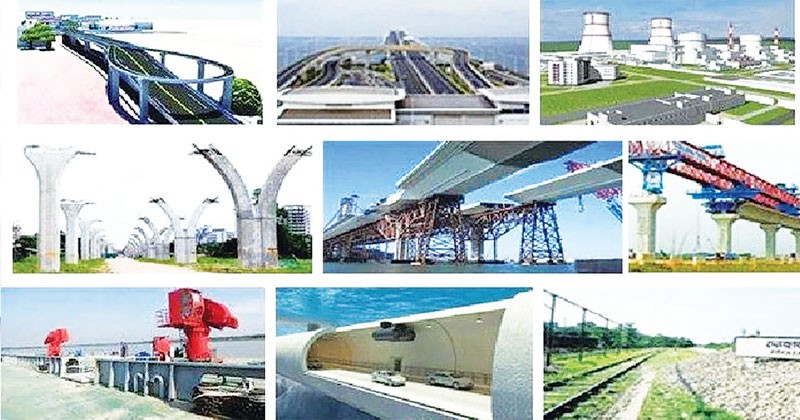
For the relatives of people who died crossing the river on stormy nights, for traders who could not deliver goods on time, and for people who spent nights at ferry ghats, the Padma Bridge is more than a way to cross a river. It is a new experience that saves life, money and time. Goods trucks racing along the four lanes of the Dhaka Chattogram highway, passengers who skip traffic jams on the elevated expressway to reach the airport, and the power plant rising at Rooppur are real national assets. Development has happened, and people are enjoying its benefits. There is nothing to argue about that.
The comfort of travelling on the metro rail between Uttara and Motijheel is true. But it is also true that the accounts behind this development have mostly stayed hidden. According to the White Paper report, about Tk 1.80 lakh crore left Bangladesh illegally every year on average from 2009 to 2023. Mr. Mostafizur Rahman, Distinguished Fellow of the CPD, worked on selected mega projects and money laundering for the White Paper. He says the country needs mega projects. But corruption in many mega projects sent huge sums of money abroad. He says several generations may have to carry the burden of this laundered money.
What the state has built is in front of our eyes. But how much do we know about who built it, how, at what price, and how much of the debt and risk today’s citizens and future generations will carry? So the questions of cost, debt, risk and accountability are not about one project. They are about the state’s financial strength and future spending. Seen this way, the five much discussed mega projects stop being five separate stories. Here we place them side by side as an investigative sample.
The repeated links we notice have at their centre the visible development and the political economy behind it. We can hardly treat these samples as isolated stories. The White Paper found at least 28 ways of corruption that used the “development narrative as a shield”. It also says that weak feasibility checks, lack of transparency in planning and papers, design changes and repeated revisions together built an institutional structure of beneficiaries behind the visible infrastructure. In this structure, raising costs, adding time and spreading blame became the norm.
The project to turn 192 kilometres of the Dhaka Chattogram highway into four lanes split into 10 road packages and 3 bridge packages. In 2006, the project cost was set at about Tk 2,161 crore. In 2009, it was revised to Tk 2,382 crore, and in 2016 it reached Tk 3,817 crore. Of the 10 road packages, the Chinese state company Sinohydro Corporation won 7. It is worth noticing that one company got most of the work on the busiest highway in the country.
After the work began, the government extended the deadline several times, the contractor demanded extra compensation and the project cost rose. But land acquisition problems, trouble in moving power and gas lines, local issues and administrative problems also slowed the work. It is easy to dismiss the cost rise as an engineering problem. But the comparison makes the question sharper. According to figures the White Paper cites, a four lane main road costs 4.4 times more in Bangladesh than in India and 2.15 times more than in Pakistan.
Market price differences alone cannot explain this gap. It raises unavoidable questions about decision making, procurement and the quality of accountability. So even if we do not claim that anyone delayed the work on purpose, the question remains. How does a company whose work drew questions win a place in the next project? To find the answer, we must go to the river management work of the Padma Bridge. Sinohydro returns there as a contractor. Its quoted bid was about Tk 8,708 crore.
This project too follows the same pattern as the highway project. The company won the work with a low bid, and then both time and cost rose. After several extensions of time and cost revisions, the total value of the river management contract reached about Tk 9,834 crore in 2024. This is a pattern. The White Paper says that about 86.4 percent of projects taken up under the previous government saw time, cost or both increase. This culture of revising projects keeps projects uncertain.
When uncertainty rises, the room to inflate costs through bargaining, change orders and new variations also rises. The question is not only the rise in cost. It is also why the same company returns from one project to another. In 2014, while people criticised Sinohydro for slow work and demands for extra money on the Dhaka Chattogram highway, the government decided in September to give it the Padma river management work. The two sides signed the contract in November. Was one company’s entry into another mega project just a coincidence, or was there an institutional reason behind it?
One White Paper observation matters here. It names the lack of transparency in project planning and papers, and the lack of the skill that ministries and agencies need to appraise and audit big projects, as fertile ground for corruption. Most important, the IMED regularly sent reports that pointed to irregularities and corruption, but in many cases no effective remedy followed. In other words, audits and monitoring exist, but remedies do not. This gap lets the same network return from one project to another without trouble.
This repetition did not stop with the highway and Padma. The CP 02 package of Line 6, Dhaka’s first metro rail (including the Uttara depot and related structures), went to a joint venture of Italian Thai Development and Sinohydro. At the same time, Italian Thai won several more packages. A big company can join several works, and can win if it has the ability. This is not unusual. The metro project director said the contractors were qualified under the rules and that the past performance of earlier projects cannot be compared with the metro tenders.
This explanation matters. But a problem remains when the history of cost rises, quality, time and accountability in earlier work has no effect on later decisions. So one contractor network shows up in one mega project after another. We must examine separately whether this return came only from market ability, or whether ties and institutional benefits after earlier projects also played a part.
The relationship gets deeper in the Dhaka Elevated Expressway. Here contracting and ownership mix in one structure. In the project company, Italian Thai held 51 percent, China Shandong International held 34 percent and Sinohydro held 15 percent. The project cost was estimated at about Tk 8,940 crore. The government gave Tk 2,413 crore of this as viability gap funding. A Chinese bank provided most of the rest of the funding.
In 2019, China Exim Bank and ICBC together gave the project company a loan of $861 million. The firms that were once only contractors now are part owners, shareholders and borrowers of the project, and they also take part in the work. After a dispute over loan repayments, the Chinese lenders stopped releasing money in 2024, and a legal fight over the share transfer began. The matter later went to court and arbitration.
Rooppur Nuclear Power Plant has a different structure. In 2015, the Bangladesh Atomic Energy Commission and Russia’s state company Atomstroyexport signed a contract worth $12.65 billion. About $11.38 billion of this was a Russian government to government loan. Under the original loan agreement, the interest was 1.75 percent plus the six month Libor, with a cap of 4 percent. The repayment period was 30 years, including a 10 year grace period.
This contract ties the VVER 1200 technology, equipment supply, construction, commissioning, staff training and the first fuel supply into one package. There is no competitive tender, no comparison of bids from many contractors and no familiar joint venture pattern. This is a government to government contract, a state loan and a long term relationship of technological dependence. So we must discuss other questions here, besides allegations of corruption. How clear are the terms of such a big sovereign loan, the interest rate, the repayment schedule and the cost of long term dependence on the technology to ordinary people?
One day people will see Rooppur’s power as light. But loan papers, terms and long term liabilities do not show as easily as light. So the question grows bigger. Borrowing is not the problem. The problem is the balance between the liabilities, risk and repayment ability on one side, and the assets, income or social benefits the loan creates on the other.
When we place these five projects side by side, we see a bigger picture. Political priority shapes the choice of projects. Then, through tenders and contracts, certain companies return again and again. Joint ventures, foreign funding, and revisions of time and cost follow, and in the end visible infrastructure stands. The government opens it, and political credit follows. In a 2026 study on the Padma Bridge, Ms. Nusrat Sabina Chowdhury showed how a visible mega project can become a tool for building political appeal and public consent.
But the accounts of who finally carries the weight of the contract terms, the reasons for cost revisions or the burden of risk rarely reach ordinary people. People enjoy the benefits of the project and save time. But the question of who pays the financial and institutional price of that saved time stays hidden. International studies also show that construction, financing and political power in big infrastructure projects are often tied to each other. A 2023 study by Mahmalat and Maktabi on infrastructure procurement in Lebanon found that in many cases, the lowest bid alone does not decide the outcome.
They found that politically connected firms, procuring agencies, and the consultant structures involved in design and supervision can weaken competition and open the way to create rents from projects. A 2019 study by Shonher in South Korea found that firms tied to political networks won more government contracts, and their projects were more likely to see renegotiation and cost rises. A study on Indonesia showed that infrastructure is not only a tool of economic growth. It can also become a tool for building political legitimacy (Hidayat, Tambunan and Haning, 2024).
Does today’s development cost only today, or must the next government and the next generation carry a part? According to CPD Fellow Mr. Mostafizur Rahman, a large part of corruption once circled inside the country in the “shadow economy”. The state got no revenue, but part of the money stayed in the country. Later, most of that money began to leave the country. So even though the visible structure of development projects stays in the country, the “invisible profit” tied to them has crossed the border in many cases.
So the loss is long term and passes across generations. Mega projects involve large import related deals, including equipment, raw materials, consultant fees and sub contracts. With weak checks, the risk of laundering through over invoicing grows many times. Even if a project helps people, were its procurement process, contract management, loan terms and risk accounts clear enough, competitive and accountable? If the answer is yes, showing that information in public should not be hard.
If the answer is no, the questions cannot stop just because a bridge or road stands. We cannot assume that when development is real, the story behind it is clear. This lack of accountability is not only on paper. It is also in the power relations. Dr. Debapriya Bhattacharya, the chief economist of the White Paper committee, said in the media that corruption and irregularity reached such a level that powerful circles even threatened foreign consultants to get their work done. They also threatened to close the offices of donor agencies or consulting firms.
In such an environment, competition, consultation and monitoring all slowly shrink into formalities. As formalities grow, the invisible accounts of projects become even more invisible. So what can we do? At least two changes are urgent. First, the government should publish, in simple language, a summary of contract revisions, time and cost increases, loan terms, project company ownership and tender evaluation for every mega project. Then even an ordinary citizen can see how acceptable the logic of decisions and costs is.
Second, a firm’s record in earlier projects, covering work quality, punctuality and accountability, should be a required part of the evaluation of later tenders. Not only the low bid, but the work record too, should be the measure of competition. Next time you cross the Padma Bridge or ride the metro, perhaps this very question will come to mind. Development stands before our eyes, but is its full account before our eyes too? Whose time was saved, whose time was spent, whose ability was built, and who paid the price?
Without this account, the picture of development is never complete. Development is before our eyes. The account of development should be before our eyes too.
Author: Associate Professor, Shaheed Buddhijibi Government College, Rajshahi