Flame Temperature Reaches 1,000°F; Water Emitting Alongside Gas
Inani Gas Eruption Sparks New Hopes for Energy Sector Potential
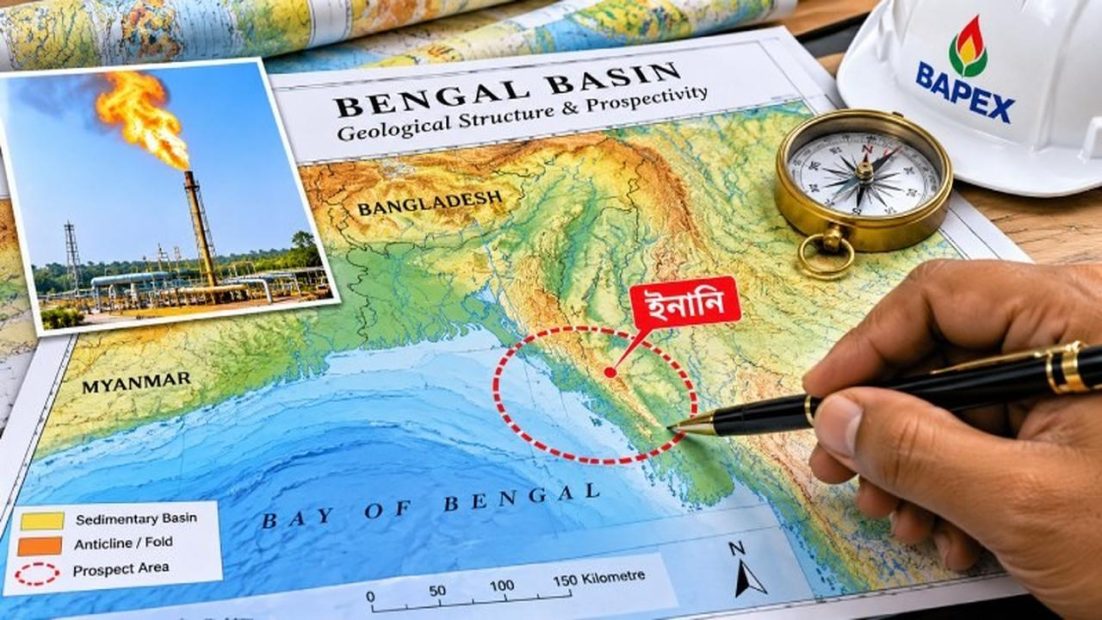
The continuous gas eruption from underground in Inani, Ukhiya, Cox’s Bazar, has reignited discussions regarding oil and gas potential along the Cox’s Bazar coast. Based on expert opinions, local residents are showing enthusiasm, hoping this event could unlock new energy prospects for the region.
Gas emission in Inani remains unchanged after a week, with initial indications of condensate presence alongside gas and water now flowing out. While this offers hope for energy exploration, extensive geological surveys and tests are necessary to determine if a commercially viable gas field exists.
Meanwhile, the Bangladesh Petroleum Exploration and Production Company Limited (BAPEX) is conducting a 15-day observation plan. BAPEX Manager (Geology) Mohammad Nasiruddin reported that flame temperatures during a site visit were recorded between 800°F and 1,000°F.
He noted that the flame height remains steady, with color and characteristics suggesting formation of gas, though laboratory confirmation is pending.
A joint committee formed by Petrobangla and BAPEX discussed measures for fire control, safe gas management, and addressing safety concerns for local residents. Petrobangla will decide on next steps for BAPEX to execute.
Oil and Gas Prospects Along the Cox’s Bazar Coast:
Beyond tourism, the Cox’s Bazar coast holds strategic energy significance. Geologists note that folded structures from Inani through neighboring hills and the Bay of Bengal coastline create favorable conditions for hydrocarbon accumulation, attracting historical exploration interest in the 1970s and 1980s.
Shell Oil drilled an exploratory well in 1969 without commercial success. In 1977, Union Oil discovered gas near Kutubdia Island, but high infrastructure costs for offshore platforms and subsea pipelines prevented commercial production.
In 1996, the Sangu gas field, located 80 to 90 km off the Inani coast, became Bangladesh’s first commercial offshore gas field. Production began in 1998 but ended in October 2013 due to declining pressure. Past discoveries at Kutubdia and Sangu underline the energy potential of this coastal region.
Interest Surrounding Condensate Presence:
Indications of condensate light liquid hydrocarbons that condense under specific temperature and pressure conditions, have heightened interest in the Inani eruption. Detailed technical evaluations and sampling are required to assess potential reserves.
Experts state that further scientific analysis and modern exploration technologies are needed to determine if this is an isolated event or connected to a major underground reservoir.
Overall, the gas eruption at Inani brings coastal oil and gas exploration back into focus. Long-term planned exploration and upcoming Petrobangla-BAPEX evaluations will determine if this leads to new opportunities for Bangladesh’s energy sector.