Rubio Proposes US-China-Russia Trilateral Talks in Phone Call with Wang Yi
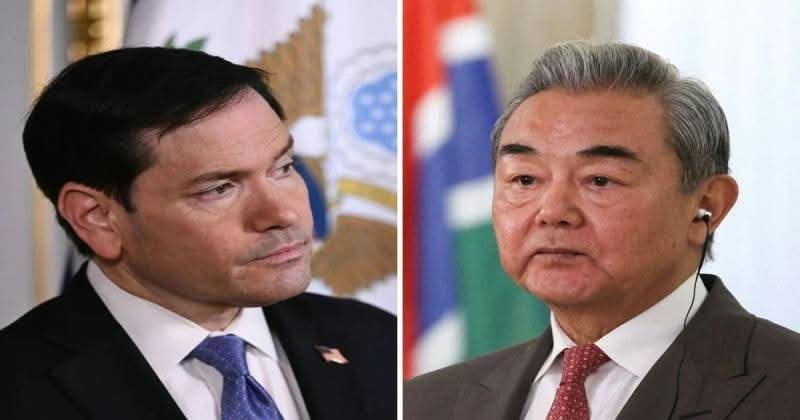
U.S. Secretary of State Marco Rubio and Chinese Foreign Minister Wang Yi spoke by phone on Wednesday to discuss holding a potential trilateral summit with Russia next week ahead of the Asia-Pacific Economic Cooperation (APEC) conference in Shenzhen. According to the U.S. State Department, both officials agreed on the importance of high-level dialogue to advance peace and nuclear disarmament, with diplomatic sources indicating the summit could yield a pledge to regulate artificial intelligence (AI) in nuclear command and control systems.
U.S. President Donald Trump is set to travel to Shenzhen for his third in-person meeting this year with Chinese President Xi Jinping, where Russian President Vladimir Putin will also be in attendance. Trump has strongly pushed to keep nuclear disarmament at the forefront of any three-way talks. Last month, he emphasized this priority by stating, “We are going to hold this meeting to talk about nuclear weapons and disarmament. We will schedule the meeting around disarmament, and it is a very positive thing for the world.”
Despite Washington’s push for a trilateral gathering, Beijing’s official readout avoided mentioning Russia and focused entirely on stabilizing bilateral ties. State news agency Xinhua quoted Wang Yi as saying, “This steady momentum in China-U.S. relations did not come easily; rather, it is a rational choice made by two major countries based on their respective and shared interests.” Chinese Foreign Ministry spokesperson Mao Ning added that the call was constructive and reaffirmed that China’s policy toward the United States remains consistent.
In parallel with diplomatic talks, U.S. Treasury Secretary Scott Bessent and Trade Representative Jamieson Greer held a video call with Chinese Vice Premier He Lifeng to finalize the economic and technological agenda for the upcoming summits. Ahead of the Trump-Xi meeting, Bessent and He will convene in Shenzhen on November 18 and 19 to address trade disputes and AI governance. However, Mr. Greer recently cautioned about a limited tariff reduction deal, saying, “We have to proceed in accordance with our legal processes.”
Trade negotiations remain closely tied to the implementation of a separate understanding to mutually reduce tariffs on $30 billion worth of goods from each side. On Thursday, Chinese Commerce Ministry spokesperson Huang Ling stated that Beijing remains open to purchasing additional American agricultural products, provided that the agreed mutual tariff reductions are put into effect. Both sides continue to work through the regulatory hurdles required to finalize this trade arrangement before the leaders meet in Shenzhen next week.
Artificial intelligence safety has emerged as a central deliverable for the bilateral summit, building on a framework established in September to manage technological risks. Speaking in New York on Tuesday, Bessent confirmed that Washington and Beijing are establishing a direct communication channel to immediately alert each other during serious AI incidents, alongside sharing best practices for pre-deployment model testing. Following the Shenzhen gathering, Trump and Xi are scheduled to meet a fourth time this year at December’s G20 summit in Miami.