COP31: Erosion Leaves Sandwip Residents Homeless, Speakers Call for Climate Funding to Protect Coast
Homes, livelihoods and the environment on Bangladesh’s coastal islands are under threat from river erosion and tidal flooding. Speakers at a discussion at COP31 called for more climate funding, stronger coastal protection and proper support for people affected by climate change to protect vulnerable islands, including Sandwip, Urir Char and Kutubdia.
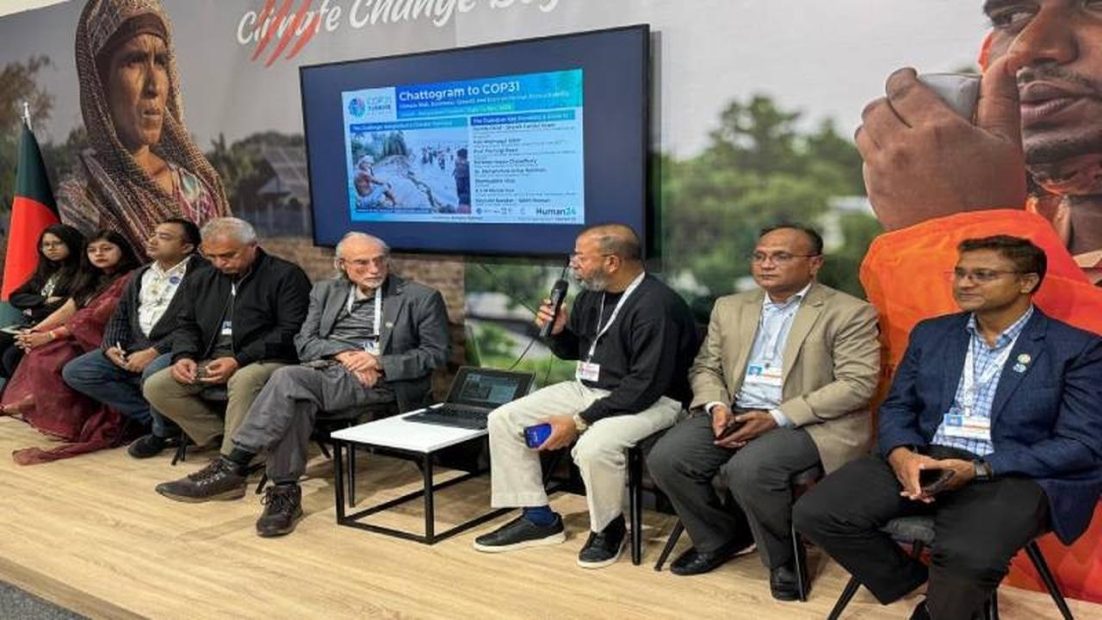
The discussion was held on Saturday at the Bangladesh Pavilion at the United Nations Climate Conference COP31 in Antalya, Turkey. The event was titled “From Chattogram to COP31: Climate Risks, Economic Growth and Environmental Accountability.” Human24 organised the event.
Speakers said that coastal communities, despite having little responsibility for climate change, are facing some of its worst effects.
The discussion was chaired by State Minister for Environment, Forest and Climate Change Sheikh Faridul Islam. The speakers included Professor Pierluigi Bozzi of the International University Network on Cultural and Biological Diversity (IUNCBD) and Monira Sharmin, Joint Convener of the National Citizen Party (NCP).
Saleh Noman, team leader of Human24, presented the main paper. Sohanur Rahman, Executive Coordinator of YouthNet Global, moderated the discussion.
State Minister Sheikh Faridul Islam said salinity was causing rapid damage to infrastructure in coastal areas. People were also facing a shortage of safe drinking water. Cyclone shelters and other facilities were becoming weak due to salinity.
He said, “Due to salinity, our structures naturally become damaged within seven to eight years.”
The state minister also spoke about several government steps. These include tree planting, canal excavation, better waste management and the introduction of electric vehicles and buses to reduce pollution. He also mentioned plans to use concrete blocks instead of traditional bricks in road and infrastructure construction.
Speaking about renewable energy, he said Bangladesh had strong potential for wind and solar power. With suitable technology and strong foundations, the country could reduce its dependence on fossil fuels.
Sandwip Is Shrinking Due to Erosion
In his main paper, Saleh Noman presented the changes in Sandwip’s geographical area.
According to the information presented at the meeting, the island covered about 502 square kilometres in 1880. Recent estimates show that its area has fallen to about 258 square kilometres. Between 1973 and 2020, Sandwip lost more than 71 square kilometres of land.
Settlements such as Katgar, Batajora and Namaste have disappeared into the river. Speakers also said that Urir Char Union was now at risk of disappearing.
Although new chars are forming due to the deposit of silt in the Meghna estuary, these areas remain at risk of erosion and tidal flooding. As a result, it is difficult to ensure permanent homes, livelihoods and essential services for people living there.
Saleh Noman said more than half of Sandwip’s residents had lost their homes at least once in their lives. But the world seemed to accept their suffering as a normal and unavoidable event.
Describing the poor communication system in Sandwip, he said people had been living through a nightmare for years, with little improvement in the situation.
He also said that the people of Sandwip were not responsible for this crisis. The aim of their initiative was to raise their voices, ensure accountability and strengthen the demand for climate justice.
Noman said displaced families lost more than their homes and property. They also lost farmland, fishing areas, traditional livelihoods, social ties and even their connection to their roots.
He said the experiences of coastal communities must receive proper attention in national and international climate policies.
Speakers Call for Support for Loss and Damage and Inclusive Policies
Special speakers at the discussion included Arifur Rahman, Chief Executive of Young Power in Social Action (YPSA); Sadia Jahan Rathi of the Centre for Climate Change and Environmental Research (C3ER) at BRAC University; journalist Shamsuddin Ilias; and Golam Mawla Murad, General Secretary of Chattogram Press Club.
Speakers said climate change was causing people to lose homes, farmland, infrastructure and fishing equipment. It was also destroying cultural identity, traditional knowledge, biodiversity and social ties.
They said these losses were not only financial. Money alone could not make up for all of them.
They stressed that the experiences and needs of affected communities must be considered in climate loss and damage funding and rehabilitation programmes. The social, cultural and mental effects of displacement must also receive attention.
The discussion also highlighted the risks of gender-based violence and discrimination faced by women. Speakers discussed the barriers faced by persons with disabilities in getting early warnings, safe shelter, healthcare and rehabilitation services.
They called for gender-sensitive policies, accessible protection systems and the active participation of women and persons with disabilities in decision-making.
They also stressed the need to include young people, fishermen, coastal workers and marginalised communities in development plans and decisions about climate funding.
Environmental Protection and Climate Funding
Speakers said economic growth and infrastructure development must not come at the cost of coastal ecosystems.
They said the environmental costs of development should not be placed on people who are already at risk. The livelihoods of fishermen and coastal workers must be protected, and natural ecosystems must be conserved.
They also stressed the need to create sustainable economic opportunities for people affected by environmental damage.
The overall action plan of COP31 also gives importance to the connection between the ocean and climate. Its key priorities include adding blue carbon ecosystems, such as mangroves and seagrass, to national climate plans.
Other priorities include strengthening coastal ecosystems, addressing marine heatwaves and ocean acidification, and improving ocean monitoring and access to scientific information.
These steps are important for protecting the livelihoods and safety of people living along Bangladesh’s coast.
Speakers also stressed the need for enough climate funding that vulnerable countries and communities can easily access.
State Minister Sheikh Faridul Islam called for accountability from countries that produce large amounts of greenhouse gas emissions. He also called for greater cooperation among Global South countries and vulnerable island nations in adaptation, emission reduction and ecosystem restoration.
Under the New Collective Quantified Goal (NCQG) on climate finance adopted at COP29, developed countries are expected to take the lead in providing at least $300 billion a year to developing countries by 2035.
There is also a broader target of raising climate funding from all public and private sources to at least $1.3 trillion a year by 2035.
Speakers said the benefits of these promises must reach vulnerable communities. They called for grant-based funding instead of loans, along with transparency and accountability.
They also urged the proper use of funds for local climate adaptation, coastal protection, ecosystem restoration and the recovery of livelihoods.
Professor Pierluigi Bozzi stressed the importance of local organisations and families alongside international agreements and government initiatives.
He said local organisations and families should not simply wait for decisions from higher authorities. They should also spend time and effort planning and developing a sustainable future and economic activities for themselves.
However, speakers made it clear that local initiatives could not replace the financial and political responsibilities of governments and major greenhouse gas-emitting countries.
They said climate justice, environmental accountability, grant-based funding and the participation of affected communities must be ensured to protect coastal islands.
They also stressed that protecting people must mean more than saving their homes and livelihoods. Their cultural heritage, traditional knowledge and identity must also be protected.