125,000-Year-Old Human Civilization Discovered in Saudi Desert
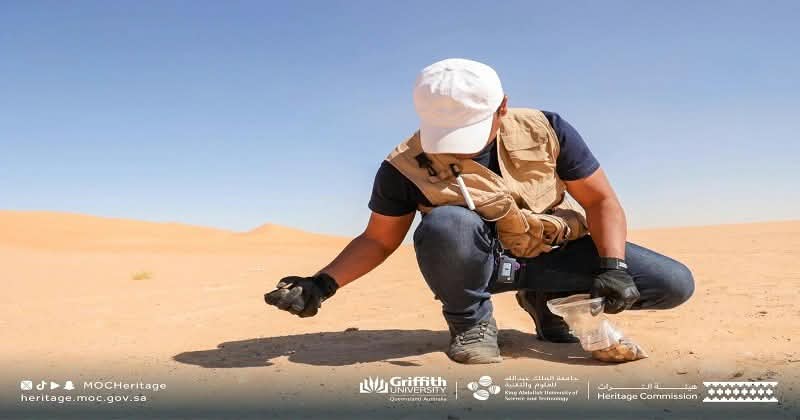
Archaeologists in Saudi Arabia have uncovered rare evidence at the Uruq Al-Julaybah site within the Rub’ al Khali desert, revealing that the hyper-arid Empty Quarter was once a hospitable landscape featuring grasslands and freshwater lakes. Published in the journal Science, the research was conducted through a joint initiative involving Saudi Arabia’s Heritage Commission, Griffith University, King Abdullah University of Science and Technology (KAUST), and other institutions. Findings indicate human activity dating back approximately 125,000 years along the shores of the ancient Mundafan paleolake in Najran, which historically spanned 340 square kilometers and reached a depth of 29 meters.
Researchers documented over 130 archaeological sites and more than 500 fossils, including hippopotamuses, extinct long-horned buffaloes, camels, ostriches, and freshwater crustaceans. The team also recovered 5,511 stone artifacts and weapons crafted using the advanced ‘Levallois’ technique. Microscopic and chemical analyses revealed preserved residues of plant fibers, wood, resin, fats, and collagen. Furthermore, impact fractures and hafting evidence on stone points indicated their use as weapons, alongside chemical compounds linked to the plant Acokanthera schimperi, though researchers noted insufficient evidence to confirm how the substance was utilized.
Dr. Abdullah Alsharekh of King Saud University stated that the shores of Mundafan provided an ideal habitat for human communities, offering freshwater, wildlife, vegetation, and raw materials for toolmaking all in one place. Professor Michael Petraglia of Griffith University noted that the discovery significantly advances our understanding of ancient human settlements across the Arabian Peninsula. Meanwhile, Dr. Frans van Buchem of KAUST stated that this multidisciplinary effort has yielded a much clearer and more comprehensive picture of ancient environments and human behavior.
In an interview with Arab News, Dr. Salma Hawsawi, a professor at King Saud University, said these discoveries are helping researchers reconsider the history of the Arabian Peninsula and dispel misconceptions regarding its contribution to civilization. She pointed to older discoveries in Al-Jouf dating back 1.3 million years and ancient footprints in Tabuk over 120,000 years old. Dr. Hawsawi emphasized that Uruq Al-Julaybah is particularly significant because it lies deep within a region now recognized as one of the most arid on Earth, demonstrating that human activity occurred there repeatedly and episodically.
Dr. Hawsawi advised caution when interpreting evidence related to potential hunting toxins, noting that current findings cannot confirm precisely how specific substances were prepared or used. Ultimately, researchers emphasize that these discoveries challenge long-held assumptions by showing that the Arabian Peninsula was not merely a marginal corridor, but a dynamic region where early humans repeatedly settled, adapted to their changing environments, and thrived.