Chief Prosecutor Challenges India’s Demand: How Can Sheikh Hasina Be Granted a Retrial?
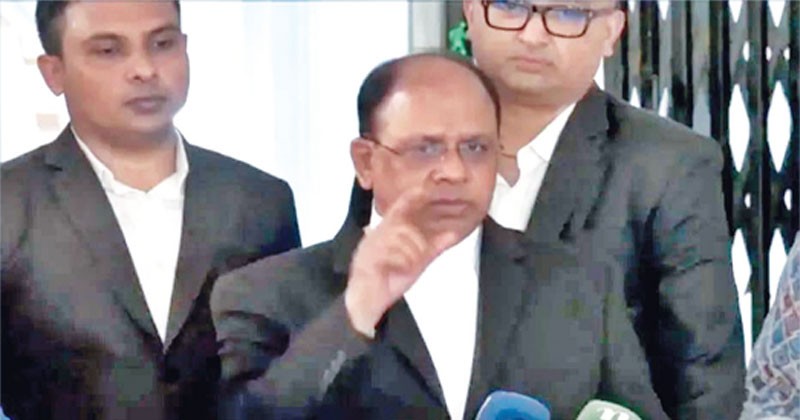
Chief Prosecutor of the International Crimes Tribunal, Mr. Mohammad Aminul Islam, has questioned how India can seek a retrial. He raised the question after the court sentenced fugitive Ms. Sheikh Hasina to death in the 2024 crimes against humanity case. He said there is no legal way to try a person a second time for the same crime. He said India’s justice system once had a provision for retrial, but the country has scrapped it. Bangladesh does not have this provision either.
He said this yesterday, Sunday afternoon, at a press briefing in the tribunal compound, in reply to journalists’ questions. Mr. Mohammad Aminul Islam said that in our country this process is called a “de novo trial,” which means trying a case once more. A case that has already had a trial gets a retrial under this process. He said India, Pakistan and Bangladesh once had the provision for a de novo trial. India’s justice system has scrapped it. Bangladesh has also abolished it. Pakistan does not have it either. He asked how a country that does not follow this practice can advise another country to hold a de novo trial. He said Bangladesh has no procedure and no provision for a de novo trial. It only has a provision for appeal.
Raising the matter of India’s advice, he said the Indian government has known about the trial of this case from the start. The accused lives under its shelter. He asked why India did not advise her to come to Bangladesh and face the trial when the trial began, or to file an appeal on time. He asked why they did not tell their guest to go to Bangladesh and face the trial, or to go in time and file an appeal. Instead, she let the time for appeal pass and the time for trial pass. Now they come to us and advise us to hold a de novo trial, which means a retrial.
The Chief Prosecutor said, “We reject such absurd statements. There is no legal way to try the same matter a second time.” He also said neither the government nor the Chief Prosecutor can give Ms. Sheikh Hasina a chance to appeal. He said it is a matter of law. The Awami League government made the International Crimes (Tribunals) Act of 1973 work. In 2010, it made the rules for the trial process under this law. The tribunal ran its work with this law and these rules until 2024.
Mr. Aminul Islam said the present government has not changed the provision for appeal. The trial follows the existing law. The appeal provision in the law will apply. If the law does not give it, neither the government, the tribunal nor the Chief Prosecutor has the power to give it.
Earlier, International Crimes Tribunal 2, led by Justice Mr. Nazrul Islam Chowdhury, took witness testimony in six murder cases against Mr. ABM Fazle Karim Chowdhury. He is a leader of the banned Awami League and the Awami League MP from the Chattogram 6 seat. Chief Prosecutor Mr. Md. Aminul Islam and other prosecutors were present. A foreign observer also watched the trial yesterday.
Ms. Rizwana Yusuf, counsel for Mr. Fazle Karim Chowdhury, said an international body of 185 countries sent a representative. The representative is watching whether the trial runs fairly and properly. Mr. Fazle Karim Chowdhury was once chairman of the IPU Human Rights Committee. So the body sent an observer to see whether the trial runs properly and stays fair. She said the body sent him after talking with the Bangladesh government.
In the six murder cases in Chattogram, besides Mr. ABM Fazle Karim, Chattogram Jubo League leaders Mr. Azizur Rahman, Mr. Tawhidul Islam, Mr. Md. Firoz and Mr. Debashish Pal Debu are under arrest. The fugitive accused include Awami League MP Dr. Hasan Mahmud, former education minister Mr. Mohibul Hassan Chowdhury Nowfel, and former mayor of Chattogram City Corporation Mr. A J M Nasir Uddin. They also include Mr. Rezaul Karim Chowdhury, Mr. Mohiuddin Bachchu, Mr. Helal Akbar Chowdhury Babor, Mr. Nurul Azim Rony, Mr. Shaibal Das Suman, Mr. Abu Saleq, Mr. Esbarul Haque, Mr. H M Mithu, Mr. Noor Mostafa Tinu, Mr. Jamir Uddin, Mr. Imran Hasan Mahmud, Mr. Zakaria Dastagir, Mr. Mohiuddin Farhad and Mr. Suman Dey.