Crime Not Stopping in Khulna Despite Joint Raids

Regular drives, arrests and joint raids are continuing to control crime in Khulna, a major industrial and business city. Khulna Metropolitan Police (KMP) and RAB-6 are carrying out drives against terrorists, armed criminals, drug dealers and members of criminal groups. Illegal weapons and drugs are being recovered, and some listed criminals are being arrested.
But crime has not come under full control despite these efforts. Public concern is growing over open gunfire, killings, extortion, use of weapons, and the activities of teenage and organised criminal groups in the city and nearby areas.
According to sources, special joint raids are continuing in Khulna. But killings, extortion and terrorist activities have not been fully controlled. At least 79 to 80 people were killed in Khulna city and district up to November 12 this year. Nine people were killed in the last 20 days alone.
Civic leaders, elected representatives and law enforcement officials say several things are making crime control difficult. These include quick bail for accused people, weak intelligence work and the unwillingness of victims to file cases.
Recently, an emergency meeting was held at Khulna Circuit House to control the situation. It decided to carry out special joint raids, also called “block raids”. Checkposts will also be set up at entry points. About 200 Ansar members will be deployed.
During the drives, illegal foreign pistols and bullets were recovered. Some close associates of identified criminals were also arrested.
However, extortion, drug dealing and killings have continued in five police station areas of the city and in Rupsa, Batiaghata, Dighalia and Terokhada. Civic leaders say five or six armed groups are creating serious fear among businesspeople. Some businesspeople are even thinking of leaving the city.
They also say frequent transfers and changes of duties among police officers are reducing the chance to use their field experience about local criminal groups and drug networks.
People in Khulna are now asking why criminals are becoming active again even after so many drives and arrests. Is there a lack of intelligence work? Or are manpower and technical limits making it difficult for law enforcement agencies to work properly?
Another question is whether the failure to identify the people who provide money, shelter and political or other influence to criminal groups is becoming a major obstacle to crime control.
The release of accused people on bail after arrest has also become an issue. There are allegations that in many cases, accused people come out on bail and become involved in crimes again.
According to police information, several top criminals from Khulna are staying in India, Singapore and Dubai. They are reportedly giving orders to local members through encrypted apps such as Telegram.
Stopping illegal firearms from entering through the border and breaking these criminal networks have become major challenges for intelligence agencies.
Another major issue in Khulna is the slow legal process and the release of accused people on bail. After being arrested during law enforcement drives, some accused people are released through legal procedures. There are allegations that some of them later become involved in criminal activities again.
Human rights activist Adv. Muminul Haque said a case can take a long time to investigate, file a charge sheet, record evidence and complete the trial. He said this makes it difficult to get the expected result in controlling crime. He said weak investigations, failure to collect proper evidence, the absence of witnesses and a lack of safety for witnesses can make the legal process more difficult.
Crime analysts say organised crime cannot be controlled by arresting only field-level criminals, shooters or drug sellers. They say the sources of money, weapon suppliers, people who provide shelter, people who maintain communication and influential people behind these groups must also be identified.
Otherwise, when one criminal is arrested, another person can take his place.
Professor Dr Md Waliul Hasnat of the Law Discipline at Khulna University told Inqilab that crime control in Khulna is no longer only a matter of police drives. He said it is also linked to intelligence work, administrative accountability, the source of illegal weapons, crime financing, witness protection and the effectiveness of the justice process. He said arresting a criminal is only one part of the police’s duty. Breaking the criminal network, presenting proper evidence in court through a proper investigation and ensuring justice under the law are equally important.
Khulna Police Superintendent Sarker Omar Faruk told Inqilab that special joint drives and patrols started on November 16 to control the situation after a series of killings, attacks and extortion in Khulna.
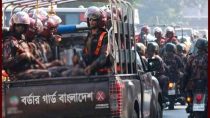
Police, SRB, Border Guard Bangladesh (BGB) and Ansar members are taking part in the drives in the presence of executive magistrates.
On the night of November 15, top criminal Azam Sheikh was arrested in a joint drive from the Shimultoli area under Sadar Police Station in Gazipur district. He is a close associate of grenade Babu, the chief of Khulna’s well-known “B-Company”, and is an accused in 13 cases.
Several cases have been filed against him over drugs, attempted murder and extortion.
On the same night, a gunfight took place between members of SRB-6 and suspected drug dealers and armed criminals in the KDA field area of Ward No. 5 under Daulatpur Police Station.
Later, one foreign-made pistol and two live bullets were recovered from the spot.
Law enforcement agencies say their zero-tolerance drives and regular patrols against drugs, illegal weapons and smuggling will continue.
Selim Mallik, a resident of Boyra, told Inqilab that city residents have only one expectation: the success of the drives should not remain limited to the number of arrests. He said the success should be seen through a real reduction in killings, extortion, illegal weapons and organised crime.