Salinity, Inadequate Groundwater Reserves, Failing Water Supply Plunge 46 Villages of Patharghata Upazila into a Severe Drinking Water Crisis
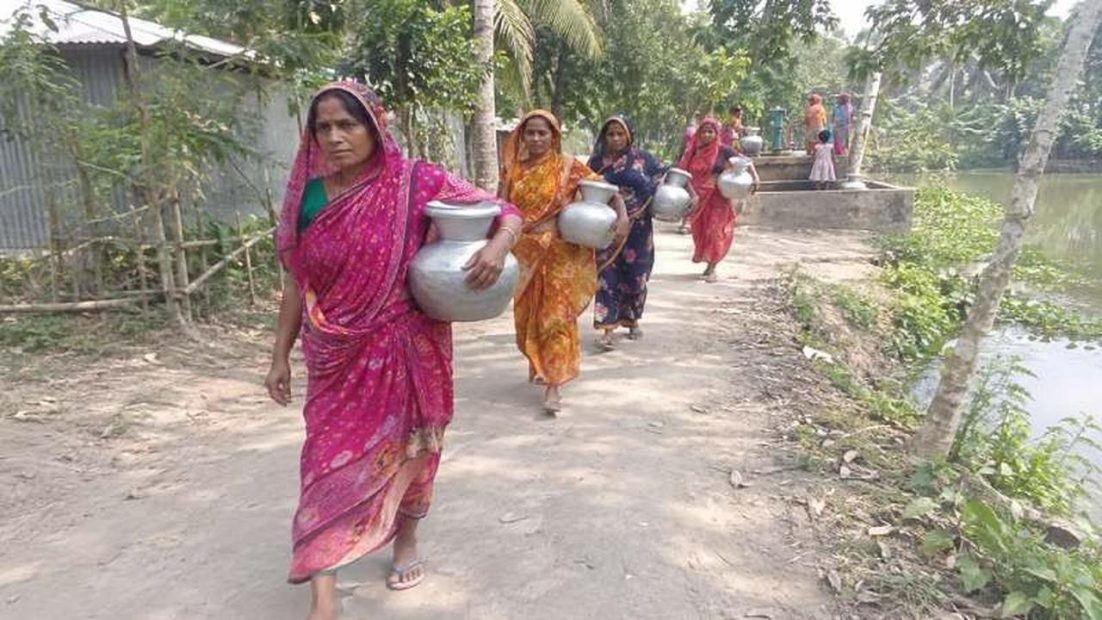
Although Patharghata in Barguna is surrounded by the Bay of Bengal to the south, the Bishkhali River to the east and the Baleshwar River to the west, the area faces a severe shortage of safe drinking water. Salinity, the lack of suitable underground water layers, non-functional water sources and weak water supply systems have left residents of many villages struggling to access clean water. The crisis becomes particularly severe during the dry season, when women and children have to travel long distances to collect a single pitcher of drinking water.
Local sources said 46 villages in the upazila are facing a shortage of safe drinking water. The crisis is severe in 25 villages and moderate in 21 others. Around 60 per cent of the water sources in these villages are non-functional.
Of the 11 villages under Patharghata Sadar Union, seven have no government water supply system. Residents of Badurtala, Charlathimara, Padma, Ruhita and Gaharpur, among other villages, face extreme difficulties every dry season.
Farida Akter, a resident of Badurtala village, said she has to travel nearly two kilometres every day to meet the water needs of her six-member family. During the dry season, collecting a pitcher of water from a distant source is the only option.
Shishir Kumar Biswas, executive engineer at the Barguna district office of the Department of Public Health Engineering, said the geographical conditions of Patharghata make it difficult to install deep tube wells in many areas.
He said experimental tube wells installed at depths of 1,200 to 1,300 feet failed to reach suitable water layers in several locations. Therefore, the crisis cannot be resolved through deep tube wells alone. Meanwhile, increasing salinity in rivers and groundwater has made the situation more complicated. Water salinity in the Charduani area of the Baleshwar River has reached 5.88 decisiemens per metre (dS/m).
Experts warn that prolonged consumption of highly saline water may increase the risks of high blood pressure, kidney complications and reproductive health problems. Local civil society groups have long been demanding eight measures to address the safe water crisis. These include repairing non-functional water sources, installing new ones, protecting ponds and ensuring regular maintenance of water supply systems.
The non-governmental development organisation NSS-Nazrul Smriti Sangsad, with support from Oxfam, once treated water from rivers and canals and supplied it to around 2,500 families, providing access to safe water for approximately 8,000 people. However, the initiative was discontinued after the project period ended.
Mohammad Mohiuddin Esme, general secretary of the Patharghata Upazila Water Committee, said the crisis could be addressed through rainwater harvesting, re-excavation of large ponds, protection of pond surroundings and installation of functional pond sand filters (PSFs).
He also suggested treating water from rivers and canals and supplying it through pipelines. He stressed the need to prepare a list of water sources in every union and regularly test their quality. Hafez Md Shafiqul Islam Khokon, a media professional and environmental activist in Patharghata, said village-based water supply centres should be established to reduce the hardship faced by women who have to travel long distances to collect drinking water.
He said a lasting solution would require the involvement of non-governmental organisations and civil society alongside government initiatives. Despite being surrounded by rivers and the sea on three sides, the daily struggle of Patharghata residents to collect a single pitcher of safe drinking water exposes the weaknesses in coastal water management.
Locals are demanding more than temporary projects and assurances. They want the government to ensure access to safe drinking water through union-based surveys, adequate funding, functional water treatment plants and the implementation of long-term plans.