Bhola’s Gas Must Be Put to Full Use
Jalal Uddin Omar
Natural gas found underground is one of the primary fuels and driving forces of modern civilization. Today’s economy and industry have developed based on gas, which is used everywhere — from the small scale of household life to vehicles and the large scale of factories. The easy availability of gas accelerates a country’s industrialization and drives its economy forward, while a shortage of gas slows industrial development and drains momentum from the economy. To move a gas-dependent economy forward, ensuring the easy availability and maximum use of gas is essential. Substantial gas reserves have been discovered in Bhola district, and to make proper use of this gas, gas-based industries must be established there on a large scale.
Use of Gas in Industry
Gas is used in almost all types of mills and factories — garment manufacturing, dyeing and finishing, textile mills, spinning mills, tiles and ceramics mills, rice mills, chemical mills, steel mills, oil refineries, and food processing factories. Garment factories and dyeing-finishing textile mills need to run boilers to produce steam, and most boilers today are gas-based; when gas shortages disrupt steam production, production at these establishments suffers. Spinning mills generally operate 24 hours a day and require several megawatts of electricity, which is produced on-site through gas generators — what we call captive power. There are currently more than four hundred spinning mills in the country, and nearly all of them run on captive power.
Spinning mills run into trouble during gas shortages. Since yarn is the primary raw material for export-quality garments, problems at spinning mills affect the entire garment sector, negatively impacting garment exports — reducing exports and dollar inflows. Ovens at tiles, ceramics, and bakery factories also run on gas. During gas shortages, gas-based power plants cannot generate electricity continuously, reducing power output, which causes load-shedding and disrupts production across all types of industry — putting the entire economy into crisis.
Gas Reserves and Locations in the Country
About 30 gas fields have been discovered in the country so far, of which 20 are currently producing gas. The potential reserves in these discovered gas fields amount to about 40 trillion cubic feet, of which 21 trillion cubic feet have already been extracted. Various geological surveys suggest substantial gas reserves underground and within the country’s maritime boundary. Being a low-lying delta country, there is long-term potential for larger gas reserves underground here — an opportunity that must be seized. The first gas field was discovered in Haripur, Sylhet, in 1955, and the most recent was discovered in Jakiganj, Sylhet, in 2021.
Gas Reserves in Bhola
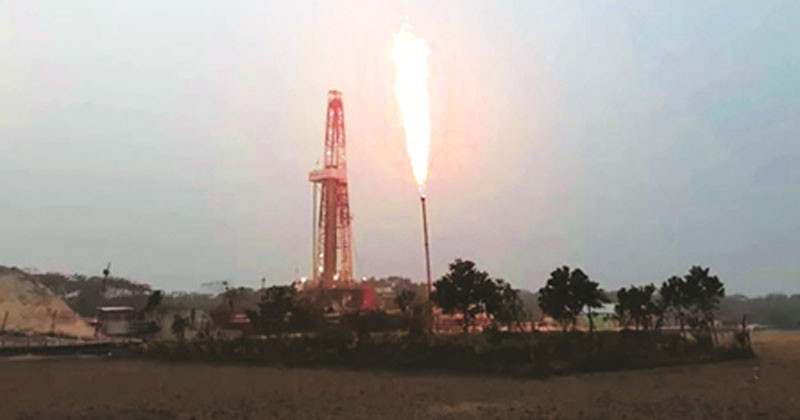
Three gas fields have already been discovered in Bhola, a sea-surrounded island district of 3,404 square miles in the country’s southern region, where nine wells have been drilled. The three gas fields are Shahbazpur, Bhola-North, and Ilisha. The potential gas reserves in these three fields amount to 2.24 trillion cubic feet. Although these three fields have the capacity to extract 180 million cubic feet of gas daily, only 70 million cubic feet is currently being extracted. Since Bhola lacks direct road connectivity with the rest of the country’s mainland, gas cannot be extracted from Bhola’s gas fields as needed and supplied to the national grid; at the same time, due to a lack of local usage venues, the necessary amount of gas cannot be used in Bhola itself either. Currently, gas is being extracted only from the Shahbazpur gas field, while extraction has not begun at the Bhola-North and Ilisha gas fields. Steps must now be taken to extract the appropriate amount of gas from all three fields and to build suitable venues for its use. Fifteen more wells are currently being drilled there, and once complete, daily gas extraction capacity will reach 300-400 million cubic feet. Additionally, given the potential for substantial gas reserves in Bhola, initiatives must be taken to explore new gas fields there.
Gas-Based Industries Should Be Established in Bhola
Bhola has a 225-megawatt and a 35.5-megawatt rental gas-based power plant belonging to the Power Development Board (PDB), both of which use Bhola’s gas, with the electricity produced supplied to the national grid. Some gas is also used residentially. More gas-based power plants now need to be established in Bhola. Alongside this, large-scale gas-based industries — such as spinning mills, fertilizer factories, and tile factories — could be established. Various other types of mills and factories should also be set up in Bhola. To assess the feasibility of setting up a fertilizer factory in Bhola, the interim government’s Adviser for Power, Energy and Mineral Resources, Mr. Fawzul Kabir Khan, Adviser for Housing and Public Works, Mr. Adilur Rahman Khan, and Commerce Adviser, Mr. Sheikh Bashir Uddin, visited Bhola on November 14, 2025. The current government must make a swift decision on this matter. The river distance from Dhaka to Bhola is 185 kilometers, and connectivity is good. Establishing gas-based industries in Bhola would turn the district into an economically prosperous region, advancing the country’s development. Necessary raw materials for factories could be transported to Bhola via launches and cargo ships, and finished products could be brought back from Bhola the same way. With Bhola’s abundant gas supply, factories there could run production uninterrupted. Setting up industries in Bhola would create local employment and ease the population pressure that Bhola’s people currently place on the country’s cities. Industrialists must come forward to establish an economic zone and factories in Bhola, and foreign investment must also be brought in.
Bhola’s Surplus Gas Must Also Be Brought to the Mainland
Alongside using Bhola’s gas in factories established there, arrangements must also be made to bring it to the country’s mainland. The river distance from Bhola to Barisal is 12 kilometers. A pipeline should be built under the riverbed to bring Bhola’s gas to Barisal, which would allow gas-based power plants to be established in Barisal and Khulna to increase electricity generation. If Bhola’s gas can be supplied to the national pipeline, it would be possible to ensure uninterrupted gas supply to factories nationwide, keeping industrial production running continuously. Therefore, gas must be extracted at maximum capacity from the discovered gas fields in Bhola, and a pipeline must be built to connect that gas, via Barisal, to the national supply line. Currently, a company called Intraco is bringing 3 million cubic feet of gas daily from Bhola after converting it to CNG; this amount must be increased, and action must be taken now. If necessary, foreign companies should be engaged for this purpose. Gas found underground is a special gift from Allah for the welfare of humankind. Ensuring the proper and maximum use of this Allah-given resource is our national duty. To accelerate the country’s economic development, uninterrupted gas and electricity supply must be ensured. As industrialization grows, demand for gas and electricity is increasing day by day, and this demand will continue to rise in the future. For this reason, work must continue to discover new gas fields, and arrangements must be made to extract the maximum possible amount of gas from the fields already discovered.