A Different Picture in Gopalganj: Ordinary People Want a Peaceful Movement, While Unruly Terrorists Want Dead Bodies.
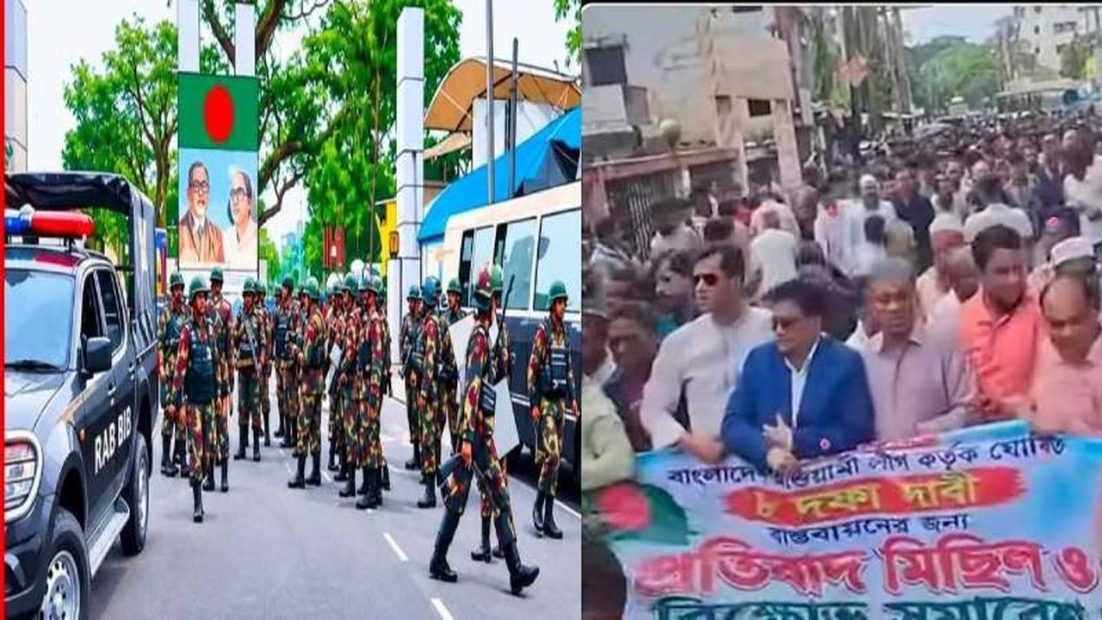
Gopalganj presents a different picture: ordinary people want protests, but unruly militants want bodies. This was said by Advocate Syed Zainul Abedin Mesbah, assistant secretary for law affairs of the BNP’s central committee. He said, “They are working according to Indian instructions. But those who have come to Gopalganj to ensure people’s safety do not want any bloodshed.”
He said the law enforcement agencies deployed in Gopalganj want peace and have shown extreme patience so far to achieve that goal. Members of the forces are not unnecessarily disrespecting anyone. The police are also not taking an aggressive stance towards anyone despite the situation. Ordinary working people say that the forces are not currently attacking anyone participating in the protests on the streets.
He further said some unruly Awami League militants wanted large-scale bloodshed because they expected to gain significant political benefits from it. However, the Awami League would never be able to reap those benefits.
“The patience and tolerance shown by the law enforcement agencies are truly commendable. Personally, and on behalf of my party, I commend all members of the law enforcement agencies deployed and working in Gopalganj district. I hope that, by continuing to show patience, the law enforcement agencies will ultimately ensure the victory of the government’s patience in Gopalganj,” he said.
He also said the Awami League had taken advantage of a small protest by exploiting the lack of coordination and disputes among three BNP lawmakers, turning it into a political opportunity. He believed the protests in Gopalganj were also encouraging similar activities in many other places. However, he said peace-loving people in Gopalganj also wanted peace.
Idris Molla, 65, said, “Eighty-eight per cent of the people in Gopalganj support the Awami League. This is the land of Bangabandhu, so it is natural that protests will take place here. However, we do not want bloodshed.”
A conversation with Afrozaman Tushan, organising secretary of the Gopalganj Mohila Dal, revealed a similar view. She said law enforcement personnel working in Gopalganj were showing considerable patience, but the protesters did not have good intentions.
“They are working according to Indian instructions. This banned group is carrying out whatever orders it receives,” she said.
She further alleged that some unruly Awami League militants among the protesters wanted to provoke law enforcement personnel by throwing brickbats at them and make them fire their weapons.
“By pushing a group of street children to the front, they want someone to be shot so that they can portray the death as a deliberate killing and use the deaths of two people to achieve political gains from their movement. At the same time, they would find an easy way to force our leader Tarique Rahman to launch a movement to leave office. This will never happen. Inshallah, our leader and the law enforcement agencies are showing considerable patience and will continue to do so, but they will not engage in bloodshed,” she said.
She added that many educated, socially aware and respectable people in Gopalganj wanted the protests to remain peaceful and free of violence. At the same time, local relatives of former prime minister Sheikh Hasina wanted to keep the movement alive and retain control of the streets by any means necessary.
On the other hand, she said, some unruly militants wanted to do whatever they pleased and continue their aggressive street protests with greater intensity. Their mindset was different because they wanted bloodshed, she added.
Educated and socially conscious residents also believe that some protesters are refusing to leave the streets despite facing law enforcement agencies while carrying locally made weapons, including shields, swords, spears, lances, machetes, chhenda blades, sabres and large ramda machetes.
According to these residents, the protesters want the forces to confront them and obstruct their movement so that they can organise resistance in response. Some unruly protesters allegedly want law enforcement personnel to fire at them and leave bodies on the streets, allowing them to use the deaths as a political tool to achieve their goals.
The law enforcement agencies, meanwhile, want to avoid bloodshed with protesters as far as possible. Residents say that the more peacefully the SRB, Border Guard Bangladesh (BGB), local police, Armed Police Battalion (APBn) and Ansar members behave, the more antisocial behaviour some unruly militants display towards them.
From close observation, it appears that the law enforcement personnel on duty in Gopalganj are behaving as if they can neither see nor hear properly and have no anger or bloodlust in their bodies, residents said.
In the main town of Gopalganj, Md Kabir Kabiraj said protesters could hold processions and meetings normally without facing any objections from law enforcement personnel.
“The police and SRB say that protests must be conducted democratically without harming anyone’s life, property, vehicles or physical safety. This is the instruction we have received.
We have no objection if the protests are conducted properly, but we will resist any attacks. Arson, destruction and acts of oppression or torture will not be allowed. We will not let anyone engage in violence,” he said.
Ordinary residents echoed his views. In general, peaceful residents of Gopalganj said the law enforcement personnel deployed in the district were their guests. They would join the protests if the forces harmed any innocent person.
They also said some protesters were deliberately trying to provoke the forces by throwing brickbats and hurling abuses. Many local people praised the extraordinary patience shown by law enforcement personnel and urged protesters not to engage in violence in Gopalganj.
Mr. Akhtar, a resident of Kashiani, said, “We also support the movement, but we do not want violence.” Atar Ali, a boot polisher from Bhatiapara, said everyone should take to the streets to protest, but there should be no vandalism. He also praised the patience shown by police, SRB and other security personnel.
Nawab Ali, a final-year honours student from the Collegepara area of Muksudpur, said, “Sheikh Hasina Apa is a sister from our district and a former prime minister. We also want her to return. We welcome peaceful protests to bring her back, but not arson.”
A Different Picture in Gopalganj
On May 12, 2025, the interim government led by Dr Muhammad Yunus issued a notification banning the activities of the Awami League and its affiliated, associate and fraternal organisations until the trial at the International Crimes Tribunal is completed.
Earlier, on August 5, 2024, the party was removed from power during the July mass uprising. Following the change of government, Awami League offices, leaders’ and activists’ homes, and sculptures and murals of Bangabandhu Sheikh Mujibur Rahman were vandalised in Dhaka and various other districts.
With senior leaders fleeing the country or going into hiding, the party’s organisational activities effectively came to a halt. However, the situation in Gopalganj remained markedly different.
In this district, which is closely linked to the political and historical roots of the Sheikh family, many memorials to Bangabandhu Sheikh Mujibur Rahman remain largely intact. At the same time, leaders and activists of the banned Awami League and its affiliated organisations remain visibly active in local politics.
Recently, under the banner of party programmes, they have not only held processions and rallies but have also openly paraded with locally made weapons, blocked roads, attacked and vandalised rival offices and establishments, and set fire to property.
The November 19 lockdown programme most recently demonstrated their show of strength on the streets. In contrast, BNP, Jamaat-e-Islami and National Citizen Party (NCP) leaders and activists have had little visible presence at the grassroots level.
A series of violent incidents and attacks on administrative facilities has raised questions about whether Awami League activists are attempting to reassert their strength in Gopalganj politics after the July uprising.
Gopalganj is considered a political stronghold of the banned Awami League. Bangabandhu Sheikh Mujibur Rahman was born in Tungipara, where his ancestral home and mausoleum are located.
Local people have longstanding political, social and organisational ties with the Sheikh family. Gopalganj also held special importance in the political life of former prime minister Sheikh Hasina. Residents say the district received particular attention in political and administrative matters during her rule.
As a result, the differences between Gopalganj and other districts have become increasingly apparent since August 5, 2024.
What Is Happening to Bangabandhu’s Memorials?
A visit to the district headquarters found that murals and memorials of Bangabandhu Sheikh Mujibur Rahman remain intact at several important sites, including the Liberation War Complex, the District Council Dak Bungalow and the municipality.
While sculptures of Bangabandhu and memorials associated with the Sheikh family have been vandalised in different parts of the country, similar incidents have not been widely seen in Gopalganj. After the July mass uprising, sculptures of Bangabandhu at a few locations were covered with cloth, but they remained undamaged.
The Bangabandhu Mausoleum Complex in Tungipara stands on 38.30 acres of land beside the Baigar River. Built with red ceramic bricks and black-and-white marble, the complex includes a flower garden, artificial hills, a library and a museum leading to the main mausoleum.
The graves of Bangabandhu’s parents are located beside his own. The mausoleum is also regarded as one of the major emotional and historical centres of the banned Awami League’s politics.
Tribute Paid at the Mausoleum After Around Two and a Half Years
The last time district and upazila Awami League leaders and activists paid tribute at the mausoleum was August 7, 2024. Their public presence remained largely absent for a long period afterwards. However, the situation began to change following the violence on November 16 and 17 and the lockdown programme on November 19.
After around two and a half years, activists of the banned Awami League reopened the party office in Tungipara Upazila. They raised the national and party flags, held a procession and organised a prayer gathering. They later paid floral tribute at Bangabandhu’s mausoleum.
After Sheikh Hasina was ousted and went to India, access for ordinary visitors to the Bangabandhu Mausoleum Complex in Tungipara had been restricted for a long period. Security was strengthened, with police deployed at three gates.
Against this backdrop, at around 10am last Monday, leaders and activists of the banned Awami League and its affiliated organisations marched to the party office and entered after unlocking it. A procession and prayer gathering were held at the office at around 10:30am.
No police, BGB or Ansar personnel were seen at the scene at that time.
Later, at around 11am, the activists entered the mausoleum complex through Gate No. 3. Although two to four police personnel were on security duty there, they did not stop the activists. Awami League activists arrived in successive processions from different areas and entered the complex.
According to reports, the national and party flags were raised to the national anthem under the leadership of Sheikh Ifti Zaman Pallab, president of Tungipara municipality unit of Chhatra League.
Sheikh Ifti Zaman Pallab said the activists had united and reopened the party office with the aim of bringing former prime minister Sheikh Hasina back to Bangladesh, allowing party members to gather there.
“Bangabandhu’s mausoleum is not the property of the Awami League alone; it belongs to all of Bangladesh,” he said. The previous night, Sunday, activists of the banned Awami League, Jubo League and banned Chhatra League had also entered the mausoleum complex, offered flowers and pledged to bring Sheikh Hasina back to Bangladesh.
Nurul Islam, a municipal Jubo League leader, reportedly led them in reciting the pledge.
Road Blockades Since November 9, leaders and activists of the banned Awami League and its affiliated organisations have repeatedly held processions in Kotalipara, Gopalganj, carrying oars, poles and other locally made weapons.
They marched from Mashbari bus stand to the upazila headquarters and proceeded to the upazila Awami League office, the Upazila Parishad premises and the Ghaghar Bazar area.
During the November 19 lockdown
programme, activists in Tungipara took part in processions despite the rain. From 8am, small groups began marching from different areas of the upazila’s five unions and one municipality.
They carried poles, oars, brooms and other locally available objects. They gathered at Patgati bus stand, Singipara intersection, Chowrangi and Patgati Bazar, chanting slogans. A recording of Bangabandhu’s March 7 speech was played over loudspeakers.
At some locations, protesters blocked roads after setting tyres on fire. Local sources said that before the programme, roads in different parts of Tungipara had been blocked by felled trees from the evening of November 17, bringing traffic to a halt.
After reports spread that students had been detained that day, people gathered following announcements over mosque loudspeakers. Protesters carrying locally made weapons then moved towards the police station.
They threatened to surround the station unless the detained activists were released. When the situation went out of control, police left the station area, after which the station was set on fire.
Tree Trunks on Highways, BGB Vehicles Burned
At around 10am last Wednesday, tree trunks were seen blocking the road beyond Ghonapara intersection on the route from Gopalganj town to Tungipara. The remains of three burned BGB vehicles were visible along the Gopalganj-Patgati road near Nilfa Bazar. Smoke was still rising from one vehicle until 3pm.
At Gimadanga intersection, tree trunks had been placed across a stretch of road at least half a kilometre long. Security was strengthened in the district following the attack and arson at the police station and the burning of the house of Member of Parliament S M Jilani.
Initially, 21 platoons of BGB were deployed. Video footage obtained through drones, body-worn cameras and improvised devices was being monitored continuously.
Officials concerned said 50 platoons of BGB had so far been deployed in Gopalganj to maintain law and order. However, after the attack on Tungipara Police Station, the burned building, signs of vandalism and looting, and the uncertainty faced by frightened police personnel about returning home all reflected the seriousness of the situation.
Banned Awami League Active, Supporters Parade with Weapons in Town
During the November 19 lockdown programme, leaders and activists of the banned Awami League gathered at several locations in Gopalganj town, including Launchghat intersection, the District Council Dak Bungalow and Madrasa intersection.
Many wore helmets and carried ramda machetes, hockey sticks and Chinese axes. They paraded with weapons from the District Council Dak Bungalow to the police lines.
Bangabandhu’s March 7 speech was played over loudspeakers. The crowds grew as the day progressed, with the largest gathering at Launchghat intersection.
At the same time, BNP, Jamaat-e-Islami and NCP leaders and activists had little visible organisational presence. Local BNP lawmakers were also not visibly present in their constituencies, and their political leadership at the grassroots level was not apparent.
Influence of the Sheikh Family and the Old Political Network
Local political observers say the influence of the Sheikh family remains important in Gopalganj politics. Several sources claim that local politics continues to revolve around former lawmaker Sheikh Fazlul Karim Selim. According to them, organisational activities across the district are being conducted under Sheikh Selim’s direction and with advice from his son, Sheikh Naim. There are also allegations that they are financing these activities.
Attack and Deaths During the July March
The major wave of political tension after the July uprising began on July 16, 2025. On the first anniversary of the July mass uprising, senior NCP leaders travelled to Gopalganj as part of the “July March to Build the Country” programme, triggering tension in the district.
After the programme was promoted under the slogan “March to Gopalganj”, allegations emerged that activists of the banned Awami League and its affiliated organisations attacked the visitors with sticks and locally made weapons.
Stage Vandalised
The motorcade carrying NCP leaders and law enforcement personnel came under attack. The clashes left several people dead and many others injured. Section 144 was imposed to control the situation. NCP leaders were later evacuated with assistance from the army, police, Rapid Action Battalion (RAB) and BGB.
Law enforcement agencies said four people were killed that day.
Afterwards, further allegations emerged of protests, crude bomb explosions, vehicle arson and vandalism involving activists of the banned Awami League and its affiliated organisations in various areas, including Gopalganj Sadar, Tungipara and Kotalipara.
Local sources alleged that activists from Bagerhat, Pirojpur, Narail, Madaripur and Faridpur also joined various programmes.
There were also allegations that some Awami League leaders and activists who fled other parts of the country after August 5 had taken shelter in Gopalganj.
November Violence Takes a New Turn
During the November 16 protests, leaders and activists of the banned Awami League and its affiliated organisations marched with locally made weapons, including poles, oars, ramda machetes, Chinese axes, spears and lances.
During the incidents, a police armoured vehicle and a police box were vandalised. The July memorial and the nameplate at Hadi Chattar of the university were also damaged.
The nameplate at the main gate of Gopalganj Government College was removed and replaced with a banner reading “Government Bangabandhu College”.
On the same day, an assistant sub-inspector of Tungipara Police Station was injured in a machete attack, and the residence of Imdadul Haque Molla, president of the municipal BNP, was set on fire.
On November 18, a banner bearing the university’s former name, “Bangabandhu Sheikh Mujibur Rahman Science and Technology University”, was placed at the main gate of Gopalganj Science and Technology University. There were also allegations of damage to the nameplate and threats to beat students.
Attacks on BNP Leaders’ Homes, a Hospital and Party Offices
During the November 19 lockdown programme, roads were blocked at Ghonapara, Neela Math, Hospital intersection, Circuit House intersection and Char Gobra along the Dhaka-Khulna highway. Tree trunks, electric poles and bamboo were used to block the roads.
Protesters set tyres on fire, effectively cutting off road communication between Dhaka and Gopalganj. On Wednesday night, Arraf General Hospital and Diagnostic Centre, owned by Gopalganj-2 lawmaker Dr K M Babar, was attacked. Windows were smashed and furniture was set on fire.
As patients were receiving treatment inside, many fled the hospital in panic. A woman carrying a newborn was seen running out of the building. The same night, the house of S M Jilani, lawmaker for Gopalganj-3, was vandalised, looted and set on fire.
On Thursday morning, the house of Selimuzzaman Selim, lawmaker for Gopalganj-1, in Kashiani was attacked and set on fire.
At noon, Muksudpur Police Station was set on fire, while the BNP office in Panchuria, Gopalganj Sadar, was vandalised.
A plainclothes police officer was injured after being hacked and beaten in Kashiani. Two branches of Grameen Bank were also set on fire. Subir Kumar Saha, assistant superintendent of police for the Muksudpur Circle, said around 90 police personnel were inside the police station before the attack.
They initially tried to resist the attackers. However, as the attackers outnumbered them, the police personnel eventually withdrew.
He said the identities of the attackers could be established by reviewing CCTV footage.
Sharif Rafiquzzaman, convener of the district BNP, told the media that no political party that believed in democracy could engage in attacks, vandalism and arson. “Those who do so are enemies of the country and enemies of the people. The BNP is a political party that believes in democracy. The people of this country will respond to this terrorist group, which harms people’s lives and property, in December 2026 in exactly the same way they responded in 2024,” he said.
Questions About the Administration’s Role
Questions have also been raised about the role of law enforcement agencies amid the repeated incidents of violence in Gopalganj.
Their visible response appeared limited during public processions, the reopening of party offices, entry into the mausoleum complex and marches involving locally made weapons. Ayub Ali, former officer-in-charge of Tungipara Police Station, said, “We tried. We are doing as much as we can; what we could not do, we did not do.”
Earlier, following the violence, the deputy commissioner and superintendent of police of the district, along with the officers-in-charge of Tungipara, Kotalipara and Kashiani police stations, were transferred.
Although 10 platoons of BGB were deployed in the district last Monday, another 21 platoons were subsequently deployed.
Political Emotions and a Show of Strength
Discussions have intensified in Gopalganj over Sheikh Hasina’s announced intention to return to Bangladesh in December. Incidents on November 10 and 15 involving displays of strength by the banned Awami League, gatherings on roads, attacks on BNP offices and the burning of police vehicles have drawn attention.
Local rickshaw puller Zamir Uddin said, “It is natural here that everyone will participate fully in the programme because this is Gopalganj.”
BM Yunus Bhuiya, a former Chhatra League leader associated with an affiliate of the banned Awami League, said, “We, the people of Gopalganj, are connected to the Sheikh family. The daughter of Bangabandhu will return to the country, and we are always prepared for that.”
During the Awami League’s nearly 15-and-a-half years in power under Sheikh Hasina, beginning in 2009, month-long programmes were held around August 15 and the August 21 grenade attack.
That reality changed after the government fell during the July mass uprising in 2024.
The interim government cancelled the public holiday marking Bangabandhu’s death anniversary and stopped observing the day officially as National Children’s Day.
However, despite the change in political power, emotions surrounding Bangabandhu and the Sheikh family, as well as the organisational presence of the banned Awami League, have not completely disappeared in Gopalganj.
Bangabandhu’s Memorials Remain Intact in Gopalganj
Political emotions centred on the Sheikh family, the old organisational network of the banned Awami League and its tendency to demonstrate strength on the streets have all been visible in recent days.
Meanwhile, the weak visible presence of rival political parties, repeated attacks on the homes and establishments of their leaders and activists, and questions about the effectiveness of law enforcement agencies are making the district’s political situation more complicated.
The political changes that swept national politics through the July mass uprising have yet to be fully reflected in Gopalganj. Instead, the district’s politics has become a maze of old political influence, new power realities and continuing violence.
Overall, ordinary people across Gopalganj district, including Gopalganj town, Tungipara, Kotalipara, Kashiani and Muksudpur, want peaceful protests, while an unruly group is seeking to implement what the article describes as an “Indian prescription” from across the border.