Trilateral Economic Corridor and Teesta Mega Project Must Begin Without Delay: A.M.M. Bahauddin
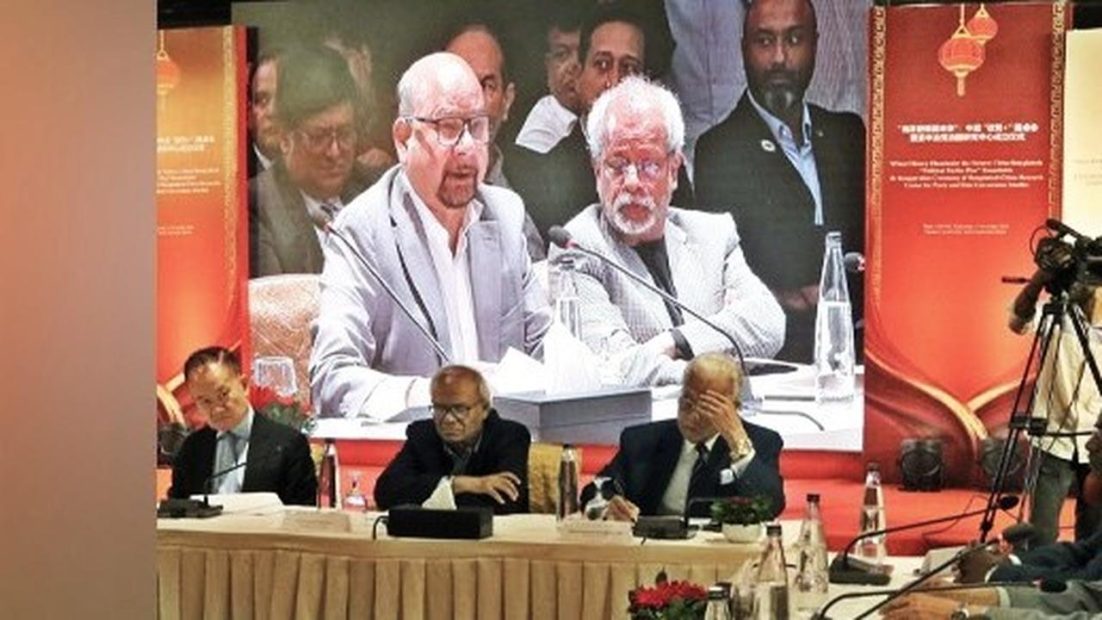
Inqilab Editor and the president of Jamiatul Modarresin Alhaj A M M Bahauddin has called on Prime Minister Tarique Rahman and Chinese Minister Liu Haixing to follow in their fathers’ footsteps and take Bangladesh-China relations forward.
Addressing the visiting Chinese minister, Mr. Bahauddin said, “Your father served as China’s ambassador to Bangladesh from 1980 to 1982. As ambassador, he presented his credentials to then President Ziaur Rahman, who visited China during that period. You are now a minister of China, while Tarique Rahman, son of Shaheed President Ziaur Rahman, is the Prime Minister of Bangladesh. The responsibility of advancing the friendship between the two countries, built during your fathers’ time, now rests with you, their sons.”
He said people expected Mr. Tarique Rahman and Mr. Liu Haixing to take Bangladesh-China development and economic relations to a new height.
He made the remarks in his opening speech at the ‘China-Bangladesh Political Parties Plus Roundtable’ at Hotel InterContinental in Dhaka on Wednesday (November 4).
Mr. Bahauddin said the implementation of the Teesta Mega Project and the launch of the China-Myanmar-Bangladesh economic corridor would transform the country’s economic landscape. People expected the two sons of their fathers’ friends, Tarique Rahman and Liu Haixing, to take the necessary steps to expedite these development projects, he added.
He also said that, after Shaheed President Ziaur Rahman, the government led by Begum Khaleda Zia had also played a role in advancing the friendly relations between Bangladesh and China.
Highlighting the deep respect and affection that people across Bangladesh have for the Chinese government, policymakers and people, the Inqilab editor said ordinary citizens, political parties and social organisations viewed friendly relations with China positively. China did not believe in hegemonic policies; rather, it had strengthened its position in the world through peaceful coexistence and mutual cooperation, he said.
Referring to the changing geopolitical situation, Mr. Bahauddin said recent elections in the United States and subsequent political changes had created new dynamics in international politics. In this situation, China had emerged as an important force in the global economy and politics. Its remarkable progress in artificial intelligence, space research, science and technology had strengthened its position on the world stage. China’s economic influence was also expanding across Africa and other regions, alongside Asia, he said.
Describing Bangladesh-China relations as a reflection of the aspirations of the people, he said the trust and affection of Bangladeshis towards China had made the relationship more people-oriented. People in Bangladesh considered China a peace-loving and cooperative power. The relationship was not limited to governments and states; it also had a strong foundation among the people of both countries, he added.
On regional cooperation, Mr. Bahauddin, a senior journalist, highlighted key geopolitical issues, including the Rohingya crisis and the proposed China-Myanmar-Bangladesh corridor. He said China had an opportunity to play an effective role in accelerating Rohingya repatriation and strengthening regional connectivity. Its cooperation was crucial for Bangladesh in this regard. He also noted that positive statements by Chinese leaders during visits to Beijing and Bangladesh had helped strengthen mutual trust between the two countries.
Speaking about Bangladesh’s economic development and infrastructure progress, he said the country needed to reduce excessive dependence on loans with stringent conditions from the World Bank and the International Monetary Fund (IMF) and expand alternative areas of cooperation. A multifaceted economic partnership with China could accelerate Bangladesh’s development. Both countries could benefit from cooperation in infrastructure, trade, investment and technology, he said.
He added that mainstream political parties and people in Bangladesh were positive about maintaining good relations with China. Bangladesh-China friendship could play an important role in national development and international cooperation.
Chinese Communist Party Central Committee International Department Minister Liu Haixing attended the event as the chief guest. In his speech, he expressed gratitude and thanks in response to the remarks made by Daily Inqilab Editor A M M Bahauddin. He also expressed hope that the longstanding friendship between the two countries would be further strengthened.
BNP Acting Secretary General and Prime Minister’s Political Adviser Advocate Ruhul Kabir Rizvi, Standing Committee member Nazrul Islam Khan, State Minister for Foreign Affairs Shama Obaed Islam, former Home Minister Air Vice Marshal (retd) Altaf Hossain Chowdhury, Opposition Chief Whip Nahid Islam and Jamaat-e-Islami Secretary General Mia Golam Porwar, among other senior leaders, were also present. Senior officials of the Chinese Embassy in Bangladesh attended the event as well.