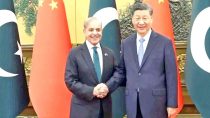
Bangladesh calls on China to Expand BRI Cooperation Beyond Infrastructure to Technology Transfer, AI, Renewable Energy, Skills Development
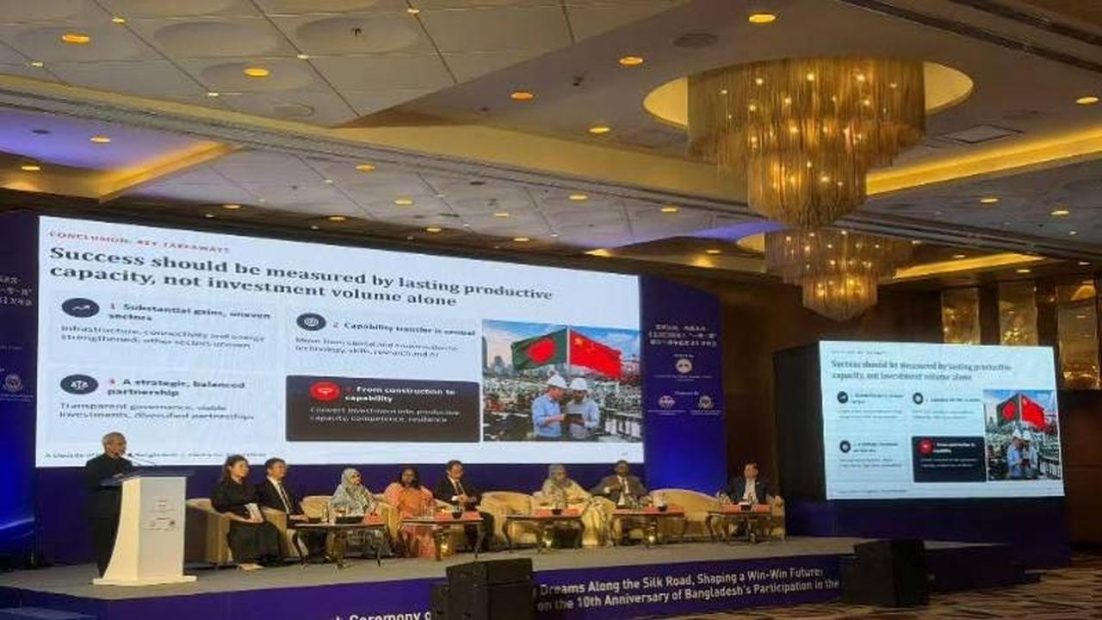
Bangladesh should expand its future cooperation with China under the Belt and Road Initiative (BRI) beyond infrastructure development. It should focus more on technology transfer, artificial intelligence (AI), renewable energy and skills development.
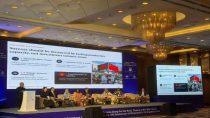
Professor Dr Imtiaz Ahmed made this call while presenting the main research paper at the launch of a Blue Paper marking 10 years of the BRI. The event was held at the Hotel InterContinental in the capital on Monday (November 23). He is the executive director of the Centre for Alternatives and the lead researcher of the Blue Paper.
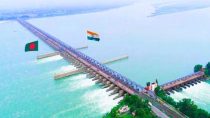
Professor Imtiaz Ahmed said Bangladesh-China relations had changed significantly over the past decade since Bangladesh joined the BRI in 2016. Chinese investment in infrastructure, power, energy and transport had opened new opportunities for cooperation between the two countries.
However, he said Bangladesh must focus on building its own skills and abilities alongside investment to make future cooperation more effective and sustainable. He said six sectors should receive special attention in the next phase of cooperation between Bangladesh and China. These are infrastructure and transport links, healthcare and the pharmaceutical industry, education and skills development, advanced technology and AI, renewable energy, and the ready-made garment (RMG) industry and industrial development.
Speaking about transport infrastructure, he discussed the possibility of building a high-speed railway network in Bangladesh and establishing road and rail links among Bangladesh, China and Myanmar.
He said such regional connections could reduce the time and cost of transporting goods and create new opportunities for trade.
In the healthcare sector, he suggested using Chinese investment and technology to build world-class hospitals and healthcare centres in Bangladesh. He also called for increasing the country’s ability to produce raw materials for medicines. In education, he stressed improving the quality of primary education, providing technical training and setting up innovation centres.
Speaking about technology cooperation, Dr Imtiaz said Bangladesh could combine the software and freelancing skills of its young people with China’s advanced hardware and AI technologies. He said the two countries could work together to develop their own large language models (LLMs) and voice models in Bangla.
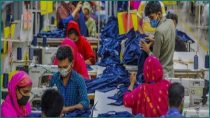
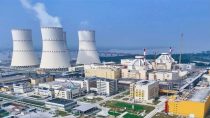
In the energy sector, he stressed expanding renewable energy and green financing by using China’s experience in solar and wind power generation. He also suggested strengthening the backward links of the garment industry, reducing dependence on imports and producing high-value industrial goods through joint investment in economic zones. He further stressed the need to retrain women workers to protect their jobs as automation and AI become more common in industries.
Imtiaz Ahmed said Bangladesh had benefited from infrastructure development during the first 10 years of the BRI. However, he said the quality of investment, technology transfer and the development of local skills would be more important than the amount of investment in the coming years. He said Bangladesh must increase its own ability and power to innovate to turn its relations with China into a true win-win partnership.
Speaking at the event, Bangladesh-China Chamber of Commerce and Industry (BCCCI) President Khorshed Alam said he started doing business with China in 1985. Since then, he had visited China 116 times.
During these visits, he had seen China’s major economic growth, modern industries and technological progress with his own eyes. He had also seen how China had changed over the years. He said Bangladesh could also make rapid progress by learning from China’s experience and working more closely with Chinese businesspeople.
Secretary of the Ministry of Textiles and Jute Ayesha Akter said Bangladesh imported a large part of the fabric needed for its garment industry from China. She described China as one of the country’s main trading partners in this sector. She said many Chinese companies were already investing directly in the garment industry, but there were more opportunities for both countries to work together.
As Bangladesh imported large amounts of fabric from China, she said Chinese investors could invest in this sector. She welcomed Chinese investment in textiles, jute and other export-oriented industries that supply products to China and other global markets. She said such investment could also help reduce Bangladesh’s trade deficit with China.
Ayesha Akter said jute was the country’s golden fibre. It was a natural and biodegradable product and an important part of Bangladesh’s heritage. She said the country’s priorities were research into new technology, better-quality seeds, the production of high-yield fibres and the export of valuable jute products to the global market. She added that Chinese investment could also help Bangladesh develop this sector.
Secretary of the Power Division Mirana Mahrook said claims that Bangladesh was falling into a debt trap were not correct. She said Bangladesh had never failed to repay its loans. She added that loans from China accounted for only around 9 to 10 per cent of Bangladesh’s total debt.
Quoting a popular saying, she said, “If you want to go fast, go alone. But if you want to go far, go together.” She said Bangladesh wanted to move forward a long way together with China.
Chinese Embassy officials in Dhaka, researchers, academics, businesspeople, journalists and representatives from different sectors attended the event.