China Breaks Stealth Look in a Big Move, 8 New Missiles Added to J-20
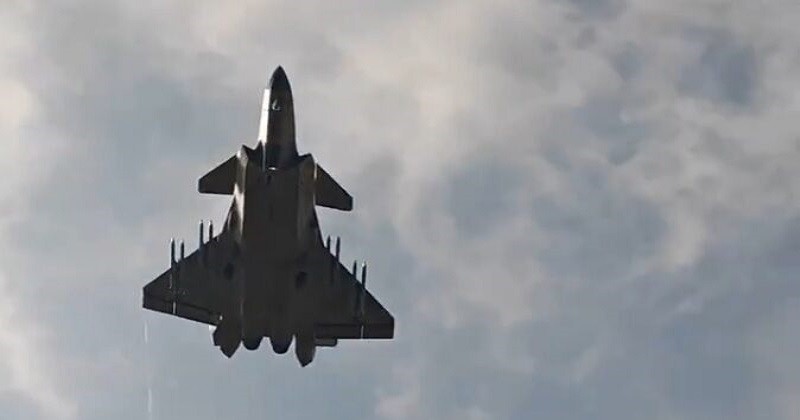
China has made a major change to the J-20, its most advanced fifth generation stealth fighter jet. The aim is to grow its strategic influence in the Pacific region and gain more control of the skies. Several recently published images show the jet carrying eight long range air-to-air missiles on external racks under its wings. Military experts say this step slightly reduces the jet’s ability to avoid radar, but it greatly increases the number of missiles it can carry and adds to China’s strength in air combat.
In military terms, this special setup is being called “Beast Mode.” According to a report by Defense Security Asia, new images published on 4 November show a total of 8 PL-15 missiles hanging from four racks on the two wings of the jet, in pairs. Earlier, the J-20 carried a total of 6 missiles in its internal bays, four long range and two short range. With the new external addition, the jet’s theoretical missile capacity has now reached a total of 14.
Big firepower or the risk of being seen on radar?
This new weapons setup is expected to give China a big strategic advantage in any possible conflict in the Pacific region. It will especially boost China’s firepower when attacking key targets such as the enemy’s airborne early warning aircraft and mid-air refueling tankers (for example, KC-46, KC-135 and E-2D).
However, military analysts warn that carrying extra weapons disturbs the jet’s aerodynamics and its “low observability,” or stealth ability. The surfaces of the missiles hung outside the wings raise the risk that enemy radar can easily detect the jet. This has raised new questions about the jet’s survival and its ability to fly long distances.
Mission based flexibility and combat tactics
According to defense analysts, this change will give China the flexibility to use different setups for different combat plans. First, in deep enemy areas where avoiding radar is critical, China will use the original stealth version with 6 missiles hidden inside.
Second, once the enemy’s early radar and defense systems are weakened, or when defending its own airspace, China can use this “Beast Mode” to fire a large number of missiles at once.
The PL-15 missile usually has a range of 200 to 300 kilometers. This long range, high power missile network is therefore forcing the United States and its allies to rethink their air tactics, tanker operations and overall network management in the Pacific region.
Main challenges and the future
Experts do not believe that seeing more missiles in photos alone guarantees China’s military success. In modern air combat, what matters more than the number of missiles carried is timely target identification, real-time data links, logistical support from air bases and the pilot’s ability to survive.
At the same time, China is trying to build a PL-15 with folding wings, or a slightly smaller new PL-16 missile, to increase the number of missiles in the internal bays. This would raise firepower while keeping the stealth advantage.
Analysts say China is not willing to make any military compromise in establishing its sole influence around Taiwan or in the “First Island Chain.” This new “Beast Mode” version of the J-20 is a bright and strong display of that.