Crumbled Roads in Pangsha Municipality Compound, Public Suffering
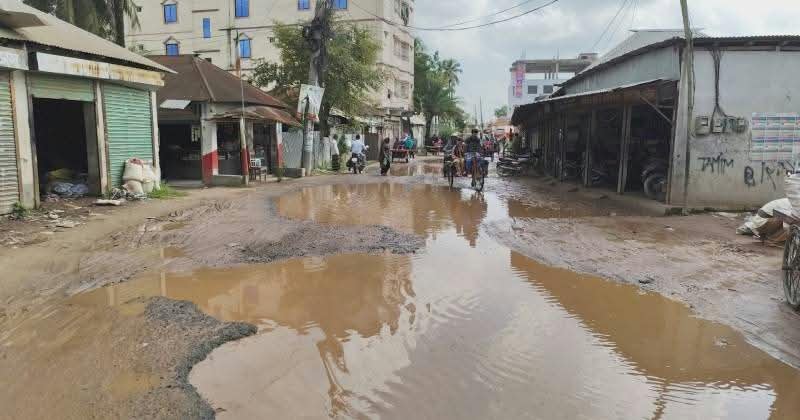
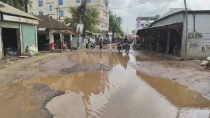
Despite holding first-class municipal status since 2018, Pangsha Municipality in Rajbari has failed to deliver basic civic amenities, leaving residents in severe distress due to the dilapidated condition of its major roads. Established as a municipality in 1990, the town has seen little improvement over the past nine years, with neglected roads developing massive potholes and deep ruts. Even light rainfall triggers severe waterlogging, turning daily commutes into hazardous journeys for pedestrians, students, patients, and traders. Minor and major accidents have become a frequent occurrence across the municipality, raising serious questions about the standard of local governance and infrastructure maintenance.
On-site observations reveal that several vital arteries of the town have become nearly unfit for movement. The stretch from Maishala Bazar to Maishala Baragachhi Bus Stand, which connects thousands of residents from the southern upazila to the town and sits beside a primary school, madrasa, and major businesses, is riddled with large craters. Similarly, the road from Pangsha Railgate to Tempu Stand witnesses daily accidents while serving patients visiting Liza Health Care, citizens heading to the veterinary hospital and Pangsha Model Police Station, and students from five major educational institutions, including Pangsha Mohila College and Kazi Abdul Majed Academy.
Other critical routes face equally deplorable conditions, disrupting both education and local commerce. The road running from Tempu Stand via Pangsha Government College to Shilpakala Mor, used daily by thousands of residents and students from six schools, colleges, and coaching centers, is severely damaged. Meanwhile, Pangsha Station Bazar Road suffers from chronic waterlogging after minimal rain, driving away shoppers and inflating transport costs for merchants. Additionally, residents have flagged Narayanpur Dattapara Road, Maishala Karmakarpara Road, and Maishala Rishipara Road as needing urgent reconstruction alongside an effective rainwater drainage system to prevent recurring inundation.
Daily commuters and transport workers bear the brunt of this infrastructural collapse, facing physical strain and financial loss. Banker and Collegepara resident Sharif Shahriar Palash noted, ‘In daily life, the dilapidated condition of the roads in this area wastes time while also causing physical harm. We want relief from this.’ Echoing this frustration, van driver Md. Masud Kha shared that half of his earnings go toward vehicle repairs, adding, ‘Right now, we have to get a municipality license by paying money to ride a van. Yet the roads are in a dilapidated state. We want the roads to be repaired quickly.’
Students and business owners are equally vocal about the daily disruption to their livelihoods and studies. Student Akash Ahmed explained that stagnant rainwater hides deep potholes, ruining uniforms, delaying arrivals at school, and creating constant accident risks. On the commercial front, trader Khairul Islam highlighted the economic toll on local markets, stating, ‘Because of such a condition of the roads, our business faces many problems. Customers cannot come to the market comfortably. Bringing goods in and taking them out is also difficult. Our demand to the municipal authorities is that arrangements be made to repair these roads quickly.’
In response to the growing public outcry, municipal authorities have indicated that initial steps toward road restoration are finally underway. Upazila Nirbahi Officer (UNO) and Administrator of Pangsha Municipality Md. Rifatul Haque stated that agreements with contractors have already been finalized to repair three roads, and construction work will commence soon. While welcoming the announcement, residents continue to urge the authorities to prioritize comprehensive road repairs and proper drainage across the entire town so that Pangsha truly reflects the standards and civic services expected of a first-class municipality.