
Prime Minister to Inaugurate ‘Model Canal’ on November 19
Excavated Canals Across Country Must Be Turned into Income-Generating Projects: Asadul Habib Dulu
Disaster Management and Relief Minister Asadul Habib Dulu has said that Prime Minister Tarique Rahman will formally inaugurate the ‘Model Canal’ on November 19. The government plans to develop 20 canals across the country as ‘Model Canals’ on a pilot basis next year.
These canals will not only have facilities for water drainage and storage but will also include integrated activities such as tree plantation along the banks, fish farming and duck rearing. The government plans to expand the model to different parts of the country later.
The canals will also have arrangements for storing and draining rainwater. Canals excavated and re-excavated across the country at different times should not be limited to water drainage or reducing waterlogging. They must also be linked to income-generating activities. Canals excavated with public funds should be used in a planned manner to create income and employment opportunities for local people.
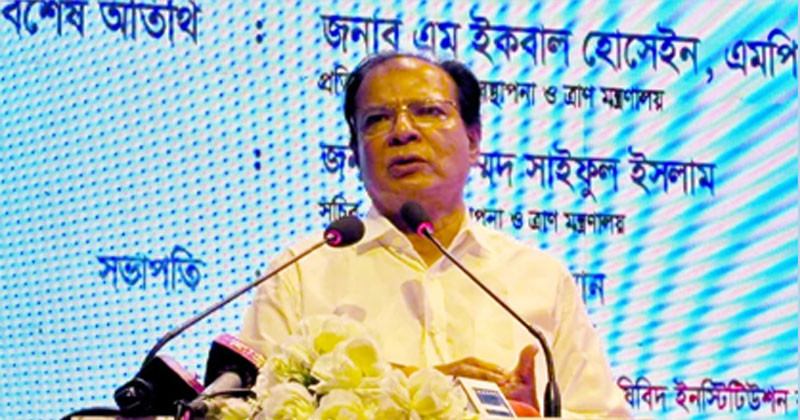
The minister made these remarks at a conference of district relief and rehabilitation officers and Upazila Project Implementation Officers at the KIB Convention Centre in the capital on Saturday. The Relief Minister said various programmes of the Ministry of Disaster Management and Relief should not remain limited to traditional assistance and relief. Instead, they should focus on ensuring people’s long-term self-reliance.
He said this would help improve the living conditions of people in disaster-prone areas and strengthen local economies. He said, “If a canal is excavated in an area, it should not be viewed only as an infrastructure project. We also need to consider how the lives, livelihoods and economic activities of local communities can be linked to the canal.”
He said income-generating programmes could be introduced at the local level to ensure the proper use and maintenance of canals after excavation. Asadul Habib Dulu said new ideas must be developed to increase people’s employment and income. Instead of implementing the same traditional programmes everywhere, the type of project should be determined based on the local environment, people’s needs and the market system.
Giving the example of mushroom cultivation, the minister said he had personally visited a mushroom farming initiative and gained experience of its potential. He said a woman entrepreneur had made mushroom cultivation popular through her farm. Mushroom farming requires comparatively less capital and has a market. Therefore, many people can increase their income through such initiatives if they are provided with proper training and support.
He said mushroom cultivation is also possible during the winter season. Such initiatives can be started on a small scale at the local level and gradually expanded. He said income-generating programmes, alongside traditional assistance, could help poor and low-income people become self-reliant in the long term.
The minister said the government plans to implement a programme in 25 upazilas this year on a pilot basis to assess the effectiveness of such new ideas. The activities will first be carried out experimentally in these upazilas, after which their results will be evaluated. If successful, the programme will later be expanded to other parts of the country.
He said simply allocating funds for a new programme would not be enough. It would also be necessary to monitor how effective the programme is in practice, how much people’s incomes are increasing and how far they are becoming self-reliant. He said if an effective model could be developed, it could be implemented in various disaster-prone and poor areas of the country.
Rehabilitation of Disaster-Affected People
Speaking about housing and rehabilitation programmes for disaster-prone people, the minister said people should not be separated from their own communities and environment and rehabilitated in separate areas or shelter-like facilities. Instead, arrangements should be made so that they can become self-reliant while remaining in their own areas.
He said a person would feel fulfilled if they could live within their own community and have employment opportunities there. It would also help maintain their social ties. He said simply providing a house or shelter is not enough in rehabilitation programmes. People’s living conditions, employment and social connections must also be given importance.
Programmes should be designed in such a way that beneficiary families can earn an income while remaining in their own areas and gradually become self-reliant.
Proposal to Increase Rice Assistance
The minister also spoke about the amount of food assistance provided under existing programmes. He said it was necessary to reconsider whether providing 10 kilograms of rice to a poor person was consistent with the current market situation. As the price of 10 kilograms of rice is comparatively low in the current market, a working person can earn almost the same amount of money by working for a day.
Therefore, instead of providing only a small amount of food assistance, greater importance should be given to increasing people’s income and employment opportunities. He said a proposal was being considered to increase the amount of rice provided to poor people under food assistance programmes from 10 kilograms to 20 kilograms.
This could require an additional Tk 1,000 crore. Communication and discussions are underway with the relevant authorities on the matter.
If the necessary funds are allocated, initiatives will be taken to implement the programme more effectively.
More Use of Banking System
The Disaster Management and Relief Minister also stressed the importance of providing assistance through the banking system. He said if government assistance could be delivered directly to beneficiaries through the banking system, wastage and irregularities could be reduced significantly.
This would increase transparency in ensuring that the assistance reaches the actual beneficiaries. He said modern technology and the banking system should be used more extensively to distribute funds under various government programmes.
This would ensure transparency and accountability in fund distribution while reducing opportunities for the misappropriation of public money.
Proposal to Rename Food-for-Work Programmes
The minister also expressed a positive view of a proposal to change the names of the Food for Work (KABIKHA) and Cash for Work (KABITA) programmes. He said society and people’s thinking are changing with time. People’s tastes, lifestyles and needs have also changed.
Therefore, the names and structures of long-running government programmes could also be changed according to the needs of the time.
State Minister for Disaster Management and Relief M Iqbal Hossain, Secretary Saiful Islam, senior officials of the ministry, district relief and rehabilitation officers and Upazila Project Implementation Officers were present at the conference. They shared their experiences, challenges and opportunities in implementing various programmes at the field level.