Fishermen Return to the Sea After Long Break, But Their Faces Show No Relief
Abu Hena Mukti
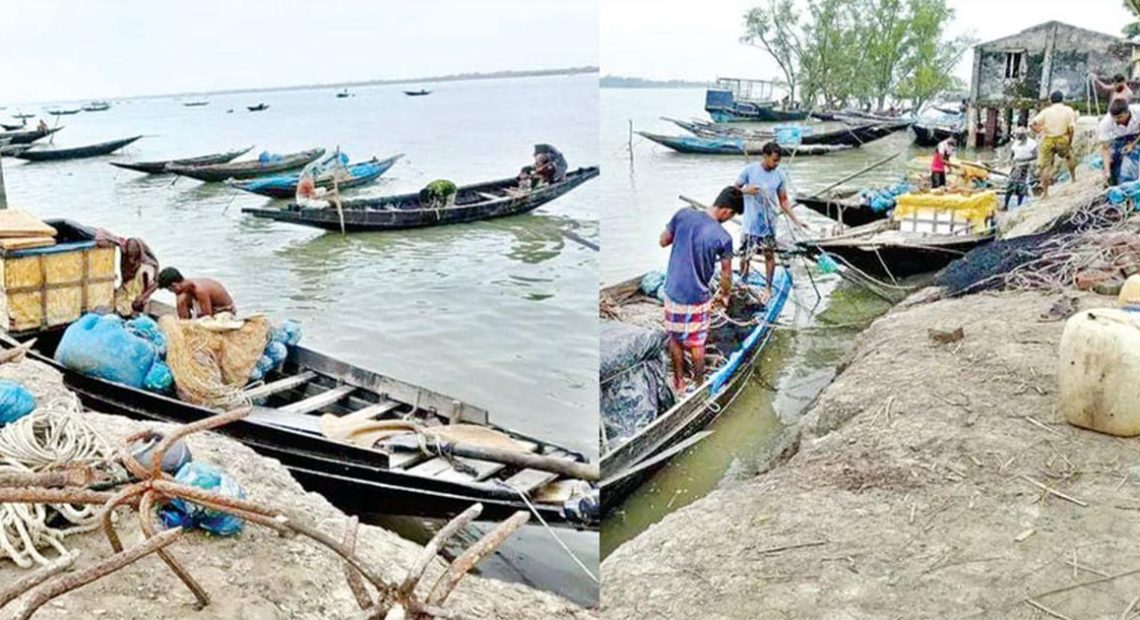
Even after the fishing ban in the Sundarbans ended, fishermen in Bangladesh’s coastal areas are finding little reason to smile. After a long wait, they have returned to the water in search of livelihoods, but their lives are facing severe challenges due to both natural and man-made factors. Soon after their return, continuous rain in coastal areas and “mora katal,” a period of weak tidal currents, have prevented them from catching fish as expected. Adverse weather conditions are also often making it impossible to take boats into the deep sea.
Climate change and unregulated fishing have reduced the availability of hilsa and other fish in the shallow waters near the coast. As a result, fishermen are being forced to travel farther into the deep sea, which is extremely risky and costly for those using small boats.
During the three-month fishing ban, the rice and assistance provided by the government often fail to reach genuine fishermen properly or are simply insufficient to support their families. As a result, fishermen who took high-interest loans to survive during the ban are now unable to repay their debts because they are not getting the expected catch after returning to sea. Thus, although fishing has resumed, coastal fishing families are facing extreme uncertainty, burdened by debt on one hand and pirates and adverse natural conditions on the other.
According to sources, after the government’s 65-day fishing ban ended, coastal fishermen cast their nets in the sea and rivers with high hopes. However, adverse weather, navigability problems in rivers and changes in fish migration routes caused by climate change have led to a severe shortage of hilsa in coastal areas. Frequent low-pressure systems and bad weather in the Bay of Bengal and coastal areas are preventing fishermen from properly taking their boats to sea. Moreover, severe load-shedding in coastal areas is disrupting ice factories, making it difficult to preserve even the limited fish they catch.
Important waterways such as the Andharmanik and Ramnabad channels in coastal areas have developed shoals, obstructing the natural route through which hilsa migrate from the sea to freshwater. As a result, fishermen in the deep sea are catching some hilsa, while ordinary fishermen in coastal and river areas are returning empty-handed. Despite borrowing money, taking high-interest advances and purchasing expensive fuel, fishermen are finding that their catches do not even cover their fuel costs. Supporting their families and repaying loan instalments have therefore become a nightmare for coastal fishing households.
Fishermen said that their joy at returning to the sea after a long wait has been overshadowed by several days of continuous rain, the resulting low-pressure system, weak tides and rampant pirate groups. As a precondition for entering the Bay of Bengal and the Sundarbans adjoining the coast, fishermen are being forced to pay large sums in extortion money, which they cannot afford after remaining unemployed for a long period. Forest-dependent people across the coastal region are consequently spending their days in deep anxiety and frustration.
Haydar Ali Biswas, a fisherman from Dakop, told Inqilab, “If we cannot catch fish now, we cannot run our families. That is why I have come to the river. We have hardly caught any fish, and we have not gone into the forest because there is mora katal.” He added that there had been no source of income for three months. He planned to repay debts to shopkeepers with the proceeds from fishing. “We obtained permission to enter the forest with the burden of debt on our heads. We are short of some money to manage the pirates’ extortion demand, and because of the weak tide, we still have not been able to enter the Sundarbans,” he said.
Several fishermen, speaking on condition of anonymity, alleged that extra money is being collected beyond the government revenue for obtaining permits. They also alleged that during the ban, some people entered the Sundarbans by evading the Forest Department’s monitoring and by managing some dishonest officials, and caught fish using poison. Although fishing remains prohibited throughout the year in sanctuaries, some people allegedly continue fishing with poison by managing corrupt officials. They fear this has reduced fish stocks. At the same time, they said fear of extortion by pirates is also influencing their decision to enter the forest.
Nasir Uddin, an official of Kashiyabad Forest Station, said the station has boat licence certificates (BLCs) for 884 vessels. “It has been raining for several days. Weak tides have prevailed in the river since the day permission was granted, which is why many have not taken permits. Those who obtained permission and went to sea are also not finding much fish. So many are preparing to go to the Sundarbans during the next tide,” he said.
According to Forest Department sources, 2,717 registered boat licence certificates (BLCs) are held in the Khulna Range of the western Sundarbans, while 2,900 registered BLCs are held in the Satkhira Range. Around two to three fishermen operate each boat, and fishermen enter different rivers and canals of the Sundarbans in phases.