India’s Muslim Civilization Is Being Silently Erased
A Muslim is a statistical presence within a population, while “Muslim-ness” represents the presence of an entire civilization. The former refers merely to people of a particular faith, while the latter encompasses history, memory, language, literature, poetry, music, art, architecture, food habits, dress, customs, and thought — through which Muslim life has been inseparably woven into the history of India’s formation for nearly a thousand years.
The Rashtriya Swayamsevak Sangh’s (RSS) strategy is to separate this “Muslim-ness” from Muslims themselves. This process is quite subtle, since it is not practically possible to expel 200 million or more Muslims from India. But it is possible to render them politically powerless, institutionally invisible, and socially irrelevant. Through this, even as they remain a social group, the importance of this “Muslim-ness” as a component of India’s national identity would gradually diminish.
RSS chief Mohan Bhagwat’s remark in New York on August 29 needs to be examined against this backdrop. There, he said that if any Hindu believes no Muslim should live in India, then that person is no longer a Hindu. He further added that a Hindu believes all paths lead to the same goal and that every person has dignity.
On the surface, this might appear to be a positive shift in tone. But Bhagwat did not say this standing in Nagpur or Delhi — he said it in the United States, where the RSS has built its international network and is eager to present itself not as a religious majoritarian movement but as a cultural nationalist one.
However, his words bear no resemblance to the reality inside India. Despite Muslims making up more than 14% of India’s total population, only 24 out of 543 Lok Sabha members (4.4%) are Muslim, none of whom belong to the ruling NDA coalition. There has been no Muslim minister in the central cabinet since 2022. The number of Muslim legislators in state assemblies has fallen from 339 in 2013 to about 255 currently. There is currently no Muslim holding the post of President or Vice President of India, though these posts had Muslim representatives in the past. Similarly, Muslim presence in the higher levels of government bureaucracy is extremely thin.
This exclusion is also evident in economic and institutional spheres. The landmark 2006 Sachar Committee report found that although Muslims made up 13.4% of the population, they represented only 3% of the elite administrative cadre, 4% of senior police services, and just 3.2% of central security forces. Two decades later, this gap has deepened further alongside their distance from political power.
So Bhagwat’s assurance that “Muslims can live in India” sidesteps the core, difficult question: does this historical “Muslim-ness” have any place in the “Hindu Rashtra” the RSS envisions?
The RSS’s organizational strength lies in strategic patience — it operates with decades-long planning. Once outside the mainstream pluralistic system of India and banned three times, this organization has gradually moved from the margins to the very center of power.
Urdu is a major example of how a language’s form can be altered or diminished without any formal ban. Developed on the Indian subcontinent, Urdu became a vast repository of Indian poetry, literature, and music — one of the principal slogans of India’s independence struggle, “Inquilab Zindabad,” was also Urdu. But after Partition, Urdu came to be identified solely as the language of Muslims and, more damagingly, of Pakistan.
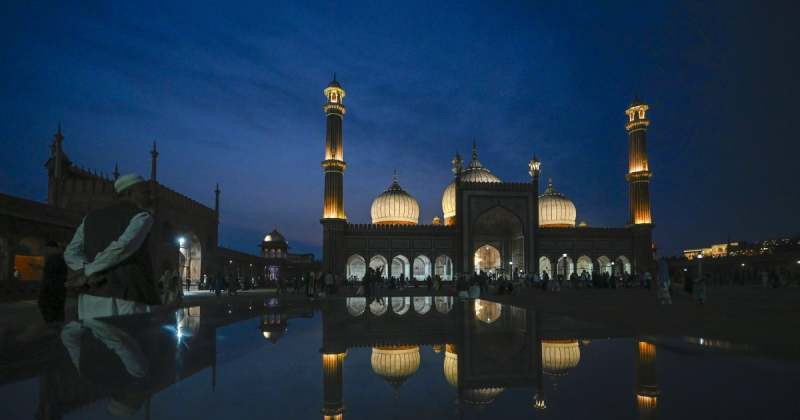
Although it survives in poetry, film, and popular music, the script of this language has visibly begun to disappear from official life. In the early 2000s, while walking from Delhi’s historic Jama Masjid toward Ballimaran, Ghalib’s residence, one noticed that even the mosque’s prayer-time schedule was written in Devanagari (Hindi) script rather than Urdu — meaning that in Ghalib’s own neighborhood, a generation is being raised that is forced to read him through an entirely different script.
Asked about this decline of Urdu, the renowned historian Irfan Habib at Aligarh Muslim University offered a simple explanation: Urdu was branded with having played a role in the creation of Pakistan. When a language stops offering educational or economic opportunity, families eventually stop teaching it to their children.
The same thing is happening to the history of India’s Muslims. Although nearly a thousand years of Muslim heritage cannot be erased outright, its place in national memory can be diminished and distorted. History concerning the Delhi Sultanate era and the Mughals has been removed or reduced from school textbooks. Rather than being presented as part of India’s own complex formation, this history is increasingly portrayed as that of “invaders” and “outsiders.”
There is a clear contradiction here. In India’s anti-colonial discourse, pre-British India is remembered as the “golden bird,” one of the world’s major economic centers — yet most of that prosperity occurred during the Sultanate and Mughal periods. One cannot simultaneously speak of the wealth the British destroyed while rejecting, as “outsiders,” the very civilization under which that wealth was built.
Once Muslim rule is separated from history in this way, Muslim culture comes to be seen not as part of India but as something that “happened to” India. Their descendants may remain citizens, but their heritage becomes “foreign” to the state.
However, this attempt to force a society into a single mold does not stop at one minority. When the boundaries of thought begin to shrink, they constrict independent thinking as a whole.
Recently, a school in Ahmedabad faced pressure over including Nobel laureate Malala Yousafzai’s “I Am Malala” and Anne Frank’s “The Diary of a Young Girl” in its reading list. When students, teachers, and citizens later organized public readings of these books, they faced obstruction from Hindutva organizations.
This monoculture’s aggression ultimately strikes inward, with the pluralism of India’s intellect and thought as its principal victim. The Indian civilization that was built over a thousand years through the coexistence and debate of diverse philosophies, beliefs, and doctrines is today at risk of being trapped within its own narrow definition.
This forced uniformity does not merely diminish minorities — in the final analysis, it also impoverishes the majority society’s own intellect and thought.