Is Loan a Tool for Development or a source of Debt Crisis?
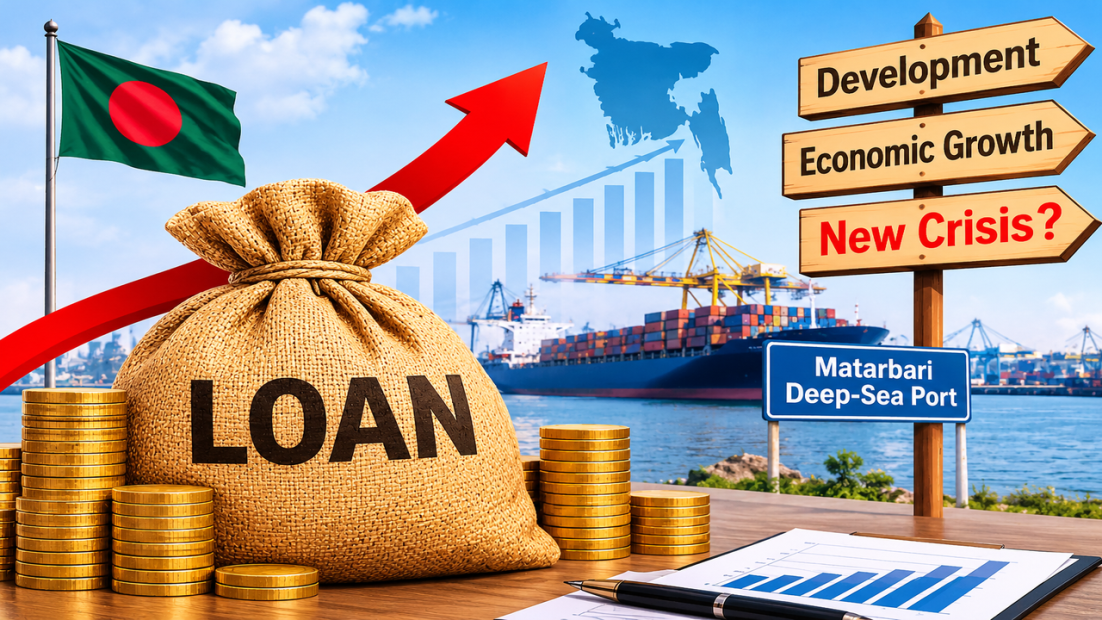
The current government is taking steps to secure funding by borrowing from domestic and foreign sources. As part of this initiative, it jointly organised an international conference on public debt management with the Asian Development Bank (ADB) in Cox’s Bazar on November 15–16, 2026. The workshop was titled “Public Debt Management in a Changing Global Context” and brought together more than 100 representatives from 30 countries.
At this point, it would not be appropriate to simply praise the government’s initiative or argue that taking such large amounts of loans from external sources is wrong. In an unstable global environment, long-term loans at low interest rates are necessary to finance energy imports, meet budget deficits and repay foreign loans and interest. However, questions remain over how reasonable it is to raise funds at high interest rates by issuing bonds in the international open market. If the country cannot generate enough revenue from its own sources, how justified is it to borrow money to finance imports or increase domestic investment?
On July 12, in response to a question in Parliament, Finance Minister Amir Khosru Mahmud Chowdhury said the government’s total debt had reached Tk 22,06,462 crore. Of this amount, Tk 9,59,311 crore was foreign debt. This means a large share of the government’s total borrowing comes from domestic sources.
Meanwhile, the National Board of Revenue (NBR) is expected to collect Tk 6,95,000 crore in revenue in the current 2026–27 fiscal year, against the national budget target of Tk 9,38,000 crore. This will leave a shortfall of Tk 2,43,000 crore. The budget for the current 2026–27 fiscal year has allocated Tk 1,27,500 crore for interest payments on government debt. Of this amount, Tk 1,05,000 crore is earmarked for interest on domestic loans and Tk 22,500 crore for interest on foreign loans. The allocation was Tk 1,22,000 crore in the previous budget, according to The Business Standard on November 15, 2026.
To meet this huge deficit, the government borrows from domestic and foreign sources every year. In the current 2026–27 fiscal year, the country will spend $4.49 billion on principal and interest payments on these loans. If the trend continues, the cost of repaying foreign loan principal and interest will reach $7.6 billion by 2030.
Meanwhile, the country’s losses due to conflict and instability in the Middle East have reached $4.12 billion. It is reasonable to assume that this figure could rise further. Although discussions are underway with the International Monetary Fund (IMF) for a new $4.5 billion loan programme, the government is also exploring alternative ways to raise foreign currency. For the first time, it is preparing to issue sovereign bonds in the international market. Alongside bonds denominated in US dollars and euros, the government is considering Samurai bonds in Japanese yen and Panda bonds in Chinese yuan.
Many believe that, given the current global and domestic instability, raising funds through bonds in the international open market would not be a wise decision at this time. The government, however, says, “The growing burden of principal and interest repayments, weak revenue collection and limited scope for budget expenditure are major challenges for the economy. Our goal must be to ensure that every borrowed taka makes a meaningful contribution to economic growth, productivity and public welfare.”
When the government borrows from the IMF, it has to comply with various conditions. For example, the IMF calls for an increase in the tax-to-GDP ratio to boost revenue collection. In many cases, this can negatively affect the living standards of ordinary people. On the other hand, it also recommends measures to address weaknesses in the banking sector, which could benefit the country.
Reforms and coordination are essential to strengthen the banking sector in the national interest. While some IMF conditions may be beneficial to Bangladesh, others may not serve the country’s interests. In this situation, continuing negotiations with the IMF while exploring alternative sources of financing is certainly an initiative that could offer hope. However, the country’s debt burden is already substantial. If new loans are used not for productive investment but to repay the principal and interest on existing loans and cover budget deficits, the risk of growing dependence on borrowing will increase. How much hope can be placed in a strategy of taking new loans to repay old ones?
Prime Minister’s Special Assistant Tanvir Shahriar Gani said, “Considering how much debt Bangladesh can afford to bear, the country should explore the possibility of raising funds through dollar-denominated Eurobonds and Sukuk. If Bangladesh is included in a JP Morgan index of government bonds in emerging markets, the country’s government securities could become more familiar to international investors.”
Many believe the government has lost the confidence to borrow from domestic sources. The state has already raised funds from the country’s banking sector and the open market through bonds. As a result, private-sector investment has remained at its lowest level in recent years.
Previously, the government attempted to borrow from foreign sources through sovereign bonds, but those efforts were never implemented and remained at the discussion stage. This time, however, it is seeking to enter the international market with the support of US-based JP Morgan and by borrowing through the US International Development Finance Corporation (DFC).
However, Sri Lanka’s experience could serve as an important example of the risks associated with sovereign bond borrowing. Bangladesh should learn from that experience. Under the country’s current circumstances, excessive borrowing could push it towards a situation resembling sovereign bankruptcy.
The government’s main problem is its ambitious budget, which has a record-high deficit alongside a shortfall in expected revenue collection. Considering all these factors, there may be no alternative to borrowing. But an important question remains: how far can a country progress through borrowing if it lacks the capacity to generate income?
Borrowing from domestic and foreign sources is not inherently wrong when it serves the country’s development interests. However, taking new loans to repay the principal and interest on existing debt is harmful to the economy. In other words, the country is spending beyond its means by relying on borrowed money. Now it is taking further loans to repay the principal and interest on previous borrowing. This weakens the country’s economic capacity.
By contrast, borrowing to create employment or invest in productive sectors can certainly benefit the economy. In such cases, the returns from the investment can be used to repay the loans. But borrowing simply to meet expenditure can never be beneficial to the country’s economy.
Therefore, at this critical moment, the government should avoid all but essential expenditure. The country’s economy is in a contractionary situation, meaning that spending should be limited to what is absolutely necessary.
Remittance inflows have already declined to some extent. Export earnings are likely to fall due to instability in the garment sector, while import costs are unlikely to decrease. The burden of loan repayments and interest payments will also remain high. Therefore, adopting a contractionary fiscal policy is essential to protect the country’s economy and, ultimately, the nation itself.
The author is a banker and columnist.
aktarrofikul@gmail.com