New Horizon in Drug Discovery: Bangladeshi Researcher Faisal’s AI-Powered ‘DawnDock’ Outperforms US Software
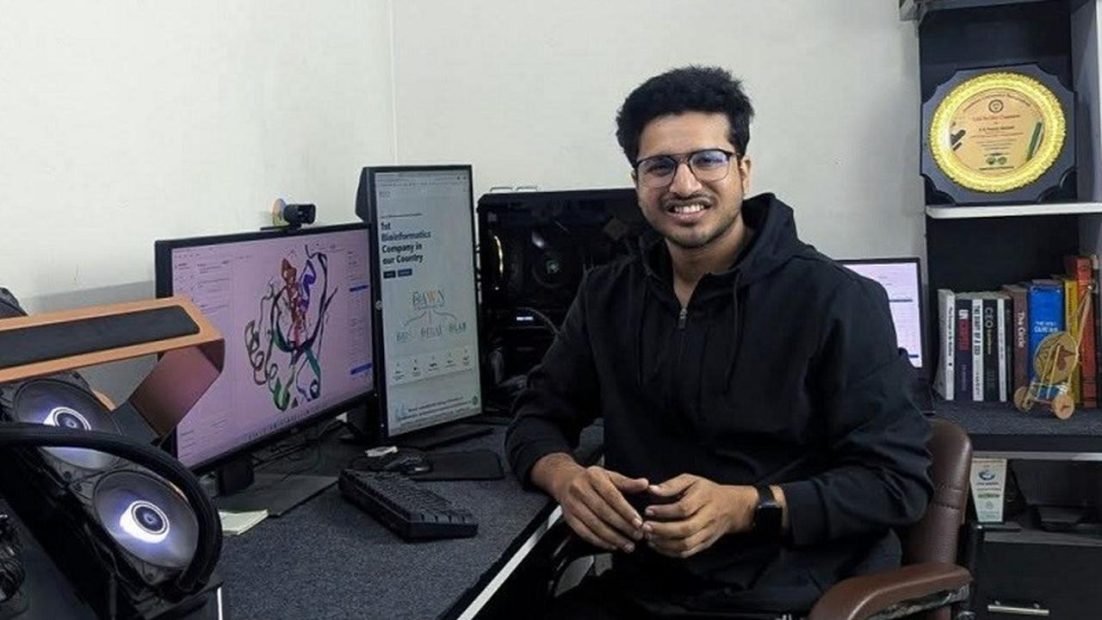
New drug discovery research often involves huge costs, long processes and dependence on expensive foreign software. To change this long-standing practice, Bangladeshi researcher SK Faisal Ahmed has developed an artificial intelligence-based software called DawnDock.
Ahmed is the founder and CEO of the Bangladeshi company Dawn of Bioinformatics Limited and a former student of Noakhali Science and Technology University (NSTU). The software is claimed to have performed better in accuracy tests than the popular US software PyRx. Tests using the international Astex Diverse Set showed that the GNINA neural network-based docking engine used in DawnDock achieved 80.5 percent accuracy. In the same test, the traditional AutoDock Vina engine used in PyRx achieved 52.4 percent accuracy.
At the beginning of new drug development, computers are used to test which chemical molecules can effectively bind with proteins linked to a disease. This process is called molecular docking. It greatly reduces research time and costs before direct laboratory chemical tests are carried out. Researchers using PyRx often need several separate software tools to prepare proteins and analyse docking results. DawnDock, however, has more than five docking engines. This allows protein preparation, analysis of possible binding and evaluation of drug effectiveness to be done on the same platform. It can also accurately analyse seven types of chemical interactions between proteins and chemical molecules after docking.
The success of molecular docking depends on correctly identifying the specific binding site, or “binding pocket”, of a protein. In the traditional PyRx software, users often have to select the protein’s grid box or specific area themselves. This can be time-consuming and may lead to errors. In contrast, the developers said DawnDock can automatically identify the correct binding pocket in 98.8 percent of cases. The innovation has also opened a new way to discover medicines from Bangladesh’s own natural resources. Earlier, the same research team created the Bangladesh Medicinal Plants Phytochemicals Database (BMPPD) using information on around 63,900 chemical compounds, or phytochemicals, from more than 700 medicinal plants in the country.
Researchers can now directly analyse the compounds in that database through DawnDock. They can check whether compounds from local plants can block proteins linked to cancer and other serious diseases. Explaining the idea behind the innovation, SK Faisal Ahmed said, “Science cannot be limited to the walls of a particular country or an elite laboratory. This belief has guided our journey. We wanted even an ordinary university student from any part of the country to be able to carry out the early stages of international-standard drug discovery research using their own computer. DawnDock was born from that dream. Our effort to make the software open to everyone is also part of that vision.”