16 Years in Chains: Mother and Quran Hafiz Son Endure Inhumane Conditions in Kaliakair
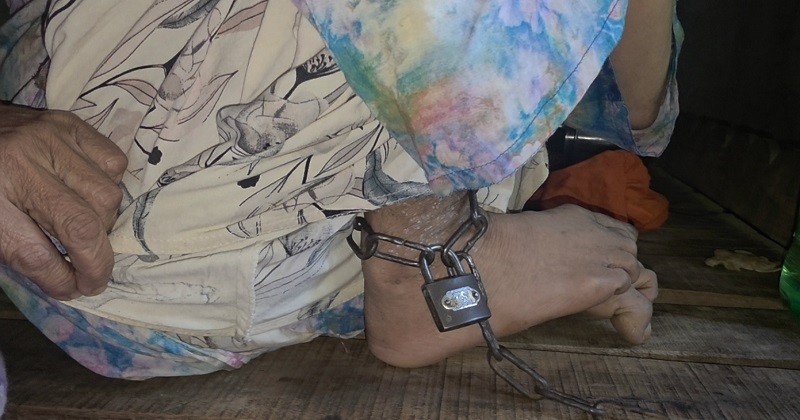
A dark room. A dull window. A heavy iron chain clangs against that window. Saleha Akter, once a bright officer of the state owned Agrani Bank, sits chained there in silence. Right beside her, another chain binds her only teenage son. He is Hafiz Baratul Mustakim, who has memorized 18 paras of the Holy Quran.
Their lives should have been full of light. Today their whole world is trapped inside a few yards of chain. For 16 years they have lived an inhuman life in this cruel, dark cell. Saleha sits on a wooden cot with her knees folded. An iron chain and a lock are on her leg. Her elderly mother, Mumtaz Begum, sits beside her in a pink scarf with her eyes closed. A bowl of rice and a bottle of water lie nearby. This has been their life for 16 years.
Saleha now lives in a rented house in Purachala village, ward number 7 of Mouchak Union in Kaliakair Upazila. She lives in two rooms with her elderly mother Mumtaz Begum and her son Baratul Mustakim. She cannot pay the rent, so the landlord is harassing her. He tells them to leave if they cannot pay. Where will helpless Saleha go with her mother and her son? They can see no way ahead. Besides the chains, they now fear losing their home. They face chains on one side and a threat of eviction on the other.
Saleha Akter was no ordinary woman. She held a graduate degree and was refined and self reliant. She worked at the state owned Agrani Bank in Motijheel, Dhaka. A bright future and a happy home were within her reach. She married Faruk Ahmed, and they had a lovely baby. She had come to her mother’s home in Kaliakair to give birth.
But no one knows when a storm will hit a person’s life. When the baby was only three months old, Saleha screamed “fire, fire” one terrible night. That scream took away her sound mind, and she lost her mental balance. At that moment, society showed its cruelest face. Her husband, Faruk Ahmed, left his newborn child and sick wife helpless and ran away in the dark of night for good. He never asked about them again. He never even looked back.
That day the whole world of three people went dark forever. They were a three month old baby, a sick woman and an elderly mother bent under the weight of age. Mumtaz Begum is old now, and her eyes are full of tears. Holding back her heartbreak, she says, “I am a mother. My heart breaks but my words do not come out. Tell me, how can I tie my own daughter with a chain? But what else can I do? If I untie her, she walks out of the house and gets lost.”
Saleha had gone missing from home three times before. No one knew where she went or how she lived. Her mother feared that something bad might happen to her if she got lost, or that someone might harm her. Out of this deep fear, the helpless mother has kept her daughter chained to the window for the last one and a half decades.
At night, when the whole world sleeps, Mumtaz Begum sits by the heads of her daughter and grandson. She strokes them with great love. She whispers a prayer to Allah, “O Allah, make my daughter and grandson well. Let me see them in the open air before I die.”
The shadow of the mother’s tragic fate and extreme poverty also fell on her only son, Baratul Mustakim. How bright the boy was! He studied at a local madrasa and memorized 18 paras of the Holy Quran. People in the area had many dreams for this child who carried Allah’s holy words in his heart. Everyone said this boy would one day become a great Hafiz and Alem.
But his mother’s sudden mental illness, neglect from society and relatives, and severe hunger slowly began to affect young Mustakim’s mind too. Today that Hafiz of the Quran also lives chained with iron beside his mother. Even a heart of stone would melt at this sight.
The family has no land and no income. Their elderly grandmother, Mumtaz Begum, goes from door to door and survives on small help from locals. They do not even get proper meals, so medicine and better treatment are beyond imagination. The biggest trouble is administrative complexity. Their old permanent address was in Gazipur Sadar and Sreepur Municipality, so they could not become voters at their current home in Kaliakair. Because of this paperwork problem, they also get no government disability allowance or any other grant.
A bank officer and a Hafiz have spent 16 years in chains because of one piece of paper and a change of address. What crueler joke can there be? On top of that, they are now under pressure to leave the house because they cannot pay rent. Mumtaz Begum says, “I cannot pay the rent, and the landlord tells us to leave the room. Where will we go with this chained daughter and grandson?”
The tragic and heartbreaking story of Saleha and Mustakim has reached the Kaliakair Upazila administration. Kaliakair Upazila Nirbahi Officer (UNO) Mr. A H M Fakhrul Hossain has made a strong and humane promise.
He said clearly, “I was deeply shocked when I learned about this tragic incident. A mother and her child staying chained for 16 years can never be accepted in a civilized society. The first duty of the state is to stand beside these helpless people. Because they are residents of Sreepur Municipality, there are some legal complications for them to become voters or receive allowances in Kaliakair. We will quickly change their address or work with the Sreepur Upazila administration to arrange their disability card. We will also take every step to bring them back to normal life through better treatment.”
He added, “No citizen will be denied treatment and human rights on the excuse of paperwork problems. We will work with the Social Services Office and the Health Department to remove these chains as soon as possible.”
Hearing the UNO’s assurance, elderly Mumtaz Begum saw a ray of hope in her eyes after a very long time. She says, “If the sir comes once and arranges treatment for my daughter and grandson, I will die in peace.”
Their lives began with light, but today the darkness of chains covers them. This story is not only the personal pain of Saleha and Mustakim. It is a living record of the indifference and failure of our whole society.
What more sorrow can remain in the lives of those already torn apart by grief? Let us not waste more time and stand by this unlucky mother and her Hafiz son in Kaliakair. The administration has started its work. Now each of us must offer a humane hand from our own place. A share or a small help may end their captivity and bring back their lost dignity.
If this report has touched your conscience and heart, please share it so that more kind people and officials come forward to help this helpless family.