‘Hidden’ Awami League, Workers League Resurface Under Rickshaw Drivers’ Banners
Battery-Rickshaw Drivers Turned into ‘Political Fronts’
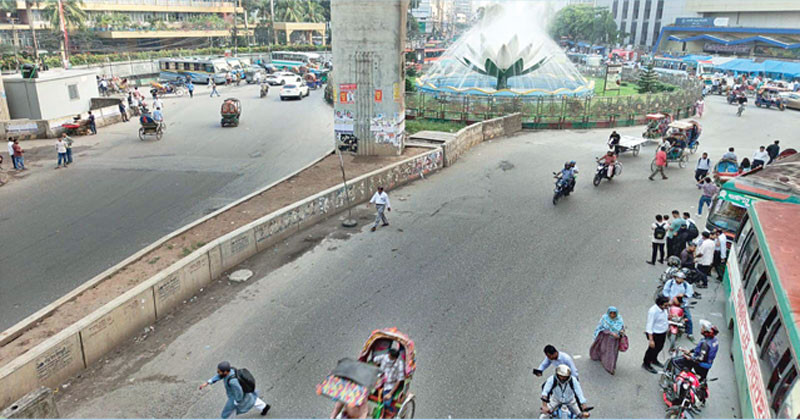
The temporary absence of battery-powered autorickshaws on Dhaka’s main thoroughfares briefly restored order to traffic flow and provided noticeable relief to pedestrians. However, the resulting shortage of rickshaws, combined with a deficit of public buses and soaring ride-sharing fares, forced many short-distance commuters to walk. While traffic congestion initially eased following drives by the Dhaka North and South City Corporations to shut down illegal autorickshaws, unauthorized factories, and garages, the situation quickly transformed into a major operational disruption across the capital city.
The issue rapidly escalated as autorickshaw drivers were mobilized onto key thoroughfares, leading to widespread blockades, protests, and strikes in vital hubs like Gulshan, Banani, and near the National Press Club. Political analysts suggest that these demonstrations reflect coordinated efforts to destabilize the nation, linking the unrest to rumors of deposed Prime Minister Sheikh Hasina returning in December and opposition programs. Observers point out that financially vulnerable activists from Awami League affiliate organizations, including the Chhatra League, Jubo League, Shramik League, and Mazdoor League, are being pushed onto the streets, using the labor movement as a front, with support from underlying political networks to generate government unrest.
Following the change in political power, numerous former ruling party leaders and activists went into hiding, with many quietly relocating to Dhaka. The ongoing controversy surrounding battery-operated rickshaws has subsequently emerged as a critical political flashpoint. Allegations have surfaced that some absconding operatives have taken up autorickshaw driving to conceal their identities, while others have invested directly in vehicle ownership, garage operations, or commercial fleets. Although participating drivers contend that their protests are strictly aimed at preserving their daily livelihoods, political entity involvement suggests grievances are being leveraged to advance broader tactical goals.
Reports further indicate that former ruling party operatives hiding in the capital utilize the autorickshaw trade as an ideal cover to evade detection while actively managing garages, leasing vehicles, and organizing driver unions. Amidst these developments, political speculation has intensified regarding Sheikh Hasina’s potential return. Analysts note that although such claims lack practical feasibility, political factions are exploiting the narrative to co-opt autorickshaw operators into a broader anti-government movement. Simultaneously, groups like Jamaat-e-Islami and the National Citizen Party (NCP) are closely monitoring the demonstrations, seeking to leverage local grievances into larger public momentum.
In recent years, the unchecked proliferation of battery-powered autorickshaws on major thoroughfares has severely compromised Dhaka’s traffic management system. The chaotic co-existence of high-speed buses, private vehicles, trucks, and low-speed three-wheelers has created severe gridlock and elevated safety hazards. Driving against traffic flows, reckless maneuvering, and violating traffic signals continually jeopardize road safety. Furthermore, the rapid sector growth is propelled by rural migrants seeking immediate daily cash flow, who subsequently establish informal networks that draw relatives into the urban transit market.
Traffic and urban transport experts emphasize that simply banning a single vehicle class will not resolve Dhaka’s structural transit crisis. Sustainable order requires comprehensive management, designated routing, driver training, vehicle registration systems, and mass transit expansion matched to road capacity. Experts universally recommend restricting autorickshaws through designated zones and fixed hours. Expressing a driver’s perspective, former bus helper Hafiz explained, ‘Driving an autorickshaw provides predictable daily income and flexible hours without oversight, but these vehicles belong on local feeder roads rather than main arterial highways’.
In response to the growing crisis, government officials have implemented regulatory measures to restore discipline in urban transport. Adviser for Road Transport and Bridges, Sheikh Rabiul Alam, announced that a concrete policy framework is being formulated to strictly regulate battery-powered rickshaws. ‘Under the proposed guidelines, a designated number of registered vehicles will be permitted to operate exclusively within specified local zones’, the adviser stated, adding that these three-wheelers will remain strictly barred from main highways and primary arterial routes.
Highlighting the systemic nature of the problem, Dr. Md. Hadiuzzaman, Professor of Civil Engineering at Bangladesh University of Engineering and Technology (BUET), warned that unchecked autorickshaws have become a structural crisis. ‘Operating without driver training, licensing, or documentation, these vehicles flood the streets, while unaccounted capital allows single investors to purchase multiple units,’ he explained. He further noted that unregulated assembly workshops and illegal garage charging operations frequently exploit residential power connections, directly driving the capital’s severe traffic congestion and gridlock.