Auto-Rickshaws Turn Deadly, Sending an Average of 22 Patients to the National Institute of Traumatology and Orthopaedic Rehabilitation Daily
Hasan-uz-Zaman
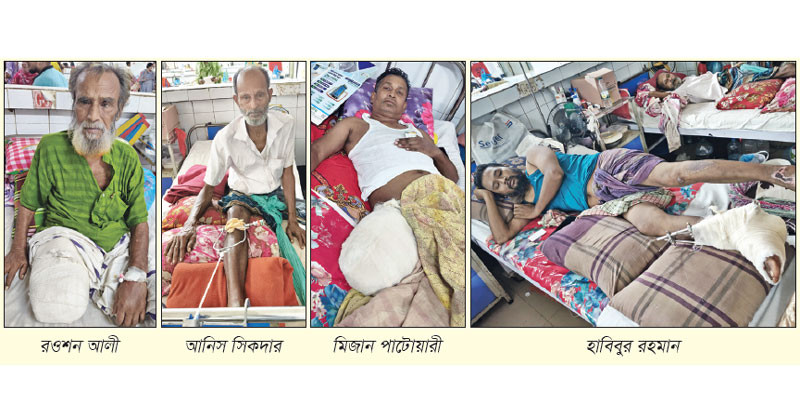
Rowshan Ali is in his seventies and is one of the country’s spice suppliers. He travelled from one end of the country to the other for his business. He was a strong man and his family lived in comfort. But a speeding battery run auto rickshaw took everything from him, and he has lost the ability to walk.
Doctors had to cut off his right leg on 4 October to save his life. The cost of his long treatment has left him penniless. Yesterday, Sunday, he spoke in a tearful voice from bed G-35 in ward C-A-1 of National Institute of Traumatology and Orthopaedic Rehabilitation (NITOR). He said that banning auto rickshaws to save lives is the demand of the time.
Rowshan Ali lives in West Para of Kakran under Dhamrai police station. He described what happened three and a half years ago in the Ghoripara area of Savar. The rickshaw was speeding and he fell from it into a ditch. Then the same rickshaw ran over his body, and blood covered the spot.
The cruel driver did not help him. He drove away faster instead. Rowshan Ali has received regular treatment since then, but doctors finally cut his right leg above the knee. He is not the only victim. Many people lie in hospital beds in great pain after auto rickshaw crashes. Many have lost their limbs, and some have died.
The emergency department NITOR shared its figures. On average, 17 patients with serious injuries from auto rickshaw crashes are admitted there every day. This month the number is a little lower. Still, 99 patients were admitted in the first ten days of this month.
The hospital could not give the figures for last month because of a server problem. Two months ago, 604 people received treatment there. The month before that, about 300 people received treatment over roughly three and a half weeks. Ms. Rina, Ms. Mim and Ms. Mahmuda run the ticket counter in the emergency department. They spoke to this reporter.
They said they once wrote only RTA in the register under the type of accident. Now they have had to add a new column called auto rickshaw. Crashes involving auto rickshaws keep rising. So the hospital officially added a special column for them.
Mr. Noor Mohammad is the ward master of the institute. He said most patients once came from motorcycle crashes. Now a large share come from auto rickshaw crashes. He said that if one hospital gets 17 to 18 such patients on average, nobody can tell how many go to hospitals across the country. He said it has become a national problem.
Mr. Noor Mohammad warned that people will suffer more if the government does not stop illegal auto rickshaws. He said some dishonest businessmen run an illegal battery rickshaw trade. He said fugitive terrorists of the banned Chhatra League drive many of these vehicles. Many of them know little about road laws. They also lack the skill to drive such vehicles on the road.
A survey by the Passenger Welfare Association gives more figures. It says an average of 22 patients come to NITOR Hospital every day after auto rickshaw crashes. District hospitals receive 10 to 12 such patients a day. Upazila level hospitals receive 6 to 7 a day.
Mr. Mozammel Haque Chowdhury is the secretary general of the association. He told Inqilab that admissions across 4,000 government and private hospitals show how dangerous battery rickshaws are. He said they also put heavy pressure on the health system. He said the cost of treatment is several times higher than the revenue from auto rickshaws. He said it is time to think about this, and the government must take effective steps to control them.
No agency has clear figures on how many illegal auto rickshaws run in the country. A police survey based on estimates says there are 6 million illegal battery rickshaws nationwide. The two Dhaka city corporations believe there are 12 to 15 lakh auto rickshaws in Dhaka. Rickshaws that were once registered became illegal after they switched to batteries. Still, the government has not started any legal process to cancel them.
Drivers ignore the ban on using main roads. According to information given in parliament, 6,729 road crashes killed 9,011 people in 2025. Uncontrolled battery auto rickshaws were involved in 13.54 percent of these crashes. Experts question the build quality, braking systems, lights and safety gear of many vehicles.
A recent study by the CPD says the country has about 4 million battery rickshaws. About 90 percent of them are made in Bangladesh. The study also raised concern about the chassis and braking quality of these locally made rickshaws.
Authorities carry out drive after drive to control battery auto rickshaws on main roads of the capital. In some places, police let rickshaws go in exchange for money after stopping them. Some rickshaws are seized and dumped, but the problem does not stop. Every day, battery rickshaws enter important roads of the city despite the ban.
In some places they race with buses and cars. In other places they stop carelessly near turns, U turns and signals and cause traffic jams. Factories and garages that make these dangerous vehicles still run in many areas of the capital. The traffic division of the DMP has recently run drives in some areas. The DMP said drives against illegal making and selling of auto rickshaws will continue.
When the government raids factories and seizes rickshaws, several thousand drivers block roads. They act on hints from interested groups. They create chaos to press their illegal demands. Seizure and dumping go on at one end, and new production goes on at the other. Because of this, people now question how well the control works.
Concerned people say drives continue but production does not stop. They say action against drivers alone will not solve the problem for good. Before a rickshaw reaches the road, a wide network of factories, garages, charging points, parts suppliers and owners supports it. Production and use of these vehicles must stop.
Experts say drives on the road alone cannot stop new vehicles from coming while production and supply stay out of control. Road Transport Minister Mr. Sheikh Rabiul Alam said recently that the government will bring battery auto rickshaws in the capital under a clear policy. He said it will control their movement on main roads and in important areas. But the real picture shows a big gap between announcement and action.
One leg of Anis Sikder is tied to bed G-56 of NITOR Hospital with a belt. He was crossing the road in front of his home in Dakshin Kajir Char of Muladi, Barishal, 17 days ago. A speeding battery run auto van came from somewhere and knocked him down. His leg broke. After Barishal hospital, he now stays at NITOR Hospital.
Doctors said they do not need to cut off his leg. But he must stay in bed with his leg tied by a rope for many days. He now depends on other people.
Mizan Patwari, 40, lives in Durganagar of Sadar upazila in Noakhali. He runs an electrical goods business in Abdullahpur, Dhaka. On 9 October he was riding his motorcycle to his home in Nabinagar. A speeding auto rickshaw came from the opposite side and hit his motorcycle. Mizan was thrown several yards away.
His right leg broke into three pieces. After first aid nearby, people brought him to NITOR. Doctors had to cut off his right leg to save his life. He lies in bed G-6 of the casualty department in ward 2, crying in pain. His cries bring tears to the eyes of others. He asked who is to blame for handing such machines to anyone without a licence or training. He said every country has a system for everything, but Bangladesh has none, and ordinary innocent people like him pay the price.
Habibur Rahman, 35, is admitted to bed 5 of the same ward. He owns a medicine shop in Ikuria, Keraniganj. A battery run auto rickshaw carrying him overturned in the Hasnabad Basundhara area on 10 September. He said passengers asked the driver again and again to drive slowly and carefully. The driver did not listen.
Habibur said the driver tried to race with other vehicles and put others in danger. He is a father of one son and one daughter. He worries about his own life and his children’s future. He said a battery rickshaw is not a vehicle but a death trap. He said the government must stop them now, or lives will face greater risk in future.
It is not only Habibur or Mizan. Reckless auto rickshaws cause crashes all the time. Lives come to a stop. A few seconds of reckless speed from one auto rickshaw can change the whole life of a family. Some lose a limb and some stay in bed for months. Deadly auto rickshaw crashes put public safety in danger.
To escape this death trap, local administration and highway police must act strictly. Removing illegal battery rickshaws and controlling their movement outside fixed routes is the demand of the time.