No Steps Taken to Revive the Fragile Economy
Hasan Sohel
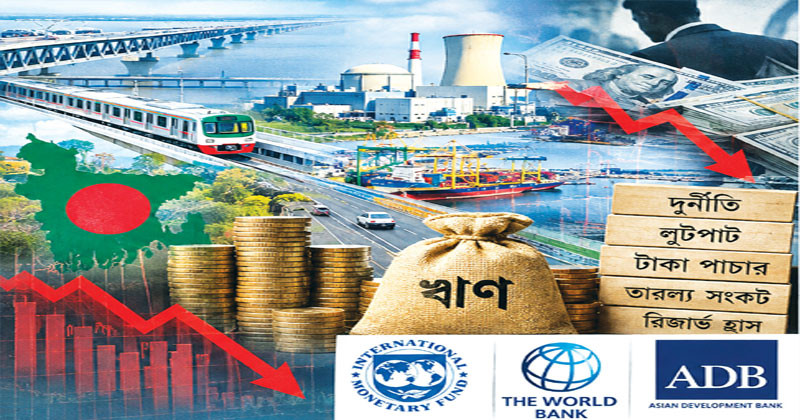
During its 15 years, the autocratic Awami League government carried out widespread irregularities and corruption. It looted banks, committed loan fraud and sent thousands of crores of taka abroad. This caused a cash crisis in the banking sector, cut foreign currency reserves and left the economy fragile. The government also showed inflated costs and stole money in the name of mega projects. These include Padma Bridge, Metro Rail, Rooppur Nuclear Power Plant, Payra Thermal Power Plant, Payra Sea Port and Dhaka Elevated Expressway. Now the public bears the burden.
The World Bank, International Monetary Fund (IMF), US Treasury Department and other multilateral development agencies say Bangladesh inherited this fragile economy. Still, the forecasts of the IMF, World Bank and Asian Development Bank hold only bad news. The IMF report released earlier this week says the gross domestic product (GDP) will fall further to 3.2 percent. The World Bank and Asian Development Bank give the same forecast. Reports by many national agencies also describe a deep crisis, and businesspeople are crying out.
Autocrat Ms. Hasina fled to India in 2024 after the student and public uprising. After that, the interim government lacked proper policy for a year and a half and pushed the financial sector closer to the edge. The present government took power with a public mandate after the election in February this year. It now carries the duty of fixing the fragile economy.
Prime Minister Mr. Tarique Rahman acted directly and started a rooftop solar revolution to face the fuel and power crisis. He also brought the Family Card, the Farmer Card, a digital health card, and stipends and uniforms for students from class one. These are many good steps to cut costs. But Finance Minister Mr. Amir Khasru Mahmud Chowdhury has taken no groundbreaking or urgent step to revive the economy. Mr. Tarique Rahman has also laid out a plan to turn Bangladesh into a trillion dollar economy by 2034. So the finance minister needed to take quick steps, which would have raised jobs and speeded up growth.
Without these steps, the economy moves toward a terrible crisis every day. Investment has dried up, import and export trade has stalled, and unemployment is rising. Working people are losing their jobs, incomes are falling and prices keep climbing. There is no good news for the economy, and every indicator points down.
Extortion, illegal grabbing and weak law and order also hurt public life. Ordinary people are slowly becoming angry. In some places workers, businesspeople and farmers protest, and some block roads over extortion and fertiliser shortage. Earlier this week, about one thousand garment workers blocked the Dhaka to Mymensingh road in Uttara and demanded higher pay. Battery run rickshaw drivers in Savar blocked a road to protest higher garage rent.
People in Mymensingh marched against extortion. In Naogaon, over one hundred farmers blocked the Rajshahi Naogaon highway over fertiliser shortage. The anger of all these groups has almost the same cause. High prices of daily goods make life very hard, and they struggle to run their homes. So they had to join the protests. But in some places, leaders, workers and supporters of the banned Awami League fuel these protests.
Economists say there are no jobs, many firms have closed, and more are about to close. Workers live in misery without work. Some workers took jobs with lower pay than before, but thousands remain jobless. Even running factories face many crises, and many firms cannot pay their staff. This is a warning sign for a big economy. During the autocratic Awami League rule, officials often showed wrong statistics to mislead people, but the Hasina government did not last. When people’s backs hit the wall, they have to join protests.
Economists say this protest is a warning sign for the government. They say it is not easy to recover from this fragile state. They say the government must take bold and far reaching steps. The government has a long term plan to revive the economy. But it must also take some urgent steps now to give ordinary people relief.
Sociologists say ordinary people are peaceful by nature and want to avoid big disorder in daily life. But when the social system pushes people against the wall, they have to turn and stand up. History shows that such forced movements have brought big social and political change across the world. They say these movements are not sudden events. They are the final sign of social anger and a deep structural crisis. So the government must act now to cut price rises, create jobs and protect public welfare.
Professor Dr. Rashed Al Mahmud Titumir, the prime minister’s adviser on finance and planning, spoke to Inqilab about reviving the inherited economy. He said the autocratic Hasina government committed irregularities and corruption, looted banks, committed loan fraud and sent thousands of crores of taka abroad. He said the present government has to carry the burden of these wrongs. He said the World Bank, IMF, US Treasury Department and other multilateral development agencies and international partners accept this.
He said that for the first time, a political party has found the country’s problems by itself. He said the government has also made its programmes based on the election manifesto and political promises. He said lending agencies have welcomed the government’s own plan for economic recovery and reform. Dr. Titumir said the government will move its recovery programme forward with everyone together.
Adviser Dr. Titumir said talks with international partners gave clear agreement on three points. First, the present government inherited a fragile economy. It chose to fix the problem openly and with accountability instead of hiding it. Second, the Middle East crisis has put new pressure on fuel and daily goods prices. Partners still trust the government’s plan to face it. Third, partners think the government’s programmes on economic recovery, bank sector reform and poverty cutting are realistic.
The adviser said, “We are not hiding the problems under the carpet. We face them with openness and accountability. We have our own plan, and international partners have trust in that plan.”
Professor Mr. Abu Ahmed, chairman of the Investment Corporation of Bangladesh and a noted economist, said the economy is in a bad state now. He said investment is stuck, there is a fuel crisis, government income is falling and bad loans are rising. He said this decline began in the time of Ms. Sheikh Hasina. He said the present government also does not earn more, yet it has to spend more. In his view, the country has already fallen into a debt trap. He said the pay rise for government employees will make things worse.
He said no visible step has been taken to revive the economy. He said financial indicators have in fact grown worse in recent times. For example, GDP growth is not rising, but inflation is rising. He called this terrible for the economy because it raises poverty and unemployment and creates inequality. He urged the government to take some quick and bold steps to improve the situation.
Sources say there is no good news on the economy and on job growth. But political stability and less money in people’s hands have lifted the local tourism sector a little. Hotels, motels, restaurants and transport have picked up a bit, and domestic spending has risen. This has appeared as a small ray of hope for the economy. Yet the government has taken no visible step for the housing sector, the biggest source of jobs in the country.
Without policy support and proper coordination, the local housing sector, a major driver of the economy and jobs, is now in deep crisis. The Real Estate and Housing Association of Bangladesh (REHAB) and sector experts say about 5 million people directly and indirectly depend on this industry for jobs and income. Recently, high tax policy, high bank loan interest and endless price rises in building materials have pushed the sector into a sharp slump. Because of the economic uncertainty, flat sales have fallen by about 65 to 70 percent.
About 300 linked industries, including rod, cement, brick and sand, depend on this sector. When one housing project starts, hundreds of production and service sectors start moving automatically. The housing sector has collapsed, so the speed of new job creation has slowed. Private sector investment has fallen, and big industries have cut production, so job chances for new workers have shrunk. It is now very hard for the middle class to buy a flat or own a home. This directly hurts the economy.
High inflation and the dollar crisis are also making people lose interest in import and export trade and in the SME sector. New business is not growing, and the buying power of ordinary people falls sharply every day.
Professor Mr. Muha. Mizanur Rahman of the Department of Social Work at Shahjalal University of Science and Technology spoke to Inqilab. He said people are peaceful. They only want to work, eat, dress and live normally. But for a long time, people have had no jobs for many reasons, and inflation makes normal life hard. He said this is why crime is also rising in society.
He said economic instability, unemployment and fewer job chances for young people put a country in crisis in many ways, both economic and social. He said criminal activity rises at a geometric rate in society. So he said the government must take steps to raise jobs very quickly.
Dr. Mostafa K. Mujeri, former director general of the Bangladesh Institute of Development Studies (BIDS), said the economic situation has become terrible. He said this did not happen in one day. He said it built up over a long time. He said the situation is growing harder and, if the country cannot handle it well, there is a fear it may become a failed state.
Asked how to get out of this state, he gave three answers. First, the government must raise its revenue income. Second, in future the government must not take new loans for anything except productive sectors, for example, to pay government employees. Third, the government must stop corruption and waste of money with a firm hand.