Fire Risks Rise as Winter Approaches
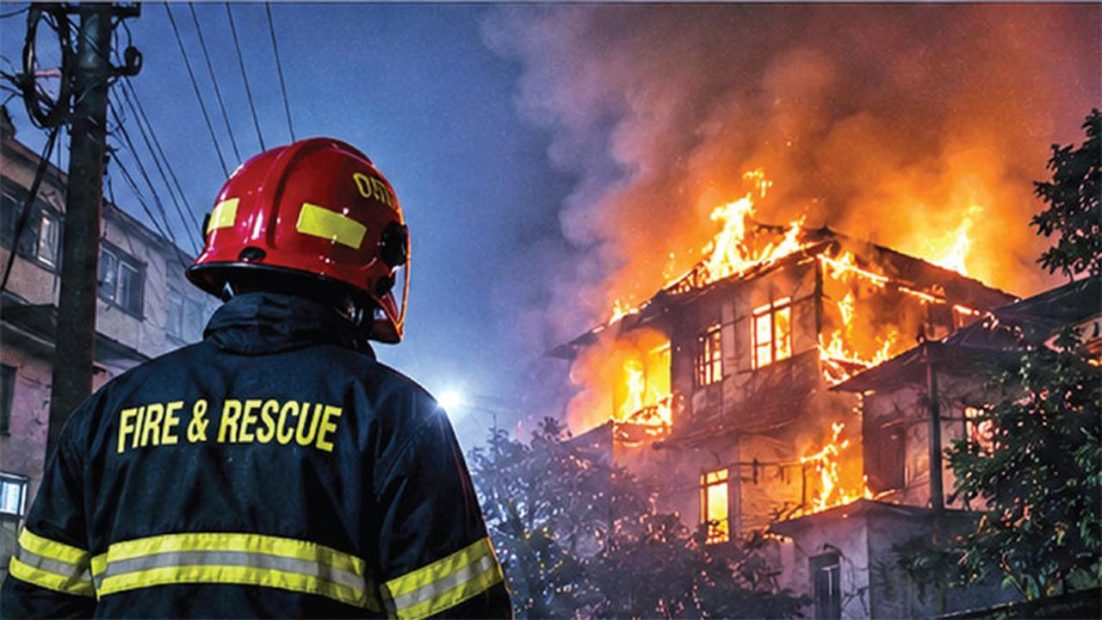
At least 10 tourists, including children, were killed in a devastating fire at a beach resort in Cox’s Bazar. The most tragic aspect of the incident was that six members of the same family died. Around the same time, a major fire broke out at a pharmaceutical factory in Safipur, Kaliakair upazila, Gazipur. Two fires in Gazipur within three days caused damage worth thousands of crores of taka.
Following the deaths at the Cox’s Bazar beach resort, questions emerged about how the establishment had been operating without proper approval and adequate safety measures. According to Fire Service sources, many major fires occur because of negligence by owners. Some establishments ignore warnings even after being marked as highly risky or having warning signs displayed on their premises. Other fires result from a lack of awareness, while negligence is also a major factor.
Fire Service officials say fires destroy not only property but also human lives. In many cases, basic precautions and proper fire safety measures can prevent major losses. Greater emphasis must be placed on preventing fires rather than extinguishing them after they break out. Awareness and preventive measures are essential to stopping fires before they start.
Experts point to a lack of awareness, reluctance to comply with safety regulations, unplanned urbanisation and serious coordination problems among the relevant agencies as major causes of the problem. According to the Fire Service and Civil Defence, 244,305 fires occurred across the country between 2015 and 2025. Most were caused by electrical short circuits. The source reported 78,034 fires caused by electrical problems in the previous year. Cooking fires ranked second, with nearly 40,000 fires caused by electric, gas and other types of stoves. The actual figures may be higher.
These incidents claimed around 1,700 lives and injured at least 7,000 people, including firefighters. Fire Service officials said they had inspected at least 50,000 government and private establishments, residential buildings, offices and high-rise buildings over the years. Of these, 7,060 were identified as risky, including 2,164 classified as highly risky. Warning signs have been placed at some establishments, but many owners continue to ignore them.
Officials warned that the risk of fire increases during winter, making early awareness and preventive action essential to avoiding major disasters. On Saturday afternoon, a fire broke out at the pharmaceutical factory of The Ibn Sina Pharmaceutical Industry Limited in Safipur, Kaliakair, Gazipur. Just two days earlier, another establishment in Gazipur had caught fire, requiring firefighters to work for more than two days to bring it under control. Last month, four people died in a fire at Mymensingh Medical College Hospital. A fire at the Rooppur Nuclear Power Plant project last month also damaged a server and some documents.
Mohammad Talha Bin Jasim, an official at the central media cell of the Fire Service and Civil Defence, said the department provides various training programmes to raise public awareness and help people extinguish fires at an early stage. It also routinely inspects establishments and high-rise buildings. He said inspections of major companies had revealed that some lacked fire extinguishing equipment. In other cases, the equipment was outdated or ineffective.
He added that major disasters often occur because establishments fail to install proper firefighting systems or ignore warnings after being identified as highly risky. A minor mistake or lack of awareness can lead to a major accident, destroying property worth thousands of crores of taka.
Fire Service sources said electrical faults were the leading cause of fires, accounting for an average of more than 9,000 incidents annually. Dhaka and its surrounding areas bear the greatest burden, with Dhaka Division recording the highest number of fires among all divisions. March has the highest number of incidents by month.
According to Fire Service statistics, 27,059 fires occurred in Bangladesh in 2025, destroying property worth Tk 5.6997 billion. In 2024, 26,659 fires caused damage worth Tk 4.4628 billion. In 2023, 27,624 fires damaged property valued at Tk 7.9236 billion.
The data also show the number of fires caused by electrical faults in each year: 6,516 in 2016, 4,236 in 2017, 7,825 in 2018, 8,644 in 2019, 7,729 in 2020, 7,755 in 2021, 3,877 in 2022, 9,813 in 2023 and 9,069 in 2024. The figure for 2025 was reported at approximately 3,000.
Firefighters said many buildings and establishments continue to use the same electrical wiring for years after installation. When wires become damaged, some people reconnect them themselves instead of arranging proper repairs or replacing the wiring. Old wires often lose their effectiveness, increasing the risk of accidents. Fires can also occur when people use makeshift electrical connections to operate several air conditioners or heavy machines simultaneously.
Fire Service officials said the department conducts inspections of risky buildings, factories, hospitals, shopping centres and chemical warehouses. It also assesses fire hazards, provides training and runs public awareness programmes to reduce deaths and property damage. They said stronger preventive measures and proper safety arrangements could significantly reduce losses.
On October 12, a fire broke out at a market in Chawkbazar, Old Dhaka. It took nearly 37 hours to extinguish the blaze completely. Fire Service official Shahjahan Shikder said reaching a fire site quickly and bringing the flames under control were major challenges in densely populated areas such as Dhaka. Narrow roads, traffic congestion and inadequate fire safety arrangements in buildings make the situation more difficult.
He stressed the importance of ensuring fire safety during building construction and keeping emergency exits clear and functional. In many cases, electrical wires, circuits and other equipment are installed without meeting the required standards. A lack of regular maintenance also increases the risk of accidents. He urged building owners and occupants to be more aware of these risks.
Data for the past three years show that March recorded the highest number of fires, followed by April. There were 3,522 fires in March 2025, 3,421 in March 2024 and 3,334 in March 2023. Talha Bin Jasim, a station officer at the Fire Service headquarters, said the risk of fire rises during the dry season because of carelessness, electrical faults and other sources of ignition. He said homes, businesses and factories need to take extra precautions during the dry season, particularly in March. Public awareness must be accompanied by effective fire safety systems.
According to Fire Service and Civil Defence statistics, fires increase during the four-month period from December to March. Humidity levels tend to be lower in winter, while many people use room heaters and ovens more frequently. Some people also leave multiple-plug power strips switched on after use, creating a fire risk through even minor carelessness.
In addition, people carrying out electrical wiring work in buildings often lack specialised training or experience. Stronger government oversight is therefore essential to ensure safe electrical installations and reduce the risk of fires.