Sherpur’s Sento Hajong Invents 25 New Rice Varieties in 21 Years
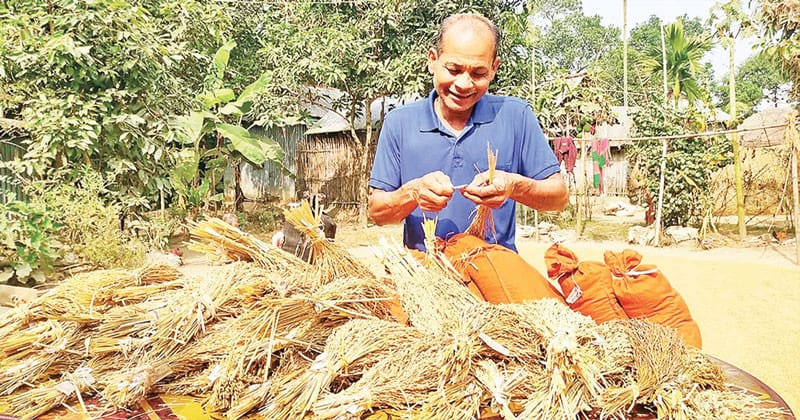
Sento Chandra Hajong, a 50-year-old marginal farmer from Chatkiya village in Nalitabari upazila of Sherpur district, has successfully invented 25 new rice varieties over the past 21 years through independent home research. Operating without advanced technological support or laboratory facilities, he utilises just 60 decimals of his land as an experimental field. His notable creations, officially numbered from Sento-1 to Sento-25, include ‘Sento Shail,’ ‘Sento Pajam,’ ‘Sento Gold,’ ‘Chini Shail,’ and ‘Tulshimala.’ He spent seven consecutive years developing his first successful variety, ‘Sento Shail,’ after training from an NGO in 2005.
Working day and night, Mr Hajong applies hybridisation and breeding methods between different rice strains, establishing 440 experimental plots across 12 kathas of his land. Alongside creating new strains, he passionately dedicates time to preserving endangered indigenous rice varieties such as Bogi, Haloi, Golapi, Malanchi, Moynagiri, Malsira, Anamia, Parijat, Apchi, Kaishabinni, and several others. To cultivate these crops sustainably, he avoids chemical fertilisers entirely, relying instead on natural cow dung and home-produced vermicompost to protect native agricultural diversity from disappearing.
The high-yielding nature of his innovations is substantially benefiting local agricultural communities across the district. Local marginal farmers like Abdur Razzaq, Satyendra Barman, and Subol Barman reported that while they previously harvested 30 to 40 maunds of paddy per acre, cultivating Sento Hajong’s ‘Sento Pajam’ and ‘Sento Gold’ now yields 50 to 60 maunds. This provides an extra 10 to 20 maunds per acre, bringing significant profits and creating a rapidly surging market demand for his developed rice varieties among regional growers.
Despite his remarkable achievements, Mr. Hajong continues his groundbreaking research entirely through personal endeavours without external institutional support. He noted that lacking a dedicated laboratory forces him to conduct experiments right inside his home. Although local authorities are aware of his long-term efforts, he has yet to receive formal national recognition. However, his mission is far from complete, as he revealed that the development process for over 200 additional new rice varieties is currently underway to further transform local farming success.
Addressing the situation, Nalitabari Upazila Agriculture Officer Mohammad Mashiour Rahman stated that Mr. Hajong possesses excellent innovative capacity and should officially apply to the Bangladesh Rice Research Institute regarding his research work. He noted that while standard incentives are available, formal government recognition and equipment cannot be attained without applying through proper channels. Nevertheless, the agriculture officer assured that the local agriculture office will continue to provide him with all necessary cooperation, consultation, and various forms of support moving forward.