No bridges at Karatoya river ghats, thousands of people in three upazilas suffer
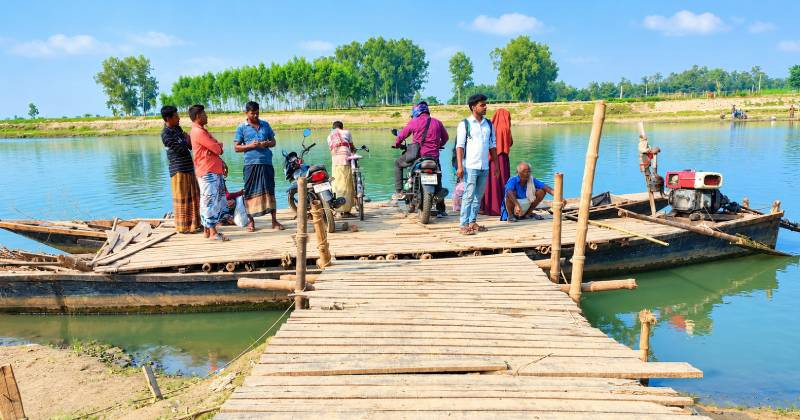
Lakhs of people in three upazilas have been suffering for years because several important ghats on the Karatoya river in Rangpur’s Pirganj upazila have no bridges. School and college students, pedestrians, farmers, labourers and wedding parties have to cross the river by boat at these ghats, risking their lives. For people in these areas who depend on boats to cross the river, the absence of a bridge has become almost synonymous with hardship.
The Karatoya flows through Pirganj, Nawabganj and Ghoraghat upazilas. Of the river’s 11 ghats, large bridges have been built at three locations on the initiative of the Bangladesh government. But because the remaining important ghats have no bridges, local residents suffer every day. In some places they have to cross by boat, in others by bamboo footbridges or other temporary arrangements.
Satpara ghat, Kumarpur ghat, Kuwaitpur Hamipur ghat, Kulanandapur ghat, Hossainpur ghat in Boro Alampur union, Ramnathpur Shalkedah ghat, Shalpara ghat and Jater ghat in Tukuria union are known as important crossing points. People from the three upazilas use these ghats every day. Cattle, goats, nasimons, vans, rickshaws and motorcycles are also ferried across by boat. As a result, many people have to cross the river at considerable risk.
Speaking to a boatman at one ghat the day before yesterday afternoon, he said people are ferried across by boat regularly. Minor accidents do occur during crossings, he said. Major accidents are comparatively rare, but the risk remains when the water level in the river is high.
Locals said a large stretch of the Karatoya flows through Pirganj upazila. Since people from the three upazilas own farmland on both banks of the river, farmers must cross it regularly for cultivation. People also use these ghats for trade and commerce, education, medical care and many other purposes. Although the population and the pressure of travel are growing day by day, the hardship is not easing for want of a permanent bridge.
According to local residents, building bridges at the important ghats would make travel easier for people in the three upazilas. Farmers would be able to bring their produce to market quickly. This would expand the transport of agricultural goods, import-export and trade. It would also strengthen social contact and kinship ties among people of the three upazilas.
Pedestrians Monarul Islam, Ashraful Islam and Majedul Islam said that if bridges (or culverts) were built at these ghats, people’s suffering would be greatly reduced. At present, crossing the river costs both time and money. Farmers in particular face various problems in transporting their produce. A permanent bridge (or culvert) would improve the living standards of the area’s people, they said.
Boatmen said the ghats are leased out every year under government rules. Through a set process, the highest bidder among the participants is given charge of a ghat for one year. As a result, passengers have to pay a fixed fare to cross the river by boat at these ghats.
Habibur Rahman Habib, a prominent businessman and social worker of Chatra union, said his ancestral home is on the bank of the Karatoya, so he knows well the hardship of crossing the river. When a patient needs to be taken urgently to the health complex, often there is a boat at the ghat but no boatman can be found. Even when both boatman and boat are available, valuable time is lost waiting. Traders also cannot get their goods to the wholesale markets on time. To solve these problems, bridges must be built at the important ghats, he said. Farmers, traders, patients and people from all walks of life would benefit.
Concerned citizens and teachers said that even though people pay to cross the river, they often have to wait a long time. If not enough passengers board, boatmen in many cases are unwilling to set off. This wastes the valuable time of students, office workers, farmers and ordinary passengers. People also suffer in emergencies when they need to cross the river.
In their view, building bridges at the important ghats of the Karatoya is now a demand of the times. If the authorities concerned conduct the necessary studies and take initiatives to build bridges at these locations, the long-standing suffering of people in the three upazilas will ease. At the same time, new possibilities will open up in agriculture, trade and commerce, and communications, they said.