Bangladesh’s Businesses and Employment Suffer as US-Israeli War in the Middle East Intensifies
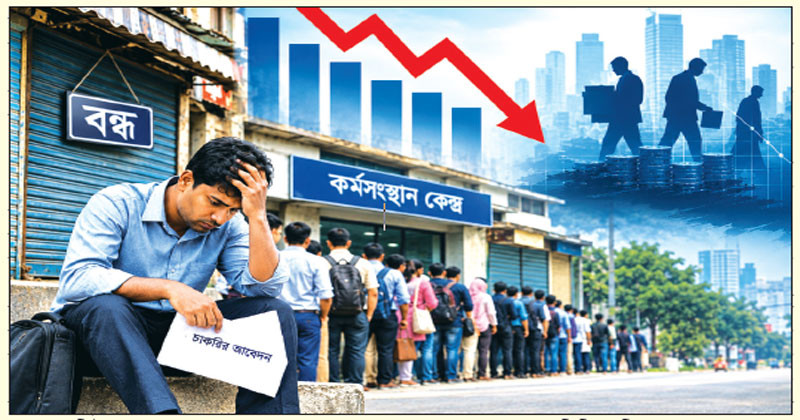
Md. Zahidul Islam, Daily Inqilab
The war that the United States and occupying Israel forced on Iran in the Middle East has pushed up fuel oil prices across the world. The supply chain has broken down. Ships carrying fuel face uncertainty in the restless Strait of Hormuz. As a result, fuel oil prices have gone up worldwide, and high inflation has hit the whole world. Buyers are now cutting their spending.
Because of this, the garment industry, the country’s biggest export sector, has stumbled. Other industries also feel the effect. Orders have fallen, raw material prices have gone up, workers are demanding higher wages, and fuel and electricity prices have risen. Factories do not get the expected prices for export goods, and consumer demand has dropped in the home market, so sales have fallen.
Industrial units have cut their production. At least 50 factories have closed this year alone, and in some places owners are cutting costs by laying off workers. These facts come from analysing data and talking to people in the sector.
The latest layoffs took place at four garment factories of Kea Group in Konabari, Gazipur city. The units are the Knit Composite Division, the Spinning Division, the Cotton Division and Kea Yarn Mills Limited. In September, the group laid off more than 600 workers and staff from these factories in the first round. Earlier this week, it laid off another 739 workers and staff. In the two rounds together, the number of laid off workers has passed 1,300.
A notice signed by the managing director and the chairman gives the reasons. It says normal production at the factories has suffered because of banking problems that have continued for a long time. It also says the gas connection has been cut because the factories could not pay gas bills on time. The factories also have more manpower than they need, so they have cut some posts in various departments and sections to reduce production and administrative costs.
Data from the Industrial Police, BGMEA and BKMEA show that 457 industrial units closed for good in the seven main industrial areas of the country between August 2024 and June this year. Of these, 108 were BGMEA member factories, 35 were BKMEA member factories, eight were BTMA member factories and 19 were linked to BEPZA. The other 287 were from sectors outside garments. In the first six months of this year, at least 80 factories sacked or laid off about 19,188 workers, and 27 of those factories shut down. People in the sector say the number of laid off workers will pass 30,000 in the first nine months of the year. Many small businesses have also closed, but there are no exact figures.
Mr. Mohammad Hatem, president of the knitwear owners’ body BKMEA, told Inqilab that about 450 factories have closed in the last three years. He said at least 45 to 50 factories have closed since January this year. “The government is raising wages on one side, but many factories cannot pay wages even under the present structure,” he said. He added that some factories are closing, and in other places workers are being laid off even before the wage increase.
Mr. Hatem said they have told the Labour Minister that, whatever the wage increase is, time should be given to apply it for two reasons. First, owners could bargain with buyers over the new wages. Second, factories that cannot adjust wages could decide whether to keep running or to close.
Buyers are cutting their shopping because inflation has risen worldwide due to the Iran war. This has naturally reduced the export of goods made in the country. The International Monetary Fund (IMF) forecasts that global average inflation could rise to 4.70 percent this year, 2026. The IMF also forecasts that inflation in Bangladesh could rise to 10.90 percent in the 2026-27 fiscal year.
Mr. Faruque Hassan, former president of the garment makers’ body BGMEA and managing director of Giant Group, told Inqilab that inflation has risen worldwide because of the war. He said demand for garments has also fallen. Because orders have dropped, their costs have gone up. Prices of goods, raw materials, fuel and electricity have also risen at home. He said they have to take orders at low prices to hold on to the market, and it is hard to compete.
Speaking on price control and extortion, Mr. Hassan said party extortion on buses and trucks everywhere pushes up the prices of goods. He said that if the government can control prices and inflation and look after house rent in worker areas, workers will not demand higher wages. He said workers already get a nine percent increment every year. If the increase goes higher, more factories may close. He said the government must deal with these issues firmly.
Exports are also suffering because factories are not getting the Bangladesh Bank package loan and because the NBR is not cooperating. Data from the Export Promotion Bureau (EPB) show that the country earned $13.09 billion from exports in July to September, the first quarter of the current fiscal year. In the same period of the last fiscal year, export earnings were $12.31 billion. That means export growth is 6.34 percent. When exports move at a normal pace, growth should usually be higher.
Bangladesh Bank had announced a stimulus package of Tk 60,000 crore to restart closed factories, boost agriculture and the rural economy, develop the CMSME sector and create jobs. Data show that Tk 11,959 crore 82 lakh of the announced Tk 60,000 crore has been paid out so far. Applications worth Tk 2,558 crore 97 lakh are still being processed. People in the sector say loan payments are moving slowly because of the fuel crisis, problems in importing raw materials and the condition of the banking sector.
The owner of a garment factory in Gazipur, which employs nearly 4,000 workers, spoke to Inqilab on condition of anonymity. He said costs have already risen a lot because electricity and oil prices went up, and costs keep rising in different ways. Buyers do not pay prices that match the costs. He said the government announced package loans, but they are not available. He said he got an order worth $4.5 million but could export goods worth only $1.2 million. Goods worth the remaining $3.3 million are stuck at the port because customs and depot authorities are not cooperating. He said that if this goes on, he will have to close his factory too.
Slow business, lower buying power due to high inflation and job losses have also cut demand for daily and consumer goods in the home market. Every sector, from real estate to technology products, has fallen into a slump. Industrial units have cut production because demand has dropped. Overall sales have fallen to half.
A top official of one of the country’s leading industrial groups, which runs businesses in steel, cement, food, tea and dairy, spoke to Inqilab on condition of anonymity. He said there have been no layoffs in their group so far, but business is in bad shape. He said sales dropped as soon as fuel prices went up. Production used to run for 12 hours, and now it runs for six hours. He said it is a very hard time for business.
Investment and sales in the real estate sector have fallen because of the political change, the sky high cost of construction materials and the cancellation in the new budget of the chance to invest undisclosed income. Mr. Shihab Ahmed, chief marketing officer of Shanta Group, told Inqilab that business is just fair. He said people cannot make up their minds because of the overall political situation. They are wondering whether to invest or not, and they are now taking their time to decide after weighing everything.
The war in the Middle East has also slowed business in the country’s technology sector. Prices of all kinds of products have gone up, from computer and laptop CPUs, GPUs and memory chips to smartphones, tablets and routers. So sales have dropped to half.
Mr. Zahirul Islam, managing director of Smart Technologies, told Inqilab that the price of semiconductor chips has almost doubled across the world. So the price of memory has gone up compared with before. The rise in the international market has also pushed up computer prices. He said sales have fallen a lot, and the crisis may last into next year. But he said the government made business friendly tax policies, so the full effect of the price rise has not been felt.
The country has more than 7.8 million small, medium and cottage industry units, and 5.5 million of them are in rural areas. More than 20 million people are involved in these units, directly and indirectly. Data from the SME Foundation show that these sectors contribute 32 percent of GDP. But many small entrepreneurs have closed their businesses because of various crises.
Mr. Nazim Hasan Sattar, managing director of the SME Foundation, told Inqilab that business costs have gone up a lot because gas and electricity prices have risen. For this reason, many small entrepreneurs have closed their businesses. He said various trade bodies have reported business closures. For example, the association of plastic businesses in Lalbagh says many of its member businesses have closed. He said many other organisations are saying the same. But he could not give exact figures on how many businesses have closed.
This rhythmless economic situation has also hit the country’s revenue earnings. So the government has to take more loans. Data from the National Board of Revenue (NBR) show that the revenue shortfall in the first two months of the current fiscal year is Tk 29,000 crore. In the last fiscal year, 2025-26, the revenue target was Tk 5.03 lakh crore. At the end of that year, the shortfall was nearly Tk 88,000 crore. The revenue target for the current fiscal year is Tk 6.04 lakh crore.
Imports have fallen, there is a dollar crisis, and rules for opening LCs are tight. The private sector is in a slump, and sales in every sector have dropped by 30 to 40 percent, from real estate, rod and cement to shopping malls and food items. When business is not good, revenue collection falls. As a result, the government has to lean more on bank loans to meet its spending. Bangladesh Bank data show that private sector credit growth is now 4.47 percent. Even during Covid, private sector credit growth stayed above 7.5 percent.
Banks hold plenty of money, but entrepreneurs show no interest in taking loans. Data for August this year show that idle or surplus liquidity in banks has passed Tk 4.41 lakh crore, or Tk 4,41,954 crore. Because entrepreneurs do not take loans, banks are investing their idle money in government treasury bills and bonds.
People in the sector say entrepreneurs do not want to take risks on new investment because of the overall economic and political uncertainty. An uncertain supply of fuel, gas and electricity disrupts production in factories. Because the total cost of production has gone up, businesspeople are discouraged from setting up new industries or expanding old ones. Efforts are under way in some cases to cut interest rates or keep them under control. But banks are also extra careful about giving new loans because of high defaulted loans and security concerns. So money lies idle in banks, and the government is taking that idle money.
Speaking on the overall situation, Dr. Zahid Hussain, former lead economist at the World Bank’s Dhaka office, told Inqilab that the government’s aim is to widen the field of jobs in the economy. For this, he said, the government must ensure the environment that business expansion needs. Creating a better investment climate, keeping gas and electricity supply steady, making business friendly policies, a favourable banking and tax system and better law and order are the government’s job. Even then, jobs will be created in some cases and businesses will close in others. He said these are part of the ongoing process of the economy.
Dr. Hussain said that when business does not make a profit because of international issues, the government can do little. But he said the government has a duty to see whether the workers who lost their jobs have received their dues under the labour law.