Japan Grants Duty-Free Access to 7,379 Bangladeshi Products
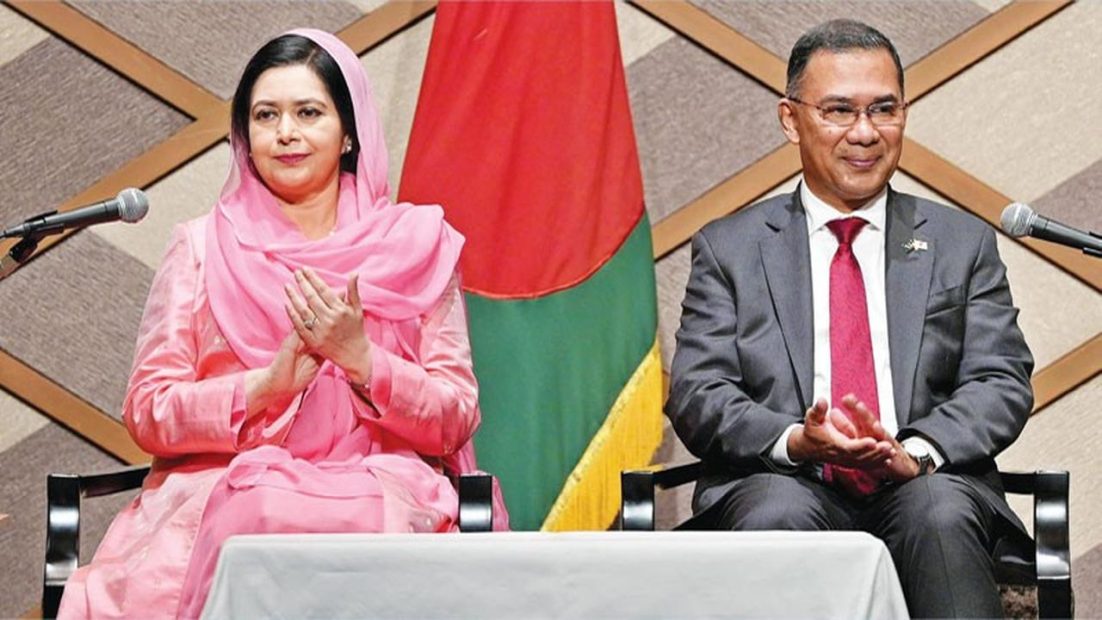
Prime Minister Tarique Rahman has called for elevating Bangladesh-Japan relations beyond their long-standing development partnership to a new level of economic and trade cooperation over the next 30 to 50 years. Presenting a major plan to transform Bangladesh into a global manufacturing hub, he urged Japanese entrepreneurs to make large-scale investments in the country.
The Prime Minister made the call on Wednesday during a series of high-level meetings in Tokyo, a keynote address at an economic forum and an exchange of views with expatriate Bangladeshis. Alongside announcing that 7,379 Bangladeshi products would receive duty-free access to the Japanese market under the newly signed Economic Partnership Agreement (EPA), he proposed Japanese investment in sectors including energy, high-speed rail, artificial intelligence and space research.
During the day, he held separate meetings with Japan’s Minister of Economy, Trade and Industry, the president of the Japan External Trade Organization (JETRO), the governor of the Japan Bank for International Cooperation (JBIC) and senior executives of global clothing brand Uniqlo.
Bangladesh on the Path to a $1 Trillion Economy
Addressing the Bangladesh-Japan Economic Forum Dialogue at JETRO Hall in Tokyo, Prime Minister Tarique Rahman highlighted Bangladesh’s demographic advantage and investment potential. The forum was attended by leading business representatives from both countries, including JETRO President Susumu Kataoka.
The Prime Minister said Bangladesh had a large domestic market of more than 180 million people, with an average age of just 27. Between 40,000 and 50,000 students graduate in engineering each year. He said the growth of the country’s increasingly affluent middle class could make Bangladesh the world’s ninth-largest consumer economy by 2030. The country’s annual gross domestic product (GDP) is expected to exceed $1 trillion by 2034.
The address followed a bilateral summit between the prime ministers of Bangladesh and Japan on Tuesday, which both sides described as productive.
Duty-Free Access Under the EPA
Highlighting the Economic Partnership Agreement signed between Bangladesh and Japan this year, Tarique Rahman said it was the first agreement of its kind signed by Bangladesh with any country. Under the agreement, 7,379 Bangladeshi products will receive duty-free access to the Japanese market. Japanese products, including steel, automobile parts and electronic goods, will also receive preferential market access in Bangladesh.
He said updated and simplified regulations covering investment, services and customs procedures would benefit investors in both countries
Steps to Address Investors’ Concerns
“I fully understand that business requires certainty and investors need confidence. Our job is to create the right environment to ensure both,” the Prime Minister said. He identified three major concerns raised by Japanese companies: uninterrupted energy supply, efficient infrastructure, and predictable customs clearance and tax systems.
He said the government had already addressed some of these issues and was working continuously to resolve the remaining challenges as quickly as possible. The government would provide all necessary support for Japanese automobile manufacturers, major retailers and agricultural machinery producers seeking to establish factories in the Japanese Economic Zone in Araihazar, Narayanganj, he assured investors.
Investment Opportunities in Three Key Sectors
The Prime Minister invited Japanese companies to invest in three major areas.
1. Energy
Calling energy security essential to Bangladesh’s future, he invited Japanese companies to participate in energy infrastructure development, efficient power generation and renewable energy projects.
2. Technology and space research
He said Bangladesh planned to establish an innovation-focused Bangladesh-Japan Technology Park with the participation of Japanese companies, universities and investors. The park would focus on artificial intelligence (AI), cloud computing, robotics and electronics manufacturing. Bangladesh also wants to work with Japan in space technology, drawing on its advanced capabilities in space science, technology and satellite engineering.
3. Elevated roads and high-speed rail
The Prime Minister outlined plans for a nationwide elevated road network and high-speed railway system connecting six major divisional cities. He sought Japan’s support in preparing the master plan and arranging investment and financing for these major projects.
Priority for Japanese Language Education
Emphasising the close people-to-people ties between the two countries, Tarique Rahman said the government was launching initiatives to teach Japanese to students in Bangladesh as one of its priorities. He expressed hope that hundreds of thousands of young Bangladeshis would learn Japanese in the future, further strengthening relations between the two countries.
Expressing gratitude for Japan’s early recognition of Bangladesh after independence in 1971 and its longstanding support, the Prime Minister said, “When we were building our foundation, Japan stood beside Bangladesh. Now I invite you to help us build our industries, create new opportunities and move forward together.”
He began his speech with “Konnichiwa” (good afternoon) in Japanese and ended it with “Arigato gozaimasu” (thank you).
PM Urges Expatriates to Act as Ambassadors for Bangladesh
Prime Minister Tarique Rahman urged every expatriate Bangladeshi to act as an ambassador for the country and contribute to national development. He made the call while addressing an exchange of views with expatriate Bangladeshis and business representatives at Hotel New Otani in Tokyo on Wednesday afternoon local time. The event was organised by Bangladesh Community Japan.
Several expatriates shared their views and asked the Prime Minister questions. They welcomed him and other guests with applause upon their arrival. In response, the Prime Minister outlined his government’s plans on Japanese language education, healthcare, children’s development through sports and other activities, business facilitation, reopening closed industrial facilities, investment and employment.
Calling on expatriates to play an active role in national development, reform and attracting international investment, he said, “Each of you is an important representative or ambassador of the country on foreign soil. If you, alongside the government, present Bangladesh’s investment potential and positive aspects to Japanese businesspeople and policymakers, the country and its people will benefit in the long run.”
Four Expected Benefits from Japanese Investment
The Prime Minister said Japanese investors had shown significant interest in Bangladesh following a series of meetings with the Japanese government, senior officials and business leaders. Recalling Japan’s role in Bangladesh’s reconstruction and economic development before and after independence, he said Japanese investors were eager to invest in the country. Bangladesh now needed to strengthen its administrative and economic preparations to bring in the investments quickly.
He identified four major expected benefits:
1. A substantial increase in domestic and foreign investment.
2. The establishment of new industries and factories that would become national assets.
3. Large-scale employment opportunities for young people.
4. A stronger overall economy through increased foreign currency earnings.
Priority Reforms to Improve People’s Lives
Emphasising improvements in living standards, Tarique Rahman said reforms that directly benefit working people and marginalised communities were more urgent than theoretical discussions in air-conditioned rooms. He outlined several priority initiatives.
Education and traffic awareness: The government has introduced a decision to include a new book on road safety and traffic awareness for primary schoolchildren in the upcoming academic year, as part of its efforts to build a modern education system.
Healthcare: He said genuine reform meant ensuring quality healthcare was accessible to ordinary people and making healthcare services easier to obtain. Planting 250 million trees: The government has planned to plant 250 million trees across urban and rural areas over the next five years to reduce air pollution and protect the natural balance.
Canal excavation and groundwater recharge: He said excessive water extraction had caused groundwater levels to fall sharply. The government plans to revive effective initiatives similar to the historic canal excavation programme introduced by Shaheed Ziaur Rahman to replenish groundwater and prevent future water shortages.
Reopening closed factories: More than 500 closed mills and factories have already been reopened to help reduce youth unemployment. The government is also working to reopen 46 major state-owned factories by 2027.
PM Seeks Public Support for Reforms
At the end of his address, the Prime Minister called on people from all political backgrounds to unite beyond their differences. He said there should be no disagreement over ensuring that every child receives a good education and healthcare, has enough food and can breathe clean air. He stressed that support and prayers from expatriate Bangladeshis in Japan and people at home were essential to building a democratic, self-reliant and prosperous Bangladesh.
Commenting on what he described as efforts to create a situation against the government, Tarique Rahman said: “An attempt is being made to create a situation in which the BNP cannot carry out reforms that would benefit the most marginalised people. To all my dear Bangladeshi brothers and sisters, regardless of political affiliation, who are here today or listening to or watching me outside this room, through cameras or online, I want to say just this: if I can carry out these reforms, you and your children will be better off and benefit from them. So, whom will you support if some people are trying to obstruct the government’s work? I am asking for support. I am not asking you to vote. If you believe we are trying to do the right thing, support these initiatives, at least so that we can carry them out.”
The expatriates responded with loud applause. The Prime Minister also criticised social media mockery of Mohammad Tarique Rahman, member secretary of the Amjanata Party, who was part of the delegation. He said, “Here is Am Mr. Tarique. There is so much criticism of him on social media, yet nobody is talking about the country’s many problems.”
The programme was moderated by Abdus Sattar Patowary, a member of the BNP Executive Committee. Those attending included the Prime Minister’s wife, Dr Zubaida Rahman; Finance and Planning Minister Amir Khasru Mahmud Chowdhury; Finance and Planning Adviser Rashed Al Mahmud Titumir; Civil Aviation and Tourism Minister M. Rashiduzzaman Millat; State Minister for Foreign Affairs-1 Humayun Kabir; State Minister for Power, Energy and Mineral Resources Anindya Islam Amit; Special Assistant Dr Shakirul Islam Khan; and Invest Bangladesh Chairman Ashik Chowdhury.
Japan BNP President Reza Mir, General Secretary Emdadul Haque Moni, Vice-President Masum Zakir, business leader Kazi Sarwar Habib (NRB-CIP), Office Secretary Abul Khayer and many other expatriates were also present. Japan BNP presented photographs to the Prime Minister and his wife.
Japanese Economy Minister Expresses Interest in Investment
Japan’s Minister of Economy, Trade and Industry, Ryosei Akazawa, paid a courtesy call on Prime Minister Tarique Rahman in Tokyo on Wednesday. Akazawa described Bangladesh as an attractive destination for investment and said Japan was interested in strengthening relations and increasing investment in the country.
The Prime Minister thanked the Japanese government for its continued support and cooperation in building a developed and prosperous Bangladesh. Both sides agreed to advance areas of cooperation discussed during the summit between the two prime ministers and further strengthen bilateral relations.
They emphasised the importance of using the existing interest among Japanese businesses to attract more investment to Bangladesh. Tarique Rahman said his father, Shaheed President Ziaur Rahman, and his mother, former Prime Minister Khaleda Zia, had each visited Japan twice. He said the development of Bangladesh-Japan relations had continued since their time and that he wanted to carry this legacy forward. The Prime Minister invited Akazawa to visit Bangladesh.
JETRO Meeting Focuses on Export Diversification and Investment
Prime Minister Tarique Rahman met JETRO President Susumu Kataoka at 11:45am local time on Wednesday. Their discussions focused on increasing Japanese investment in Bangladesh, diversifying exports, developing skills and strengthening trade and economic cooperation.
The Prime Minister praised JETRO’s role in expanding Japanese investment in Bangladesh and said new investment opportunities were emerging. Bangladesh sought Japanese investment in advanced manufacturing, information and communications technology (ICT), automobiles, renewable energy and agro-processing in the country’s special economic zones.
He also sought Japan’s support for diversifying Bangladesh’s export products, expressing hope that stronger economic ties would open up new areas of trade and investment. Both sides agreed that the Bangladesh-Japan EPA would play an important role in strengthening trade and investment relations. The Prime Minister also called for Japanese support for skills development programmes and the establishment of Japanese language training centres in Bangladesh. These initiatives, he said, could create employment opportunities in Japan and strengthen the countries’ long-term economic partnership.
Mr. Kataoka said Bangladesh had strong investment potential because of its economic growth and geographical location. He added that initiatives taken by the government under Tarique Rahman’s leadership had already generated interest among Japanese companies. Following the meeting, the Prime Minister attended a luncheon hosted by Mr. Kataoka. They discussed ways to advance mutual cooperation and economic relations, and the Prime Minister invited him to visit Bangladesh at a convenient time.
PM Urges Uniqlo to Expand Investment in Textiles and Apparel
A delegation led by Tadashi Yanai, chairman, president and chief executive officer of Fast Retailing Co. Ltd., the parent company of Uniqlo, met Prime Minister Tarique Rahman at 10:30am local time on Wednesday. The Prime Minister praised Uniqlo’s confidence in Bangladesh and its longstanding business engagement with the country. He invited the company to increase investment in Bangladesh’s readymade garment sector, particularly in man-made fibres, technical textiles and sustainable clothing production.
The discussions also covered technology transfer, skills development, product innovation, advanced manufacturing systems and environmentally friendly production processes. Tarique Rahman said the government was ready to support Uniqlo’s expansion in Bangladesh, including by facilitating access to land, investment approvals and other necessary administrative clearances.
Both sides reiterated the importance of implementing the Bangladesh-Japan EPA. Takeshi Okazaki, director of Fast Retailing, and Yoshihiro Kunii, the company’s group senior executive officer, also attended the meeting.
JBIC Meeting Discusses Opening an Office in Dhaka
Prime Minister Tarique Rahman met Kazuhiko Amakawa, governor of the Japan Bank for International Cooperation (JBIC), at 9:30am local time on Wednesday. They discussed strengthening investment and economic cooperation in Bangladesh’s energy, ICT and infrastructure sectors.
The Prime Minister thanked JBIC for its contributions to Bangladesh’s economic development and its support for investment in various sectors. He said the government was reforming and simplifying regulations to improve the business environment and attract domestic and foreign investment.
He added that his government was committed to developing investment-friendly policies and improving the business climate. According to the Prime Minister, JBIC’s priority projects aligned with the current government’s development priorities.
Tarique Rahman requested that JBIC open an office in Bangladesh. Amakawa said the proposal would be considered seriously.
Bangladesh Delegation at Bilateral Meetings
Bangladesh’s delegation at the separate meetings with Japan’s economy, trade and industry minister, JETRO president, Uniqlo executives and JBIC governor included Finance and Planning Minister Amir Khasru Mahmud Chowdhury; Civil Aviation and Tourism Minister M. Rashiduzzaman Millat; Finance and Planning Adviser Rashed Al Mahmud Titumir; State Minister for Foreign Affairs-1 Humayun Kabir; State Minister for Power, Energy and Mineral Resources Anindya Islam Amit; Invest Bangladesh Chairman Ashik Chowdhury; Bangladesh Bank Governor Md Mostaqur Rahman; Prime Minister’s Special Assistant Dr Shakirul Islam Khan; and Additional Press Secretary to the Prime Minister Atikur Rahman Rumon, along with senior officials from the Prime Minister’s Office.