Safeguarding a Bangladesh-Centred Political and Cultural Narrative and Preserving July Unity Are Imperative
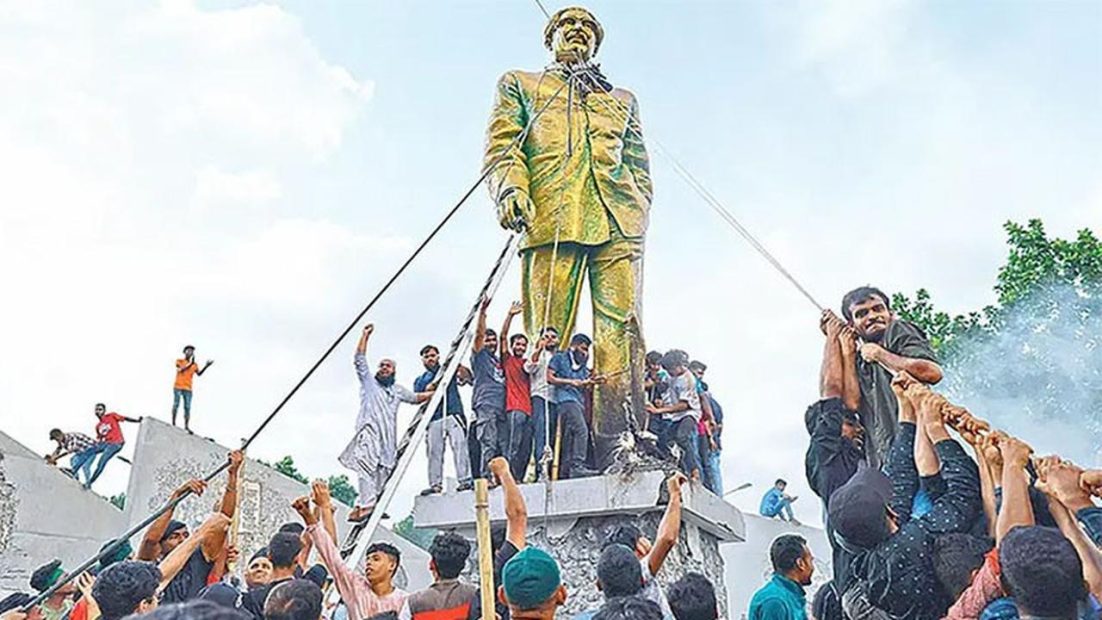
The central spirit of the July uprising is to build a Bangladesh free from Indian dominance. This political narrative was not imposed overnight. It gradually took root among the majority of people through the country’s 54 year post independence political history, imposed cultural practices and declining social and economic conditions.
We have been heavily influenced by Indian hegemonic interests. The country’s political history suggests that Indian involvement played a significant role in the events leading to the 1971 Liberation War. Several writings by Indian politicians, military officials and intelligence figures have reportedly revealed plans to weaken Pakistan by separating Bangladesh from it.
Mr. Kalidas Baidya’s book Bangalir Muktijuddha O Antaraler Sheikh Mujib, published in Kolkata in the 1970s, describes alleged Indian intelligence plans to break up Pakistan. According to the book, Indian Hindu nationalist leaders began working to separate East Bengal from Pakistan after its inclusion in Pakistan in 1947. From 1950, Mr. Kalidas Baidya, Mr. Chittaranjan Sutar and several other Bengali Hindu political figures allegedly conducted intelligence activities in West Bengal and Bangladesh. Mr. Sheikh Mujibur Rahman was their key figure in this process.
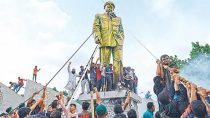
During Mr. Sheikh Hasina’s 16 year rule, presenting Mr. Sheikh Mujibur Rahman as the sole leader of the Liberation War and the greatest Bengali of all time was part of India’s cultural and political hegemony. Questioning his historical role was treated as an act of disloyalty and sedition. Although his statues and murals were demolished after the July uprising, questioning Mr. Rabindranath Tagore’s historical role remains controversial.
Mr. Tagore’s poems, songs, stories and novels enrich our minds and bring us joy. The same is true of the works of Mr. Kazi Nazrul Islam, Mr. Allama Iqbal, Mr. Jibanananda Das, Mr. Tolstoy, Mr. Dostoevsky, Mr. Goethe and Mr. Shakespeare. However, none of them had the same negative connection with our historical political development. None was a landlord accused of oppressing people or stood in the way of the educational and political advancement of Bengali Muslims as Mr. Tagore allegedly did. His opposition to the 1905 partition of Bengal and the establishment of Dhaka University is part of history. If young people question his role, should that be considered blasphemy or sedition?
After the July uprising, attempts by supporters of the ousted regime and alleged Indian agents to discredit the movement as a product of militant extremism failed. The interim government led by Nobel laureate Mr. Muhammad Yunus was not allowed to govern peacefully. Indian media and Hindu nationalist leaders repeatedly labelled him a terrorist and militant. This raises questions about how anyone unwilling to compromise on Indian dominance would have been treated in that position.
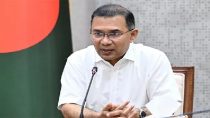
Indian media also tried to discredit Mr. Tarique Rahman even before his return to Bangladesh. Since he became prime minister with an overwhelming electoral mandate, efforts to bring him under the influence of India’s deep state have continued. His choice of China rather than India for his first major foreign visit, despite diplomatic pressure from New Delhi, sent a clear message under the slogan “Bangladesh First”. However, changing the state machinery is essential. One leader’s personal position cannot alone realise the vision of a new Bangladesh.
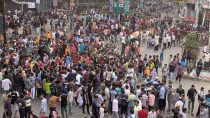
Young people who took to the streets and helped bring down Mr. Sheikh Hasina’s government are now questioning historical figures and narratives. Yet, while trampling on a portrait of Mr. Muhammad Ali Jinnah is not treated as a criminal offence or sedition, defacing a mural of Mr. Tagore, who opposed the establishment of Dhaka University, has led to arrests and sedition cases. Unless the country becomes free from cultural fascism, the return of political fascism cannot be prevented. Protecting independence is more difficult than achieving it. Democratic stability, national unity and social cohesion are essential to safeguarding sovereignty.
India’s Hindu nationalist government celebrates Bangladesh’s Victory Day as its own victory in Delhi. There is little difference between the policies of the BJP and Congress regarding Bangladesh. BJP ministers and MPs have made provocative statements targeting the country. Mr. Rahul Gandhi has supported Mr. Narendra Modi’s Bangladesh policy, while Ms. Priyanka Gandhi has said in Parliament that her grandmother Ms. Indira Gandhi supported Bangladesh’s Liberation War to break up Pakistan. Such remarks should make those who blindly celebrate India’s role in 1971 reconsider their position.
The foundations of India’s alleged long term plans for Bangladesh are becoming increasingly clear. Indian writer and historian Mr. Iqbal Chand Malhotra recently made claims in a podcast interview with Centrist Nation TV. Discussing his book Bangladesh: Humiliation, Carnage, Liberation, Chaos, he said India’s Intelligence Bureau recruited Mr. Sheikh Mujibur Rahman in 1961 as part of a plan to break up Pakistan. He identified the alleged intelligence project as “Operation Steeplechase” and described the Liberation War as part of its implementation. He also referred to “Operation Cactus Lily” as the next phase of the alleged plan.
Mr. Malhotra claimed that after the Indian military operation, a 25 year agreement was signed with Mr. Sheikh Mujibur Rahman on March 19, 1972, effectively turning Bangladesh into a subordinate state. He also alleged that Indian forces took away hundreds of millions of dollars in assets when they returned home, contributing to the famine of 1973 and 1974.
The political turmoil surrounding the 1/11 emergency and the subsequent installation of Mr. Sheikh Hasina’s government are also linked to India’s regional ambitions. It is alleged that $234 billion was siphoned out of Bangladesh during her 15 year rule, with India benefiting from much of it.
Although India’s threats, visa restrictions and trade restrictions following Ms. Hasina’s fall have backfired, its efforts to influence Bangladesh have not stopped. For 15 years, religious culture, madrasa education and Bangladesh oriented Islamic and nationalist politics were allegedly stigmatised through state sponsored media narratives.
Despite attempts to divide Bangladesh oriented political forces during the two year transition after the July uprising, maintaining unity until the election was a major achievement. The BNP’s overwhelming victory and Mr. Tarique Rahman’s assumption of office offered a historic opportunity to take the country beyond its past political constraints.
However, new concerns have emerged nine months after the election. These include Ms. Hasina’s announcement of a December return, attempts by banned Awami League activists to reorganise, renewed activity by armed groups in the hill districts, the alleged “Bongobhumi” project, India’s activities surrounding the Siliguri Corridor, uncertainty over the Teesta project and deep sea port, disagreements over the July Charter, labour unrest and deteriorating law and order. Rising inflation and economic inequality have added to the concerns.
National unity is essential to overcoming these challenges. There are also fears that controversial figures within the government and the BNP may be working against the country’s interests. When the Prime Minister’s political assistant Mr. Rashed Khan, who holds the rank of secretary, publicly tore up a copy of the newspaper Amar Desh, it raised further questions about political unity and cohesion.
If disagreements among the BNP, Jamaat-e-Islami and the National Citizen Party over the July Charter and national unity turn into political agitation, the consequences could be disastrous. There is no alternative to preserving a Bangladesh centred political and cultural narrative and maintaining the unity forged through the July uprising.