Japan’s $6 Billion Plan to Revive Bangladesh’s Economy
Japanese PM Sanae Takaichi and Bangladeshi PM Tarique Rahman have officially announced Tokyo’s commitment of $6 billion in investment over the next five years following a high-level bilateral meeting in Tokyo. The initiative focuses on expanding industrial and port cooperation to transform Bangladesh into a vital regional trade gateway. Speaking at a joint press conference on Tuesday, PM Tarique Rahman stated that the goal is clear: to transform the friendship between the two nations into a powerful driver of economic growth, opportunity, and shared prosperity.
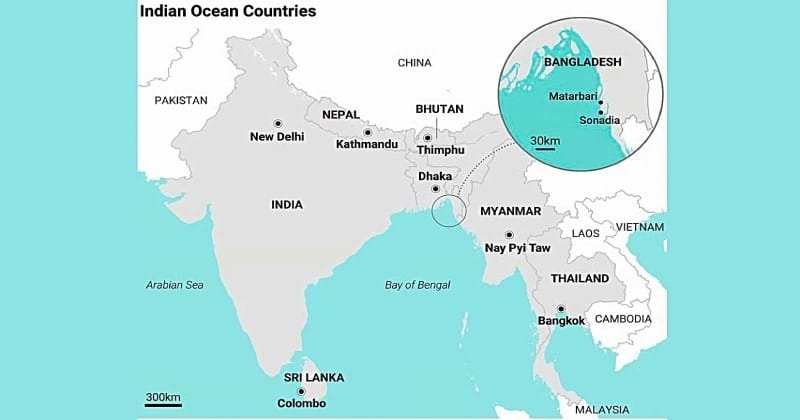
Under an enhanced framework titled ‘BIG-B for Shared Prosperity,’ both nations aim to upgrade the Bay of Bengal Industrial Growth Belt initiative originally adopted in 2014. Centered around the strategic Matarbari Deep Sea Port, this plan aims to enhance maritime access for neighboring landlocked areas, including India’s northeastern states via Tripura. Additionally, formal agreements were exchanged granting $13.4 million to the Bangladesh Coast Guard for new patrol vessels, strengthening maritime surveillance, search, and rescue operations in the Bay of Bengal following the recent elevation of bilateral relations to a Strategic Partnership.
This major financial influx arrives at a critical juncture as Bangladesh grapples with severe energy shortages, industrial distress, and a projected drop in GDP growth to 3.2% for the 2026-27 fiscal year. Analysts view Tokyo’s involvement as a strategic move to help Dhaka reduce its heavy reliance on ready-made garment exports, address persistent economic vulnerabilities, and secure vital infrastructure development. The initiative aims to enhance logistics capabilities while protecting Bangladesh’s overall economic autonomy amid ongoing global energy market disruptions.
Geopolitical experts view the investment plan as aligned with Bangladesh’s ambition to achieve greater strategic autonomy beyond its traditional economic dependencies. Sreeradha Datta, an international relations professor at O.P. Jindal Global University, noted that New Delhi will not perceive Dhaka’s strategy as a threat because India trusts Japan’s regional intentions. She further added that PM Tarique Rahman’s official visit to Tokyo likely sends a stronger signal to China than to India, highlighting Bangladesh’s evolving foreign policy maneuvers.
Conversely, trade experts suggest that China’s established commercial influence in the region will remain resilient despite expanded Japanese funding. Ajay Srivastava, founder of the Global Trade Research Initiative, stated that while Japanese investments lessen Bangladesh’s reliance on a single partner and bolster its overall bargaining position, China remains a critical source for machinery, while India retains a central geographic position in transit. Thus, Dhaka’s strategic diversification balances rather than replaces existing bilateral economic ties.
Maintaining regional stability remains an essential priority for all involved stakeholders as cross-border dynamics continue to evolve rapidly. London-based analyst Priyajit Debsarkar observed that Tokyo might encourage Dhaka to preserve constructive cross-border relationships conducive to regional development. He added that Bangladesh’s best strategy is to clearly present its commercial rationale, such as upgraded ports, manufacturing units, and market access, to attract global investment while successfully retaining its latitude to make independent strategic decisions.