Solving Problems Requires Collaboration Among Industry, Academia, and Government: Mahdi Amin
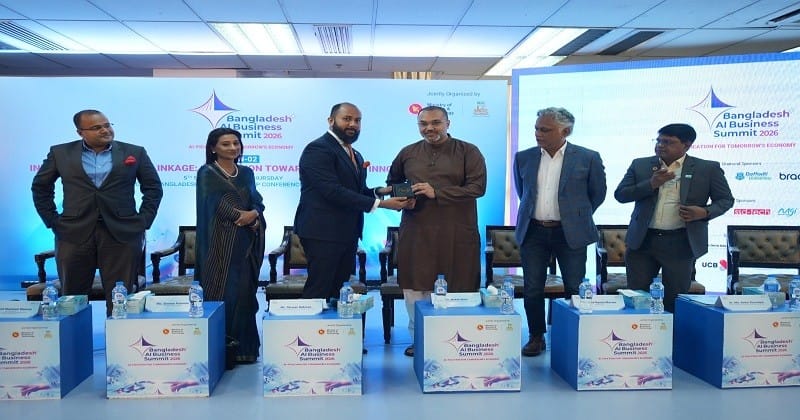
At the Bangladesh AI Business Summit 2026, Mahdi Amin, Adviser to the PM on Education and Primary & Mass Education, emphasized that industry, academia, and the government must coordinate closely to tackle the nation’s real-world challenges effectively. Speaking as the chief guest at a session titled ‘Connecting Industry and Academia: Transforming AI towards Business Innovation,’ he stated that public-private partnerships and joint academic-industrial synergy are vital for modernizing the education system. The event was held at the Bangladesh-China Friendship Conference Center and jointly organized by the Ministry of Science and Technology and the Dhaka Chamber of Commerce & Industry (DCCI).
Mr. Amin noted that the primary goal of any academic research or project should be solving practical problems rather than relying heavily on imports, consultants, and international assistance. He asserted that leveraging local talent can yield indigenous solutions for every domestic challenge. Highlighting ongoing government initiatives, he mentioned that startup funds, grants, and seed capital are being arranged to support innovation within educational institutions and the informal economy. Furthermore, a sustainable national industrial sphere will be established by integrating small and medium enterprises alongside large-scale industries.
Referencing the July mass uprising, the Adviser stated that the newly assumed government’s principal mandate is to ensure equality, human dignity, and social justice beyond political identity. He urged academia and industry to collaborate on local solutions for traffic congestion, agricultural productivity, weather-forecast-based modern farming, and manufacturing output. Emphasizing decentralization, he pointed out that innovative solutions can emerge from talented students and top-ranking universities outside Dhaka, making district-level institutional linkages essential.
Addressing the impact of artificial intelligence and robotics, Mr. Amin acknowledged that technological shifts might displace traditional roles while simultaneously creating new employment domains from data annotation to AI application development. He outlined two fundamental goals of PM Tarique Rahman’s educational framework: nurturing students into ethical citizens with social values, and cultivating professional skills for the modern workplace. He also shared that alternative career pathways through technical education and language training are being created for underperforming students in public examinations.
On the critical issue of brain drain, Amin remarked that the success of Bangladeshi experts abroad demonstrates the country’s abundance of talent, though domestic platforms have historically fallen short. To reverse this trend, the government is initiating measures to convert brain drain into brain circulation by enabling expatriates to invest easily, facilitating joint international research, and building a welcoming domestic environment. He reiterated that youth employment and entrepreneurship remain top priorities during this demographic dividend period, to transform the younger generation into a productive workforce.
The session was moderated by former DCCI President Rizwan Rahman and featured prominent industry and academic leaders. Among the speakers were Simin Rahman, CEO of Transcom Group; Syed Nasim Manzur, Managing Director of Apex Footwear Limited; Prof. Dr. Md. Abdur Razzaque, CSE Chairman at Dhaka University; and Dr. Syed Muntasir Mamun from the Ministry of Foreign Affairs. Student innovators and department heads, including BUET student and Nevolin CEO Md. Rahinur Rahman, IUT student and Ants CEO Towsif Islam, and AIUB CSE Head Prof. Dr. Mohammad Firoz Mridha, also shared valuable insights.
Concluding the event, Mr. Amin called upon citizens to unite in building a transparent, accountable state aligned with youth aspirations. He affirmed that government departments will continue to collaborate on policy reforms and implementation through mutual coordination, mirroring the partnership between the Ministry of Science and Technology and the private sector. The comprehensive discussions underscored a collective national commitment to harnessing artificial intelligence and technological innovation for sustainable business growth and human welfare.