Political Parties Must Unite to Save the Garment Sector
Bangladesh’s Garment Industry Caught in the Grip of Political Crisis
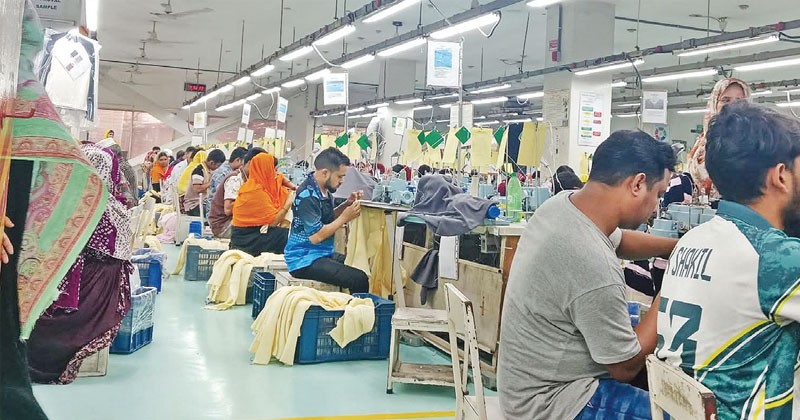
The garment sector is the main export sector of the country. Garment exports bring a huge amount of foreign currency every year. About 4 million people, including 3 million women, work in this sector. Lakhs of other people also earn their living around the garment sector.
The sector must keep running to keep the wheels of the economy moving. It must also protect 4 to 5 million people from unemployment. A lasting solution to the present crisis and unrest in the sector needs a political decision and real political will. Businessmen and economists say political parties must unite to protect the garment industry and keep the workplaces of lakhs of people safe.
To keep the garment industry alive for a long time, political parties, factory owners, labour groups and the government must take a joint and far sighted political decision. Both owners and workers must be protected. Amid the unrest, the government has formed a 6 member “Minimum Wage Board” to fix new wages for garment workers. Prime Minister Mr. Tarique Rahman said yesterday, ‘Considering the wage demands of workers, a wage board has already been formed. The board has started its work. Inshallah, within one or two months the wage board will fix a new minimum wage, so that our brothers and sisters among the workers can live even better than now.’
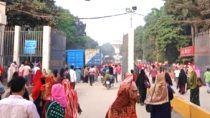
For the last few days, workers demanding higher pay created chaos on the streets. The garment areas of Mirpur in Dhaka, Savar, Ashulia, Gazipur and Narayanganj were made ready to explode. It is an open secret that this chaos was planned to destroy the garment sector and damage the image of Bangladesh abroad.
Intelligence information says some garment owners who follow the banned Awami League ideology, former ministers, state ministers and MPs of the government before the July uprising, and their family members were behind the chaos. Like “ghosts inside mustard seeds”, they worked in secret. They gave money from behind the scene and brought activists of the banned Chhatra League, Sramik League and Jubo League to Dhaka and put them on the streets. A large part of the battery powered rickshaw drivers in Dhaka are leaders and activists of the Awami League, Jubo League, Sramik League and Krishak League who came from villages. They were also sent to the streets under the banner of garment workers.
Some garment owners did not think about the interest of the country. They wanted to create a situation for the return of Ms. Sheikh Hasina in December. So they took attendance of their workers in the morning and then encouraged them to go out on the streets. Intelligence information names these groups: former MP Mr. A K Azad’s Hamim Group, Mr. Salam Murshedy’s Envoy Group, Mr. Faizul Rahman’s Tusuka Group, Mr. Elias Molla’s garments, former minister Mr. Tipu Munshi’s Sipal Group, the Renesa Group of a former state minister, Mr. Nasrul Hamid Bipu’s Hamid Group, Mr. Tajul Islam’s Ferian Group, Mr. Khosru Chowdhury’s NIPA Group, Mr. Zahid Ahmed Tulu’s XCC Knitwear, Mr. A K M Mosharraf Hossain’s Standard Group and Ms. Masuma Khatun Lipa’s Givenchy Group. Workers of these factories were brought to the streets after attendance.
Money was also spread so that police would turn violent and leave dead bodies of garment workers on the streets. The plan was to make ordinary workers angry. There is also an allegation that money was given to some members of the law and order forces who follow the ideology of fascist Hasina. Most garment workers have returned to their workplaces. But there is still a fear that they may return to the movement at any provocation. Unrest was planned in front of garments that have foreign owners, joint ownership of local and foreign owners, or foreign workers.
The government and the ruling party are making many efforts to stop clashes on the streets after days of unrest in the garment sector. Yet the opposition party Jamaat has made mysterious remarks on the garment workers’ movement. Leaders of the NCP, a partner in the Jamaat alliance, have supported the ‘so called workers’ on the streets. Jamaat Ameer Dr. Shafiqur Rahman first spoke in favour of the workers, but later became careful after reading the situation. He urged the government to take a quick decision to ensure the fair dues of garment workers.
He said, ‘The longer this decision takes, the more the industrial sector will suffer. In such a situation, many opportunists try to misuse the chance. The government and everyone involved must show sincerity and care.’ He also said, ‘Garment workers in the country are living a very hard life now. The prices of daily needs, house rent, treatment, education, transport, electricity and gas have kept rising. But workers’ income and living standard have not improved as expected.’
Yesterday, Jamaat Secretary General Mr. Mia Golam Parwar placed a 15 point list of demands for workers at a press conference. He said, ‘It is becoming hard for a worker to meet the basic needs of self and family on a monthly income. Food, housing, treatment, children’s education and social security have become big challenges for them. In this reality, garment workers are protesting with various logical demands, including fixing the minimum monthly wage at Tk 30,000.’
The reality is that the economy of the country is still on the edge of a cliff. Fascist Sheikh Hasina fled after emptying Bangladesh economically. She ruined the banking sector. A foreign debt of about Tk 130,000 now sits on the shoulder of every citizen. The newly elected government has to repay this debt. Foreign investment has not come to the country for a long time.
To bring foreign investment, the interim government of Dr. Muhammad Yunus held an “International Investment Summit” in Dhaka in 2025. Many representatives from more than 50 countries joined the summit and promised to invest Tk 32,000 crore in Bangladesh. It was said that the investment would come once an elected government took power. But not a single taka of that promise has been invested. Instead of new jobs, unemployment has risen sharply. At present, the main sources of the central bank’s reserve are remittance sent by expatriate workers and foreign currency from garment exports. But foreign orders for garments have fallen.
The garment industry in the country began under the hand of Shaheed President Mr. Ziaur Rahman, the declarer of independence and the father of the present Prime Minister Mr. Tarique Rahman. The base of the garment industry and its exports was first built during the rule of Mr. Ziaur Rahman. In 1977, Desh Garments, the first export oriented garment factory of Bangladesh, began business with the South Korean company Daewoo Corporation. A businessman named Mr. Nurul Quader Khan set up that garment factory.
The Ziaur Rahman government took steps to move the garment industry forward. These included back to back L/C facility, bonded warehouse facility and withdrawal of income tax on export earnings. As a result, the garment industry began to grow in the 1980s. According to World Trade Organization figures, China is now first in garment exports. Vietnam is second. Bangladesh is third now. A few years ago, Bangladesh was next to China.
Many people say vultures have set their eyes on the garment industry. Local and foreign circles destroyed the jute industry of Bangladesh three decades ago. When Adamjee Jute Mills was declared closed, new jute mills were being built in West Bengal of India. Now the same circle is plotting to destroy the garment industry.
Lakhs of women from villages have become self reliant by working in the garment industry. A few years ago, some girls in villages could not marry because of a lack of dowry. They were a burden on their parents and shed tears. Now those girls do not sit at home. They work in garments, stand on their own feet and run their parents’ homes. Some husbands and wives work in garments together and have brought comfort to their families.
If a crisis hits the garment industry now, these families will be left helpless. The votes of these low income people sent the leaders of the government and the opposition to parliament and made them ministers and MPs. So politicians have a big duty to make sure the way of life of these people is not destroyed. Let us look at Hindutva India. Most political parties there oppose the ruling BJP. Mr. Narendra Modi’s BJP and Mr. Rahul Gandhi’s Congress and the India alliance are bitter enemies. Their political ideas and beliefs are very different.
Even so, in a national crisis the government, the opposition and other parties sit together and decide as one. In 1982, after the killing of Muslims in Kashmir, the United Nations accused India of human rights violations. At that time, Prime Minister Ms. Indira Gandhi of the Congress sent Mr. Atal Bihari Vajpayee of the BJP, the Leader of the Opposition in the Lok Sabha, to the UN tribunal in Geneva to fight for the country. In the recent past, Ms. Sheikh Hasina was removed from power in the July uprising, fled and took shelter in Delhi. Mr. Narendra Modi was in a dilemma over keeping ties with neighbour Bangladesh and sheltering Ms. Hasina.
India treated it as a national crisis. All political parties there held a meeting and decided to shelter Ms. Sheikh Hasina. The present government of Bangladesh and political parties, including the opposition Jamaat, should do the same. They should sit together and decide to stop local and foreign plots against the garment sector and make the sector active. Political opposition and protecting state resources or national interest are not the same thing.
The global energy crisis has raised gas and electricity prices in the country, and the price of every product has gone up. Salaries of government employees have already been doubled, and that wave has hit the market. In this situation, the pay a garment worker gets is far too low to live on. So a timely decision to raise garment workers’ pay is a must. The government has already formed a wage board led by former district judge Mr. Sheikh Ashfaqur Rahman.
The other members of the board are Mr. A B M Shamsuddin, a BGMEA director who represents garment owners, and Mr. Asif Ayub, joint secretary general of the Bangladesh Employers Federation. The workers’ representatives are Mr. Anwar Hossain, president of the Bangladesh Jatiyatabadi Sramik Dal, and Mr. Babul Akhter, general secretary of the Bangladesh Garments and Industrial Sramik Federation. The board has already started work. So the garment crisis should not be pushed under the carpet for a while by forming a wage board. What is needed is a political decision by everyone together for a lasting solution.
Intelligence agencies say that after Ms. Sheikh Hasina, a fugitive in India who has been sentenced to death, announced she will return to the country in December, efforts to create chaos in many ways began. The latest attempt is the unrest in the garment sector. Oligarch officials of Hasina working in the administration are trying in many ways to bring Hasina back. They are using the weakness of some responsible ministers and state ministers inside the government and backing the disorder from behind the scene.
Now the country needs unity of all political parties that support the July uprising. They should not fall into division over the garment sector out of greed for party benefits or into the trap of foreign circles. They should protect the interest of owners and workers alike and come to one platform to keep the garment sector alive in the national interest. Without a political decision, a lasting solution to the crisis will not come, however much the wage board raises workers’ pay.