Dengue Breeds Inside Homes as City Mosquito Control Teams, Barred from Private Premises, Can Spray Only Outside and in Drains
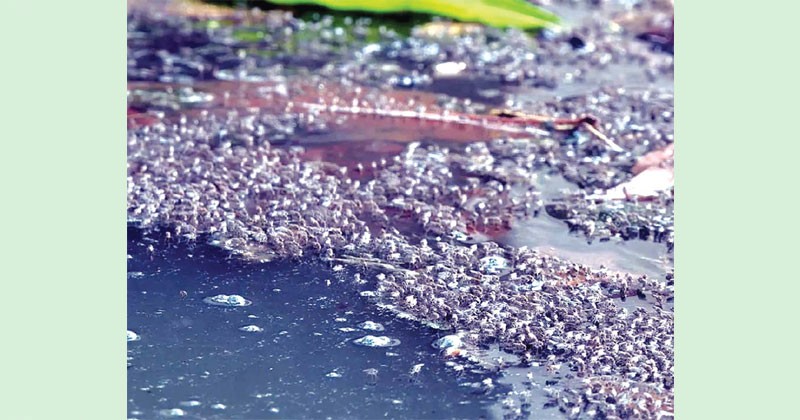
Water standing in homes, offices, educational institutions, buildings under construction and various structures has become a major reason for the spread of dengue in Dhaka. The Aedes mosquito, which spreads dengue, breeds in comparatively clean and standing water. So flower pots, buckets, drums, water tanks, abandoned containers, AC water trays, rooftop garden pots and water reservoirs of buildings under construction are becoming breeding grounds.
In the last 24 hours, 5 more people died of dengue. In the same time, 2,260 people were admitted to hospital with the disease. According to the Directorate General of Health Services, this brings the total dengue deaths this year to 466. Of these, 44 died in the first week of November.
Besides, 174 died in October, 148 in September, 43 in August, 36 in July, 13 in June and 1 in May. Two dengue patients died each in January and February. The number of patients admitted to hospital this year has reached 152,173, and 145,593 have recovered and gone home.
In the last 24 hours, the highest number of patients was admitted in Dhaka division, 1,077. In addition, 265 were admitted in Chattogram, 277 in Khulna, 243 in Barishal, 177 in Rajshahi, 111 in Mymensingh, 83 in Rangpur and 16 in Sylhet division. In 2025 too, more than one lakh people were infected and 413 died.
Experts say building density, unplanned construction and lack of cleanliness in most areas of Dhaka are creating a favourable environment for mosquito breeding. In homes where containers holding water are not cleaned regularly, there is a risk of Aedes larvae growing. In many cases, family members do not even know about it. Water standing in a small container out of sight turns into a breeding ground within a few days.
In houses with rooftop gardens, water standing in plant pots, trays and other containers is not removed regularly. After watering plants, extra water stays under the pots. That water remains. Water also stands in abandoned drums and buckets. Aedes mosquitoes are breeding in these places.
Aedes mosquitoes can lay eggs in water standing in the mouth of plastic bottles, broken containers, abandoned tyres, water drums, buckets, roof drains, water tanks or small holes. Many times, city corporation mosquito control workers conduct drives in various areas. But if they cannot enter private rooftops, water tanks or rooftop gardens, it becomes hard to find and control possible breeding places.
So even when mosquitoes keep breeding inside homes or on roofs, the workers finish by spraying medicine on the roads and drains outside. Many families clean the floor, kitchen and bathroom of their homes. But they do not look at the water standing under flower pots or at buckets left in corners of the roof. Domestic workers and security guards also do not look regularly.
In some buildings, the owner or the management committee does not inspect the roof regularly. Tenants also think that cleaning the roof and water tank is the owner’s duty. In this way, water stays standing in various places.
Recently, a survey of 2,255 houses in 75 wards of Dhaka South City Corporation revealed frightening information. The presence of mosquitoes is alarming in 57 wards. Of these, 29 wards are in the very risky or red zone. As soon as the hotspots were identified, mosquito control workers of the South took to the field. The work of destroying Aedes larvae and spraying medicine started in full swing.
Administrator of Dhaka South City Corporation Bir Muktijoddha Mr. Md. Abdul Salam said that if residents of the homes and buildings where breeding sites were found had been more aware, the effect would surely have come down. He said “we want everyone to do their own duty”. He said “our responsibility in controlling dengue is fifty fifty”. That means the city corporation holds 50 percent of the responsibility and the public holds the other 50 percent.
Dr. Fahmida Khatun, Distinguished Fellow of the Centre for Policy Dialogue (CPD), said public awareness and effective policies must be adopted to face dengue and protect public health. She said the spread, severity and duration of dengue in the country have increased over the last two decades. She said the risk of dengue may rise further in future because of the effects of climate change.
She said government steps are needed for this, and public awareness is also very important. She said uncleanliness, standing water and waterlogging create chances for Aedes mosquitoes to breed. She said it is very urgent to create awareness on public health.
Dr. Mohammad Mushtaq Hossain, former principal scientific officer of IEDCR, said we must build the capacity to solve our own problems. He said communication will succeed only when people get the knowledge, tools and ability to do the needed work on their own initiative. He said it is the duty of experts and authorities to make the public capable. For this, work must be done at the community level as well as through the media.
Dr. Md. Shafiul Alam, senior scientist of icddr,b, said an integrated effort is needed to bring down dengue deaths. He said work must also be done on new and innovative methods to control mosquitoes. He said it is urgent to combine research and new technology with the ongoing activities of city corporations and related institutions. He said everything from disease surveillance to mosquito control, research and treatment must be brought under one integrated system.
Professor Dr. Kabirul Bashar, entomologist and researcher at Jahangirnagar University, said various activities are going on to control dengue but the desired results are not coming. He said one main reason is that proper attention is not being given to the real breeding places of the Aedes mosquito.
He said a significant part of Aedes mosquitoes is born in water standing in homes, water drums, tanks, parking spaces and various containers. He said it is hard for the mosquito control work of city corporations to reach these places. So, along with city corporations, the public must also take responsibility. He said it is urgent not to let water stand in homes and yards, and to destroy breeding places in educational institutions and other structures. He said targeted action must be taken after finding where mosquitoes are breeding.