RMG Sector: Buyers’ Demands Drive Up Costs, Yet Prices Remain Unchanged
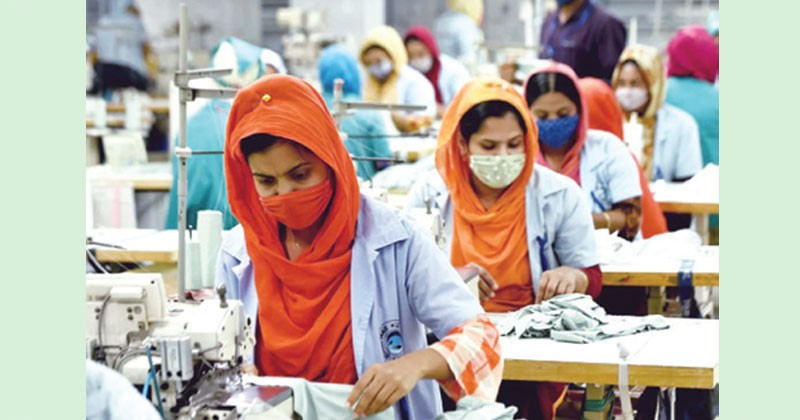
The global garment market is worth 1,200 billion dollars. Although Bangladesh has built a strong position in this sector, it gets lower prices for its garments than competing countries. It cannot make high end garments. It faces extra costs to meet various conditions of buyers. Garment owners have built environment friendly factories even though they are costly.
The construction cost of such a factory is 20 to 30 percent higher than a normal factory. The extra money mainly goes to energy saving building design, water recycling systems, better waste management, modern ventilation and the use of renewable energy. But even after this huge investment, garment owners do not get extra prices.
There are also limits in product variety, weak infrastructure, lack of necessary materials, a shortage of quality designers, very long lead times and political instability. Because of these, the brand value of Made in Bangladesh has fallen in the world market compared with Vietnam or India.
Recently, the banned party Awami League has pushed workers onto the streets to carry out its political agenda. The government has behaved softly in view of the reasonable demands of workers. Shipping costs, oil and gas prices and production costs have risen because of the Middle East war. Yet foreign buyers have not raised garment prices. On the contrary, various organisations have expressed concern and sent messages.
Economists and people in the sector say cutting business costs and improving political stability and law and order is an important issue for keeping global competitiveness. Orders have fallen as demand dropped because of global inflation caused by the Middle East war. But because of competition at home, garment owners are forced to give products to buyers at low prices.
In the European Union (EU), the unit price of garments exported from Bangladesh is less than half that of Vietnam. According to Eurostat data, in the first six months of 2026 the average unit price of garments exported from Bangladesh fell 8.47 percent from the same period last year. It stood at 13.80 euros per kg. In the same period, the average unit price of Vietnam’s garments rose 11.75 percent to 29 euros per kg. The price of China’s garments fell by a small 2.18 percent.
Among the main garment suppliers to the EU, Bangladesh’s unit price is the second lowest compared with China, Vietnam, India and Cambodia. Only Pakistan’s garment unit price is lower than Bangladesh’s.
International garment retailers and brands press for buying at low prices. Their argument is that wages in Bangladesh are low, productivity is comparatively low, factories have compliance gaps and most garments here are of the basic or low value category.
Mr. Anwar Ul Alam Chowdhury, chairman of Evince Group, one of the top garment companies, and president of the Bangladesh Chamber of Industries (BCI), said Vietnam exports high value garments while Bangladesh exports low value products. So the price in the hyper market will be one thing, and the price range for medium, upper medium and top products is different. He said Bangladesh cannot make all products, but Vietnam can.
He said Bangladesh has many limits in product variety. The infrastructure needed for it does not exist. All types of materials are not available in Bangladesh. Everything, starting from designers, is very weak in the country. He said the reason behind Vietnam’s progress is China. Its partnership with China and all product development happening there make it hard for Bangladesh.
He also said Bangladesh’s lead time is very long. It takes 10 to 12 days to go from Vietnam to Europe and America, but about 28 days from Bangladesh. Getting or not getting a price depends on all these things.
Mr. Anwar Ul Alam Chowdhury said the country brand value of Made in Bangladesh is much lower than that of Vietnam or India. He said India will also move ahead as everything from infrastructure is developing there. India works more on the upper market. It has infrastructure to make small quantities, which Bangladesh does not have. He said that in the last four years a message has gone abroad that Bangladesh is not stable. He said trouble will happen in this sector every year, and this has a negative effect on buyers.
On the various conditions of foreign buyers, he said all buyers want to buy from good factories. He said the biggest problem in Bangladesh is that factories have to be of “A” grade. He said nationalism is very strong in India and they do not bring their weaknesses forward. On the other hand, he said, “we want to find who has how many faults”. He said the mindset is very negative.
He said in RSC audits it is the Bengali boys who never call any factory perfect and try to find faults in many ways. For this reason, buyers have to be convinced in different ways. In China, he said, garments run in the day and pigs are raised at night, but these things never come forward.
According to International Labour Organization (ILO) data, the minimum wage of garment workers in China is 482 dollars. In Vietnam it is 180 to 250 dollars depending on the region. In Indonesia it is 145 to 253 dollars by regional rate, and in Cambodia it is 192 dollars. In India the minimum wage is 90 dollars to more than 200 dollars. In Pakistan it is between 92 and 128 dollars. In Bangladesh, the minimum wage of Tk 12,500 set in 2023 equals only 75 to 115 dollars at the exchange rate.
Mr. Fazle Shameem Ehsan, managing director of Fatullah Apparels Limited, said the country’s image is being harmed by worker unrest. He said the effect may not be felt at once but orders may fall in the long term. He said the country’s image is being spoiled. In future, he said, buyers will see Bangladesh as a riskier country. The higher the risk level of a country, the lower the price it gets for products.
He said buyers do not want to give good value or higher profit products. They want to give short term orders. He said “we are slowly moving away from that place”. He also said buyers do not decide orders like going from one shop to another. They set long term business strategy. After such events, he said, they will consider Bangladesh’s risk and decide future strategy. So orders may fall slowly.
To register a factory with foreign buyers, a certificate from bodies like RSC or Nirapon is needed. A businessman complained that when they apply to these bodies for a certificate, they do not get time. He said when they are called, they say there is no schedule. Even after months, no schedule is found. Then, when they come for an audit, they find different faults and waste time. For this reason businessmen want a unified compliance. He said it has become hard to do business this way.
Because of buyers’ expectations, garment owners built environment friendly factories even though they are costly. Their construction cost is 20 to 30 percent higher than a normal factory. The extra money mainly goes to energy saving building design, water recycling, better waste management, modern ventilation and renewable energy. But even after this huge investment, garment owners do not get extra prices.
Mr. Shovon Islam, managing director of Sparrow Group, said LEED has now become more a marketing strategy than a commercial benefit. He said buyers are not ready to pay even a paisa more just because a factory is LEED certified. He said we ourselves have given LEED certificates much more commercial importance than international buyers do.
Dr. Fahmida Khatun, Distinguished Fellow of the Centre for Policy Dialogue (CPD), said our competitiveness is a very important issue. She said our productivity is lower than Vietnam or Cambodia. Our main strength in the international market is low cost production, including labour cost. She said political stability is very important for foreign buyers or investors. If instability goes on without a break, there may be problems in delivering orders on time.
She said that recently exports have fallen in the United States market for all countries, not only Bangladesh. This happened because of the current economic situation, as consumer demand fell due to the Middle East crisis. But she said there is no room for complacency. She said we must keep competing regularly. Cutting business costs and improving political stability and law and order will become an important issue.
She also said we are entering a low price race. She said that although costs have risen in many areas from fuel onwards over the last few years, buyers have not raised prices. Competition among ourselves is growing. If one gives a price to get an order, another cuts it a little more.
Apart from these, the efforts of regional competitors to secure preferential market access have made the situation more complex. While Bangladesh is struggling to hold its position in the European market, competing countries are moving ahead to win duty free trade facilities. Vietnam’s agreement with the European Union and the talks between India and the EU on an agreement may also affect trade.
Those concerned think that if Bangladesh cannot sign an FTA with the EU or fails to secure GSP Plus quickly, its exporters may have to pay 12.50 percent duty after graduating from the LDC list in 2029. By then India and Vietnam may enjoy duty free trade facilities.