Victims Demand Swift River Dredging to Counter India’s Water Aggression
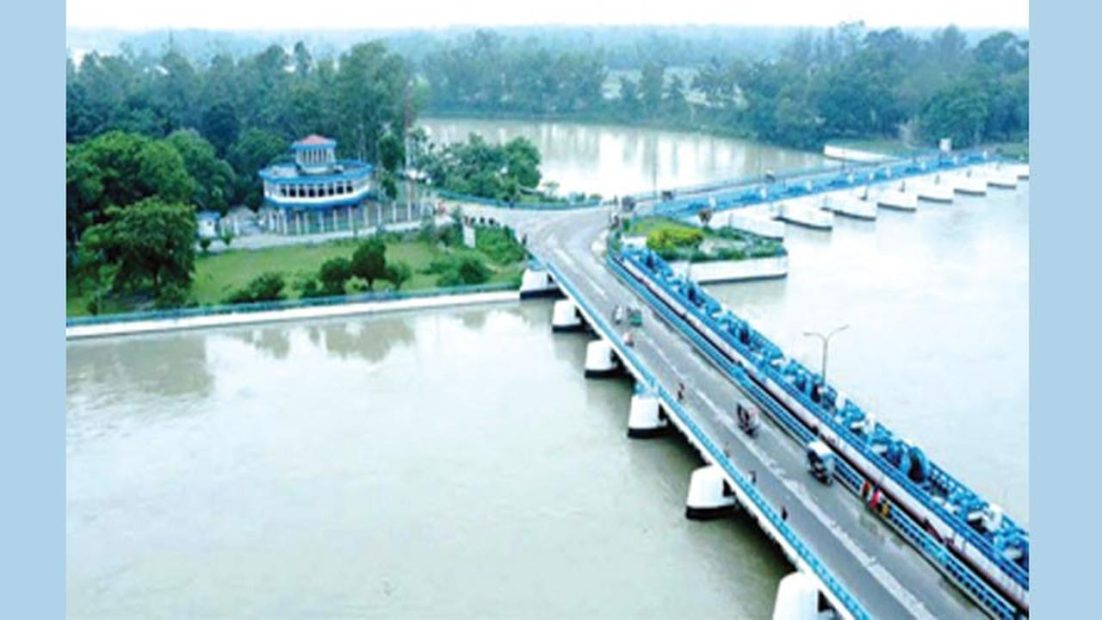
When I reached the Teesta Barrage in Dalia, it was already afternoon, and the sun was moving westward. The vast sandbanks were burning under the intense Kartik sun. Just a few yards from the barrage, Ishaq Ali was sitting by the river, fishing with a rod. Several others were fishing nearby.
As I stood watching, Ishaq Ali broke the silence and asked, “Sir, have you come to see the barrage? Why are you standing in the sun? Go and sit under the shade of a tree.” When I asked whether he was catching any fish, he replied with disappointment that fish were no longer available as they used to be. When the river had enough water, fish were abundant, and fishing helped families make a living. Now, with fish becoming scarce, people no longer take their nets to the river. However, he had heard that the Teesta Mega Project would be implemented downstream of the barrage, bringing more water and fish back to the river.
Several local residents said that rallies and human chains had also been organised in the area demanding the implementation of the Teesta Mega Project. Despite the scorching heat, I travelled through several areas of the Teesta basin, including Baishpukur, Chhotokhata, Char Kharibari, Kismat Char, Jhar Singheswar and Chhatnai Colony in Dimla upazila of Nilphamari district, as well as Dowani village and nearby river islands in Hatibandha upazila of Lalmonirhat.
Almost everyone I spoke to wanted the Teesta Mega Project to be implemented. Residents along the riverbanks in particular expressed confidence that work on the project, with Chinese financing, would begin soon. Shahidul Islam, a political activist from Dowani, said the BNP had secured votes by promising to implement the Teesta Mega Project. He said people in the area were strongly opposed to India because of what they described as its water aggression.
Residents of Lalmonirhat believe Prime Minister Tarique Rahman will fulfil his election pledge by launching the project. People living in the river basin said they wanted the project to protect themselves from India’s unilateral withdrawal of Teesta water. Some have even taken part in campaigns to boycott Indian products in protest against the diversion of the river’s water.
Almost all the local journalists who accompanied me around the Teesta basin and introduced me to residents expressed the belief that the BNP would implement the mega project and respond to India’s actions. Local people said they remained deprived of government support and facilities. During the monsoon, the Teesta frequently overflows its banks, causing floods and river erosion. Agricultural land and homes are washed away, leaving hundreds of families destitute every year.
The lack of water in the river has also left fishing communities unemployed. Many fishermen are being forced to abandon their traditional profession and take up other work. According to the Rangpur Water Development Board, India has built a barrage at Gajoldoba in West Bengal’s Jalpaiguri district, upstream of Bangladesh, and is diverting Teesta water to the Mahananda River through a connecting canal.
India uses water from this canal for irrigation in Jalpaiguri, Darjeeling, West Dinajpur, North Dinajpur, Malda and Cooch Behar districts. As a result, the flow of the Teesta has become extremely weak around the barrage at Dowani in Bangladesh. Due to the shortage of water, irrigation facilities in agricultural fields across the region have become ineffective during the dry season.
The natural environment is also gradually losing its balance, while groundwater levels in areas along the Teesta continue to fall. People living along the river, who have long been deprived of basic facilities, want the Teesta Mega Project to be implemented as a response to India’s actions. Many believe that implementing the proposed mega project could eliminate the need for a Teesta water-sharing agreement.
Hossain Ali, a resident of Kismat Char near the river, was on his way to visit his son-in-law’s family. I had spoken to him earlier at a small tea and betel leaf shop in Gaddimari, after getting off a CNG-run auto-rickshaw before reaching the Teesta Barrage in Dalia.
He said the lack of water had left vast stretches of the riverbed exposed as barren sandbanks. Life on the river islands is extremely difficult, with poor communication facilities and limited access to basic services. People living in mainland villages are often reluctant to establish family ties with residents of the chars because of these hardships.
However, as his daughter studied in Rangpur, he was able to arrange her marriage into a family living in a relatively developed area. Residents of the chars consider him a fortunate father for this reason. He said, “Sir, if you speak to the people living in villages along the Teesta, you will find that 100 per cent of them want the Teesta Mega Project to be implemented with Chinese financing.”
He acknowledged that the BNP’s organisational strength in Lalmonirhat district was weak. Nevertheless, he said people in the district voted overwhelmingly for the party because of its promise to implement the project.
He added that people living along the Teesta were deeply angered by India’s construction of the Gajoldoba Barrage and the diversion of water from the river.
After the fall of the Awami League government led by Sheikh Hasina, when attempts were made to create disorder in Dhaka, people living on the chars organised processions and human chains protesting against India’s alleged aggression.
The Teesta flows from the barrages built at Dalia in Nilphamari and Dowani in Lalmonirhat in the north, passing through Rangpur and Kurigram before reaching Teestamukh Ghat in Fulchhari upazila of Gaibandha district, where it meets the Brahmaputra, also known as the Jamuna.
This 112-mile stretch of the river has now dried up in many places and is approaching a state of near-death. The 22-kilometre road from Jaldhaka upazila town in Nilphamari to the Teesta Barrage in Dalia was impressive. It looked like a road in a European country. Seeing such a well-maintained road in Bangladesh was a pleasant surprise.
My companion, Mashiu Rahman, a cultural figure from Jaldhaka and a central leader of the Bangladesh Socialist Party (BASAD), had earlier told me that the journey from Jaldhaka town to the barrage would take 40 to 45 minutes. However, my mood changed as soon as I got off the CNG at Gaddimari near the Dalia barrage. The village had such beautiful roads, yet they ended at vast stretches of barren sand.
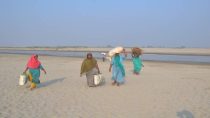
On the northern side of the Teesta Barrage, I saw an enormous expanse of sandbanks. During the dry season, the river dries up and resembles a desert. The once-mighty Teesta, which has sustained generations of people living along its banks, appears to be gradually losing its flow and dying from this point onward.
There was no strong current anywhere in the river. Vast stretches of sandbanks had emerged across its bed. While walking from Kismat Char towards the main road where our CNG was parked, I met Abdul Kader. Until a few months ago, he used to catch and sell fish. However, after the river lost its water, he changed professions and now sells bread at a nearby rural market.
He said dredging the Teesta had become an urgent necessity. “Don’t you see that the entire area is turning into a desert? If you come here in Falgun or Chaitra, you will see that the entire river has dried up. When the river dries up, people face extreme difficulties travelling from one place to another. Even now, pedestrians struggle to walk across the sand,” he said.
As I was speaking with Abdul Kader, several residents of Kismat Char, including Saju Mia, Rafiqul, Hemanta, Robin and Dharani, walked past us. Pointing towards them, Kader said they were all fishermen who had been unemployed for the past three months because the river no longer had enough water to support fishing.
They have been forced to take up other work to survive. Some are travelling to Rangpur, Dinajpur and Dhaka in search of employment.