Potential to Produce Dietary Fibre from Sugar in Fruit Juice
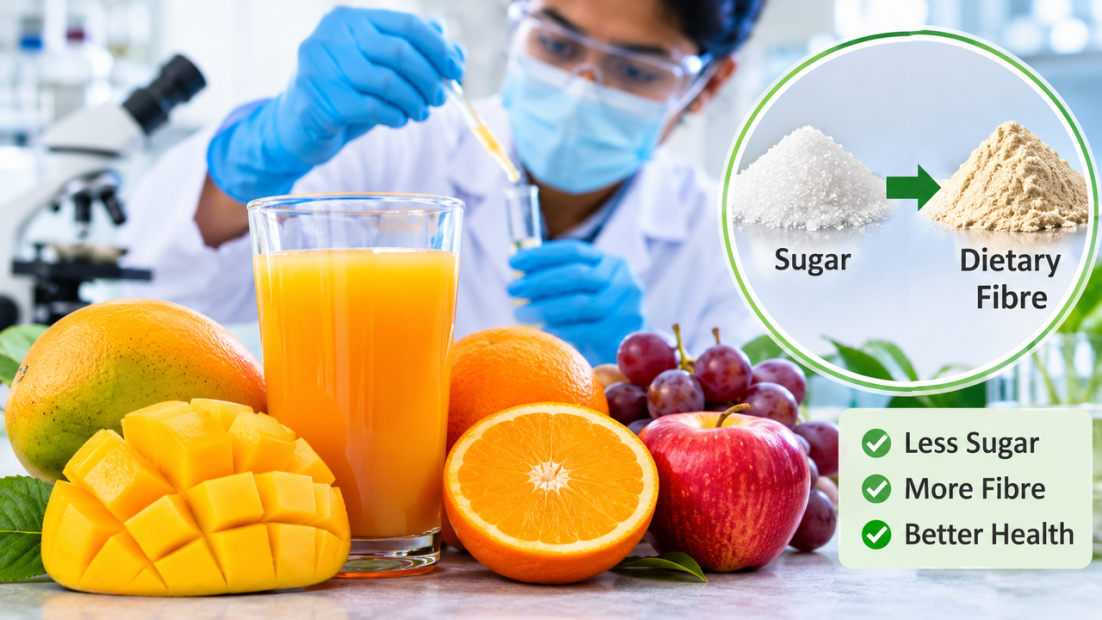
Many people consider fruit juice a healthy drink. But have we ever thought about how much sugar is contained in a glass of fruit juice? What if some of that sugar could be reduced and converted into beneficial dietary fibre? Although it may sound surprising, modern food science is exploring this possibility.
Scientists are working to develop technologies that could reduce sugar content while preserving the natural taste and nutritional value of fruit juice as much as possible. These technologies may also help produce beneficial food ingredients.
Mango, orange, grape, apple, pineapple and pomegranate juices all have different tastes and nutritional properties. Fruit juice mainly contains water, natural sugars, vitamins, minerals, organic acids and various plant-based compounds.
However, 100 per cent fruit juice, fruit nectar and fruit-flavoured drinks are not the same. Pure fruit juice generally contains no added sugar. In contrast, many commercially available fruit drinks may contain added water, sugar and other ingredients.
Most of the content of fruit juice is water, while natural sugar makes up a significant portion of the remaining ingredients. The three main types of sugar found in fruit juice are glucose, fructose and sucrose. Although these names may sound complicated, the concepts are simple. Glucose and fructose are simple sugars, while sucrose is the common table sugar made up of glucose and fructose. The amount of each type of sugar varies depending on the fruit variety and its level of ripeness. For example, grape juice contains relatively high amounts of glucose and fructose, while mango and orange juices contain different proportions of sucrose and other sugars.
Fruit juice provides several essential nutrients. Orange juice contains vitamin C and folate, while mango juice is a source of beta-carotene. Various fruit juices also contain potassium and antioxidants. These nutrients help maintain normal bodily functions. Vitamin C supports the normal functioning of the immune system, potassium helps regulate muscle and nerve functions, and some carotenoids can be converted into vitamin A in the body.
However, fruit juice also has certain limitations. When we eat a whole orange, we consume both its juice and dietary fibre. But when the orange is squeezed and strained, much of its fibre is removed. As a result, fruit juice generally contains less dietary fibre than whole fruit.
At the same time, drinking juice makes it possible to consume a relatively large amount of natural sugar within a short period. This is why nutritionists generally recommend eating whole fruits rather than relying mainly on fruit juice.
An important question arises here: Is natural sugar in fruit harmful? The answer is not necessarily. Our bodies use carbohydrates as a source of energy. However, consuming excessive amounts of sugar over a long period can increase health risks.
The World Health Organization (WHO) considers naturally occurring sugars in fruit juice to be ‘free sugars’. Therefore, even 100 per cent fruit juice should be consumed in moderation. People with diabetes or difficulties controlling blood sugar levels should be particularly careful about how much fruit juice they drink.
Now, imagine a glass of mango juice containing 20 grams of natural sugar. What if scientists could use special technology to convert some of that sugar into substances that are not absorbed by the body as easily as ordinary sugar? This could significantly change the nutritional properties of the drink. This idea has become the basis of research into converting sugars in fruit juice into other beneficial compounds.
The Role of Enzymes in Sugar Conversion
Enzymes play a central role in this research. An enzyme is a biological substance that helps speed up specific chemical reactions. Our bodies also contain enzymes. When we eat rice, digestive enzymes break down its starch into smaller sugars. Enzymes are also widely used in food processing, including cheese production, bread-making and fruit juice clarification.
Scientists are now using specialised enzymes that can convert certain sugars in fruit juice into new types of carbohydrates. Some of these newly formed carbohydrates are not easily digested in the human small intestine. As a result, they can reach the large intestine, where they may serve as food for beneficial gut microorganisms.
Under specific scientific and regulatory conditions, some of these substances may qualify as dietary fibre. Dietary fibre refers to certain carbohydrates that are neither digested nor absorbed in the human small intestine. They can help maintain normal intestinal functions. Some types of fibre are fermented by gut microorganisms, producing beneficial compounds. However, not all dietary fibres function in the same way, and they are not all fermented to the same extent.
Converting Fruit Sugar into Fibre-Like Ingredients
Fructooligosaccharides (FOS) are particularly important in research on producing fibre-based ingredients from fruit sugars. Although the name sounds complicated, the concept is relatively simple. Special enzymes are used to convert ordinary sugars into short chains of carbohydrates. Some of these chains are not easily broken down in the small intestine. Instead, they can serve as food for certain beneficial gut microorganisms.
Such ingredients are often described as prebiotics when there is sufficient scientific evidence of their specific health benefits.
Prebiotics and probiotics are not the same. Probiotics are specific live microorganisms that can provide health benefits when consumed in adequate amounts. Prebiotics, on the other hand, are substances that microorganisms in the body can use to produce health benefits.
Simply put, probiotics are beneficial microorganisms, while prebiotics are selected food sources that help support them. Another important aspect of sugar conversion research is that different types of sugar do not undergo the same transformation. Some technologies can convert sucrose into fibre-based compounds. Other processes can convert glucose into gluconic acid and fructose into sorbitol.
Gluconic acid is an organic acid, while sorbitol is a type of sugar alcohol. Although both have properties different from ordinary sugar, neither is dietary fibre. Therefore, reducing sugar in fruit juice and converting that sugar into dietary fibre are two different processes.
Research on Mango Juice
A study published in 2026 examined the possibility of producing FOS-rich ingredients from overripe mango juice. Researchers used specialised enzymes to convert sucrose in mango juice into new types of carbohydrates. In some experiments, additional sucrose was added to increase production.
The study demonstrated the potential for producing valuable food ingredients from overripe but safe mangoes.
However, success in laboratory experiments does not mean that the technology has already become commercially established for all types of mango juice.
Opportunities for Bangladesh
This research is particularly important for Bangladesh. The country produces large quantities of mangoes, pineapples, guavas, jackfruits and other fruits every year.
During peak fruit seasons, increased market supply often prevents farmers from receiving fair prices. Some fruits also go to waste because of limitations in transportation, storage and marketing.
Fruits that remain safe for consumption could potentially be processed into new food ingredients using advanced technologies.
For example, a mango processing company in Rajshahi may produce several tonnes of mango juice every day. Under conventional methods, the juice is used to make drinks, nectar, puree and other food products.
In the future, if suitable enzyme technology can convert some of the sugar in this juice into dietary fibre-based ingredients, it may create opportunities to produce new types of low-sugar beverages.
However, this would require laboratory testing, pilot-scale production, food safety assessments and economic feasibility studies.
Another potential benefit of this technology is reducing fruit waste. Safe but overripe fruits that are no longer suitable for sale in fresh markets could be processed to produce valuable ingredients.
Nevertheless, several challenges remain.
First, the sugar content varies from one type of fruit juice to another. Second, each enzyme works best under specific conditions. Third, reducing sugar content may change the natural taste of fruit juice.
Despite these challenges, the technology offers an interesting opportunity to develop healthier food products, reduce fruit waste and add value to Bangladesh’s agricultural resources.
The writer is a food scientist and food technologist.