Trump, Putin, and Xi Seen Together at APEC Summit Ahead of Today’s Historic Trilateral Meeting
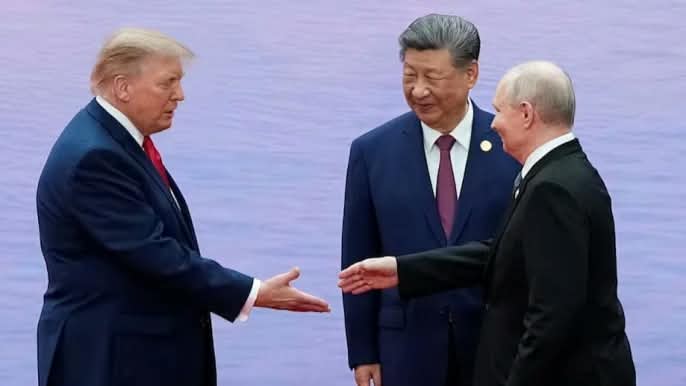
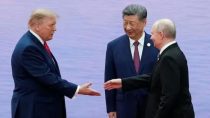
The Chinese city of Shenzhen has become the focal point of global diplomacy as U.S. President Donald Trump, Russian President Vladimir Putin, and Chinese President Xi Jinping appeared together in the same frame for the first time in history. Ahead of a formal trilateral summit scheduled for Thursday, November 19, the three leaders crossed paths on the red carpet before the Asia-Pacific Economic Cooperation (APEC) gala dinner on Wednesday evening. According to video footage released by the Kremlin press pool, Mr. Trump was standing alongside Xi Jinping and China’s First Lady when Mr. Putin approached them. This encounter marked the first face-to-face meeting between Mr. Trump and Mr. Putin since their bilateral summit in Alaska in August 2025, with both leaders shaking hands and placing their hands on each other’s shoulders in a visible display of cordiality.
Analysts cited in the reporting describe this first direct trilateral engagement among the leaders of the United States, Russia, and China as a pivotal moment in contemporary geopolitics. The formal summit in Shenzhen is expected to focus on critical global issues, including international trade, global peace, and resolving ongoing geopolitical crises. Mr. Trump has long expressed interest in negotiating a major agreement among the world’s three largest nuclear powers, an ambition dating back to his first presidential term. Adding further intrigue to the high-stakes gathering, Mr. Trump hinted at potential surprises during his whirlwind visit, noting that North Korean leader Kim Jong Un might appear, marking their first encounter since Mr. Trump returned to office for his second term. SpaceX and Tesla chief Elon Musk is also slated to attend several events during the trip, though his exact official capacity remains unspecified.
Before the red-carpet encounter, President Xi Jinping broke long-standing diplomatic protocol by personally welcoming President Trump at Shenzhen Bao’an International Airport. Immediately after Mr. Trump stepped off Air Force One on Wednesday, Mr. Xi appeared on the tarmac to greet him with a handshake and an embrace. Such airport appearances by the Chinese leader are exceptionally rare; during Trump’s visit to Beijing last May, Mr. Xi dispatched the Vice President, and earlier on Wednesday, he sent a lower-ranking official to greet Mr. Putin. Observers view Xi’s personal reception as a direct reciprocal gesture for the rare honor Mr. Trump extended to him at Joint Base Andrews near Washington last September, which was the first time a U.S. president had accorded such a welcome to a foreign leader since 1962.
Earlier on Wednesday morning, Beijing rolled out a separate, high-level reception for Russian President Vladimir Putin, whose Ilyushin Il-96 aircraft landed in Shenzhen shortly after 2:00 AM local time. Marking his second trip to China this year and his twenty-sixth since taking office, Mr. Putin was greeted on the red-carpeted tarmac by Cai Qi, Xi Jinping’s Chief of Staff and the fifth-highest-ranking official in the Communist Party of China. As a member of the Politburo Standing Committee, Cai Qi is the highest-ranking Chinese official to welcome any foreign leader arriving for the APEC summit thus far, surpassing the reception led by top diplomat Wang Yi during Putin’s May visit to Beijing. Following the airport welcome, Mr. Xi held broad bilateral talks with Mr. Putin before hosting him for a private breakfast at Shenzhen’s scenic Kylin Villa, joined by senior aides including Wang Yi, Sergey Lavrov, and Yuri Ushakov.
Despite the warm personal diplomacy extended to Mr. Trump upon his arrival, Xi Jinping and Vladimir Putin presented a united front against Washington’s economic policies during the APEC CEO Summit on Wednesday morning. Addressing the forum, Mr. Xi called for free and open trade while sharply criticizing unilateral U.S. economic sanctions and trade restrictions. Beijing’s stated position is that it does not recognize the legitimacy of sanctions imposed outside the United Nations Security Council, where both China and Russia hold veto power. Sharing the stage, Mr. Putin emphasized Russia’s economic resilience and its ability to withstand Western sanctions targeting its military, technology, and industrial sectors over the conflict in Ukraine, echoing China’s own grievances regarding U.S. restrictions tied to advanced technology, military advancements, and human rights.
Chinese officials have framed the historic three-power summit as an event carrying profound implications for global stability. In a recent interview with the Russian news agency TASS, Ma Hui, Vice Minister of the International Department of the Central Committee of the Communist Party of China, underscored the responsibility the three nations bear. ‘The very fact that this meeting is taking place is a highly significant event. World powers and major countries should bear a special responsibility toward peace,’ Mr. Ma stated, adding, ‘We must certainly play an important role in global affairs. If major powers can maintain strategic stability, it is crucial for global peace and development.’
As formal discussions get underway in Shenzhen today, the international community is closely watching whether the personal rapport displayed on the red carpet can translate into substantive diplomatic progress. The juxtaposition of Xi Jinping’s unprecedented personal welcome for Mr. Trump with China and Russia’s firm, unified opposition to U.S. sanctions highlights the complex dynamics that define the summit. With major questions surrounding nuclear arms control, global trade frameworks, and regional conflicts on the table, the outcomes of this unprecedented trilateral meeting are poised to shape international relations for the foreseeable future.
Sources: Reuters, AP, New York Post, SCMP.