Dhaka Mega Projects Gain Momentum Despite Economic Pressure
Comfort will return to urban life
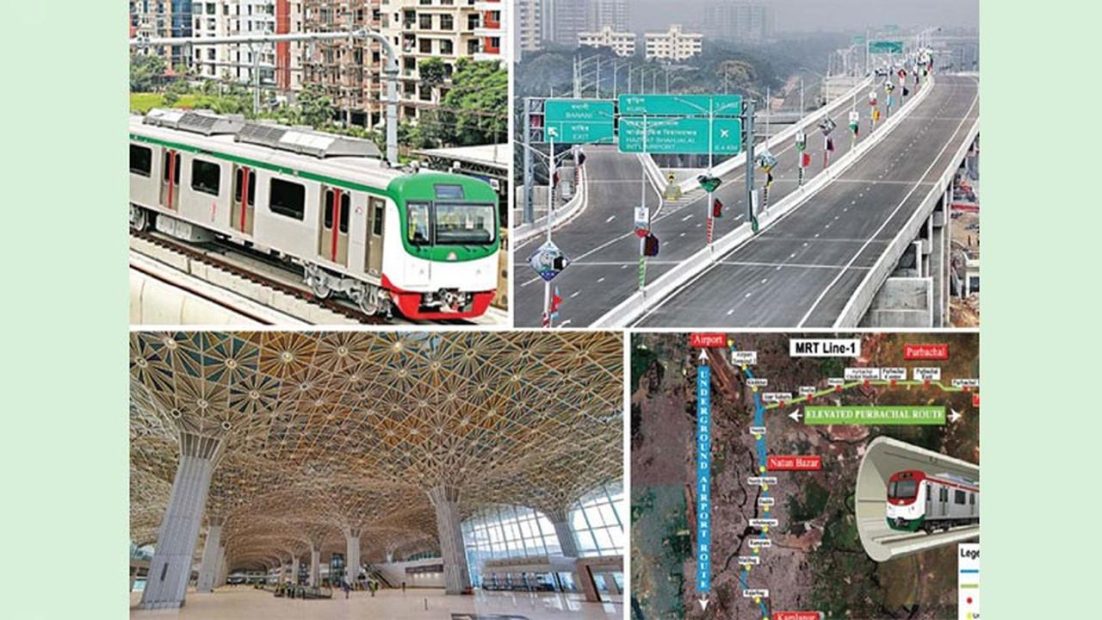
The government has taken initiatives to speed up work on major infrastructure projects centred on the capital Dhaka. Visible progress, especially in important communication and transport projects, has created new expectations among city residents. Some parts of the projects under construction have already been opened. Preparations are underway to complete the remaining work and gradually open them for public use.
Implementing large infrastructure projects is not easy for the government amid economic pressure. The projects are being carried out through a combination of foreign loans, domestic financing, government budgets and private investment. Improved connectivity plays an important role in expanding business and trade, creating employment, reducing the time needed to transport goods and attracting investment.
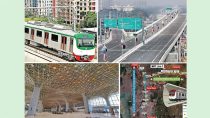
Expanding the metro rail network is one of the major initiatives to reduce long-term traffic congestion. Alongside MRT Line-6, projects such as MRT Line-1 and MRT Line-5 are expected to increase public transport connectivity between different parts of the capital once completed. The aim of these projects is to reduce dependence on private cars and make public transport more effective.
There are also initiatives to improve road connectivity around Dhaka, construct bridges and flyovers, and expand highways. Effective coordination among these projects could help reduce the pressure of excessive traffic on the capital. Once MRT Line-1 is implemented, it will create new possibilities for connectivity between the airport and Purbachal areas. Project officials said the northern route of MRT Line-5 would provide new transport facilities for passengers in the northern parts of the capital once it becomes operational.
Several important projects are currently underway, including the Dhaka Elevated Expressway, the third terminal of Hazrat Shahjalal International Airport and the extension of the metro rail from Motijheel to Kamalapur. Officials said the implementation of these projects would bring changes to the capital’s transport system, travel time, airport passenger services and urban management.
According to sources from the Bridges Division and the Bangladesh Bridge Authority (BBA), the overall physical progress of the Dhaka Elevated Expressway stood at 80.72 percent as of September 2026. Of the three phases, work on the first phase has been completed 100 percent. Progress in the second phase stands at 87.03 percent, while the third phase has achieved only 22.45 percent.
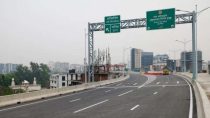
A ramp at the Panthakunja section of the Dhaka Elevated Expressway is planned to be opened to traffic in early February or even earlier. If the ramp can be opened ahead of Eid-ul-Fitr in March, it could help reduce traffic congestion on the capital’s roads. Direct access to the expressway through the ramp would also reduce pressure on the Tejgaon ramp.
There is a proposal to open two ramps for entry and exit at the Kamalapur section by 2027. However, instructions have been given to complete the work by June next year. The remaining construction work of the expressway from Kamalapur to Kutubkhali and from Panthakunja to Palashi is targeted for completion by December 2028.
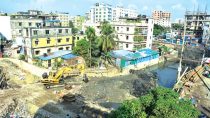
Construction of pillars, pier caps and concrete casting is underway after the foot-overbridge in the Basabo-Sabujbagh area. After completing earth and sand filling in the Basabo area, ramps for entry and exit to the main road and pier caps are being constructed.
Construction work in the Khilgaon and Malibagh sections has to be carried out in coordination with the railway line and the existing flyover. In Khilgaon, pillars and piling work is being carried out in the limited space between the railway line and the flyover while keeping traffic movement normal.
The project is being implemented under a public-private partnership (PPP) by First Dhaka Elevated Expressway Company Limited. China Shandong International Economic and Technical Cooperation Group owns 80 percent of the company, while Sinohydro Corporation owns 20 percent. The project duration has been set until December 31, 2028.
Third Terminal at Hazrat Shahjalal International Airport
The third terminal of Hazrat Shahjalal International Airport aims to increase passenger capacity at the country’s main airport, improve passenger services and enhance Bangladesh’s capacity for international air travel.
Civil Aviation and Tourism Minister M Rashiduzzaman Millat said that if everything progresses according to plan, operations at the third terminal will begin partially on Victory Day, December 16.
Metro Rail Extension to Kamalapur
The metro rail has already brought significant changes to the public transport system. Work on its extension to Kamalapur is underway.
Once the new 1.16-kilometre section from Motijheel to Kamalapur is added, the total length of the metro rail route will reach 21.26 kilometres. The number of stations will be 17.
As of September 30, 2026, the progress of civil construction work on the Motijheel-Kamalapur section stood at 84.85 percent. The remaining architectural and related construction work is targeted for completion by December 31, 2026.
However, the metro rail extension is expected to begin commercial passenger services in July 2027.
Dhaka-Ashulia Elevated Expressway
The Dhaka-Ashulia Elevated Expressway project is also progressing to improve connectivity to industrial areas. It will create an opportunity for faster travel from the airport through Ashulia to the Savar EPZ.
Once the project is implemented, connectivity between Dhaka and the industrial areas of Gazipur and the capital will become easier.
Better Infrastructure Alone Will Not Be Enough
Professor Dr Adil Muhammad Khan, executive director of the Institute for Planning and Development (IPD) and an urban planner, said that city residents could experience significant relief in travelling if the ongoing metro rail, elevated expressway, flyover and other transport infrastructure projects in Dhaka become fully operational.
He said these projects would play an important role in reducing traffic congestion, saving travel time and increasing the capacity of public transport.
“However, simply constructing infrastructure will not be enough,” he said. Effective coordination among the projects, an improved public transport system, proper use of footpaths and effective traffic management must also be ensured.
If the projects are managed in a planned manner, the traffic situation in Dhaka will improve and the daily lives of city residents will become easier.