China Vows to Shield Bangladesh Against Foreign Interference in Its Internal Affairs: Charge d’Affaires Dr Liu Yuyin
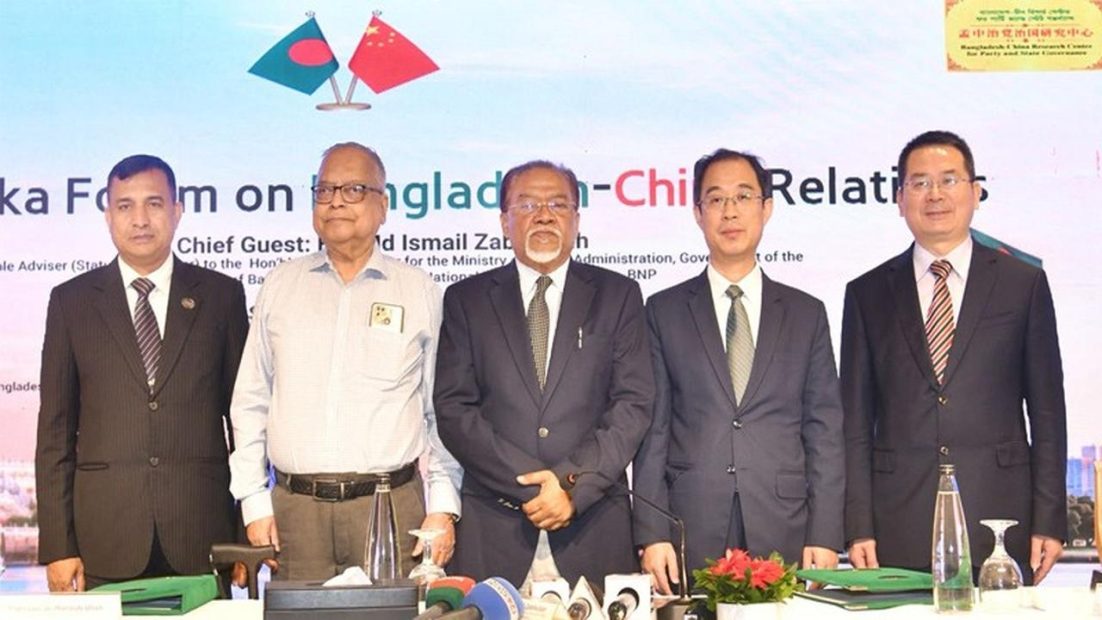
China has reaffirmed its policy of non-interference in Bangladesh’s internal affairs, with Dr Liu Yuyin, Chargé d’Affaires of the Chinese Embassy in Bangladesh, saying Beijing respects the right of the Bangladeshi people to independently choose their own development path.
He said China would continue to firmly support Bangladesh in safeguarding its independence, sovereignty and territorial integrity, adding that China would act as a shield if anyone interfered in Bangladesh’s internal affairs. He also emphasised the importance of expanding trade, investment, infrastructure and regional connectivity to deepen bilateral relations.
Dr Liu made the remarks as a special guest at the seminar titled “2026 Dhaka Forum on Bangladesh-China Relations”, jointly organised by the Bangladesh Institute of International and Strategic Studies (BIISS) and the Chinese Embassy in Dhaka at Hotel InterContinental in the capital on Wednesday (November 25).
Liu Yuyin said relations between Bangladesh and China were founded on mutual respect, respect for sovereignty and the principle of non-interference in each other’s internal affairs. China respects the right of the Bangladeshi people to independently choose their development path, he said, adding that Beijing was also working towards building a community with a shared future with Bangladesh.
In line with China’s 15th Five-Year Plan, he called for new areas of cooperation in trade, investment, industrial development, technology transfer and skills enhancement.
Speaking as the chief guest at the seminar, Prime Minister’s Adviser on Public Administration and BNP National Standing Committee member Md Ismail Zabiullah said Chinese entrepreneurs should establish factories in Bangladesh and increase investment in the manufacturing sector to reduce the trade deficit between the two countries.
He said around 75% of Bangladesh’s total exports in the 2025-26 fiscal year went to Western markets, while 18.85% went to the United States and only 1.71% to China. To change this situation, cooperation in joint investment, technology transfer and manufacturing should be expanded beyond import-export activities, he said.
He said Chinese entrepreneurs could establish factories in Bangladesh by taking advantage of the country’s geographical location, skilled workforce and market facilities. From Bangladesh, they could export products to markets in Africa, the Middle East and Europe. This could create employment, diversify exports and reduce the trade deficit, he added.
Highlighting progress in bilateral relations, Ismail Zabiullah said high-level visits and communications between Bangladesh and China had increased following the political change on August 5. The commitment to building a “Bangladesh-China Community with a Shared Future”, announced during Prime Minister Tarique Rahman’s visit to China in June 2026, had given the relationship a new dimension. Now, it was time to translate the relationship into practical economic cooperation, he said.
Regarding regional connectivity, the adviser described the China-Myanmar-Bangladesh Economic Corridor as a significant opportunity. He said an effective regional economic corridor could be developed by improving road and rail connectivity from Kunming in China to Kyaukphyu in Myanmar and establishing a maritime link between Kyaukphyu Port and Chittagong Port. However, Bangladesh’s national interests must be given the highest priority in this regard.
He said Dhaka wanted structured trilateral dialogue to implement the corridor. Beyond infrastructure development, economic integration and cooperation among the countries concerned should also be considered. This would require reviewing political realities, security conditions and economic interests, alongside research, feasibility studies and policy dialogue, he added.
Regarding the Rohingya crisis, Ismail Zabiullah said stability in Myanmar’s Rakhine State was essential for regional trade and investment. Bangladesh expects China to play a constructive and strong diplomatic role in ensuring the safe, voluntary and dignified repatriation of Rohingyas and restoring stability in Rakhine, he said.
He also sought China’s cooperation in transforming Bangladesh’s seaports into modern and environmentally friendly logistics hubs, developing another major port infrastructure similar to Matarbari and establishing Chandpur as a potential port and logistics hub. The adviser also emphasised the importance of establishing a joint shipping and logistics company between Bangladesh and China.
BIISS Director General Major General Hussain Muhammad Masihur Rahman delivered the welcome address at the event. Dr Liu Zongyi, Senior Research Fellow at the Shanghai Institutes for International Studies (SIIS) and Director of its Centre for South Asian Studies, also spoke as a special guest.
National Professor Dr Mahbub Ullah chaired the inaugural session. Diplomats, government officials, researchers, academics and journalists attended the seminar.