India-Israel ties deepen as war intensifies across the Middle East
The Guardian
As conflict spreads across the Middle East, India’s relationship with Israel has deepened. The closer ties have grown despite mounting international criticism of Israel’s military offensive in Gaza, which has reduced the territory to ruins and killed more than 70,000 Palestinians, many of them children. Stanly Johny, an Indian foreign policy expert and international affairs editor at The Hindu, said the shift was not merely political or diplomatic, but had also taken place at the strategic and defence levels. A recent investigation by Amnesty International found that India has become an important contributor to Israel’s weapons production through joint ventures and manufacturing partnerships. Indian companies, including state-owned firms, continue to supply Israeli military contractors with drone warheads, artillery shell casings, small-arms components and various parts for military vehicles, despite the risk that such equipment could be used in Gaza.
Several Western countries, including Britain, have restricted or banned arms supplies to Israel over concerns that the weapons could contribute to violations of international humanitarian law. In September, a United Nations commission concluded that Israel had committed genocide in Gaza, while another commission earlier this year said Israel was deliberately targeting Palestinian children as part of its genocidal campaign. The International Criminal Court has also issued an arrest warrant for Israeli Prime Minister Benjamin Netanyahu on allegations of war crimes. Amnesty traced hundreds of thousands of components shipped from Indian factories to Israeli military suppliers between October 7, 2023, and November 30, 2025. They included 390,516 small-arms components, 564,970 components for explosive weapons and 298 components for military vehicles.
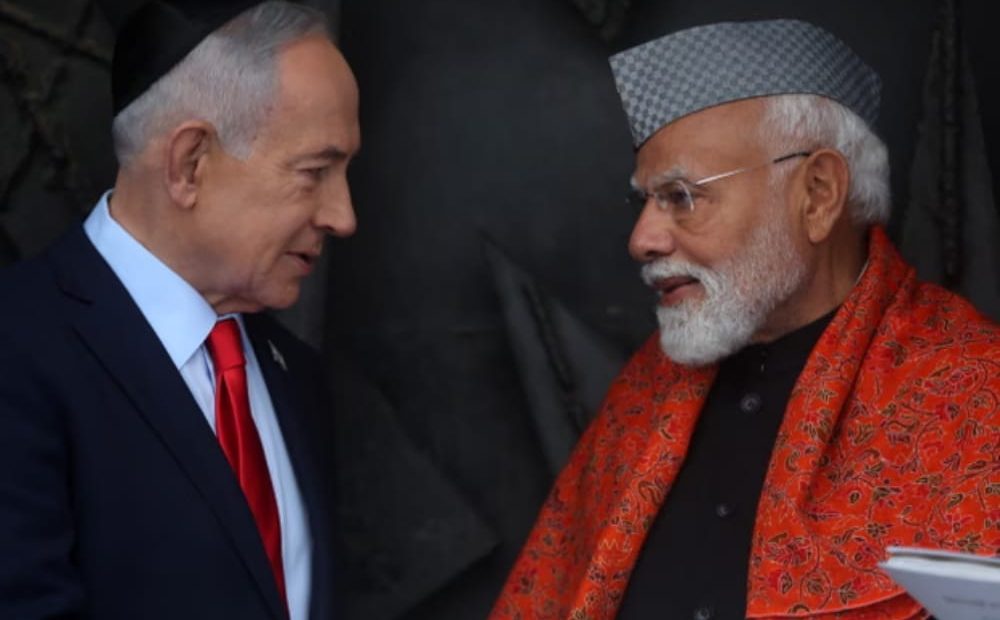
Yet Amnesty’s findings have produced little political reaction in India. Johny attributed this partly to support for Israel among Modi’s voters, saying there were clear ideological similarities between Hindutva and Zionist nationalism. Indian writer Pankaj Mishra highlighted a similar affinity in a 2017 essay, describing Israel as an example of how to confront Muslims, using “the only language they understand: force and more force”. A Pew Research survey published in June found that 32 percent of Indians viewed Israel positively, while 28 percent held a negative view. This position contrasts with declining support for Israel in many Western countries, including the United States. Modi has developed a close relationship with Netanyahu. In 2017, he became the first Indian prime minister to visit Israel, and earlier this year his visit took place as Israel and the United States launched their attack on Iran.