
Kaptai Offers a Ray of Hope Amid Power Crisis
Rafiqul Islam Salim
The Kaptai Karnaphuli Hydropower Plant in Rangamati district is showing a ray of hope amid the ongoing power crisis in the country. All five units of the plant are now fully operational as the water level of Kaptai Lake has increased due to recent heavy rains and landslides. The power generation of the plant has reached its maximum level. From there, 222 megawatts of electricity is being added to the national grid. This is providing some relief from the crisis.
Electricity is being obtained from the Kaptai power plant at the price of water with water. When other fuel-based (gas, coal and furnace oil) power plants in the country are facing a fuel crisis, this completely natural hydropower is playing a role as the most cost-effective source. Each unit of electricity generation there costs only 50 paisa. On the other hand, electricity generation from other fuel-based plants has to be calculated at three to four taka per unit. Again, all those power plants have to be kept running due to a fuel crisis.
The Kaptai Hydropower Plant suffers from water shortage for almost half of the year. Due to the drought caused by climate change, the water level in Kaptai Lake is lower than normal for about six months a year. Then, the power plant has to be shut down during the day and a few units have to be kept running during peak hours in the evening. A small amount of electricity is available from the 5 units of the 230-megawatt power plant. However, there is no water crisis now. Rather, the water level in the lake has increased significantly. In this situation, additional water is being released to cope with the pressure. To cope with the situation, 58,000 cusecs of water are being released every second since yesterday, said Mahmud Hasan, Manager (Supervising Engineer) of Karnaphuli Hydropower Plant.
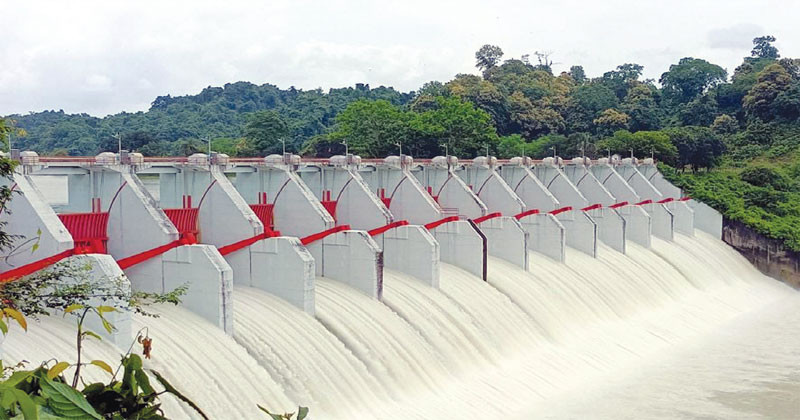
He told Inqilab that to reduce the excess water pressure in Kaptai Lake, 16 water gates of the dam’s spillway have been opened by 3 feet and the amount of water released has been increased. People in the downstream areas have been requested to be alert due to the release of water from the lake. He said that releasing excess water is a normal occurrence. However, people are warned before releasing water. The water release started around 8 pm on Saturday. During this time, each gate was opened by 6 inches and about 9,000 cusecs of water was discharged into the Karnaphuli River.
Later that night, after 10:30 PM, the water was released again. The amount was increased and about 18 thousand cusecs of water was discharged per second. Even then, as the situation did not improve, each gate was opened by 3 feet at 10 am yesterday and 58 thousand cusecs of water is being discharged per second. He also said that the water supply will continue. Currently, five units of the Kaptai Pani Power Plant are operating round the clock. Electricity generation is continuing in all units. Through this, about 32 thousand cusecs of water is being discharged.
It is learnt that due to the release of water from the lake, water has started receding from the low-lying areas of various lake-bound areas of the district including Rangamati Sadar, Baghaichhari, Longadu, Barkal and Jurachhari. Those areas were flooded due to excess water. The attractive suspension bridge of the Rangamati Tourist Motel was also submerged. It has also been reported that many houses, roads, establishments and cropland were submerged due to the increase in water in the lake. Communication is being disrupted due to the submerged roads in Baghaichhari.
Power plant officials said that till 10:30 am yesterday, the water level in the lake was 106.02 MSL (mean sea level). The maximum water capacity of Kaptai Lake is 109 MSL. If it crosses 105 feet, it is considered dangerous. Because when the water level rises from 105 to 108 MSL, many areas of Rangamati are submerged in water. And for this reason, water has to be released quickly. The amount of water released can be increased or decreased if necessary after monitoring the situation. For this reason, residents of low-lying areas along the banks of the Karnaphuli River in Kaptai, Rangamati and Chittagong have been urged to be alert.
Power plant officials said that although the capacity of Kaptai Lake is 109 MSL, now when it rises to 105 MLS, many areas, especially illegally built houses and various structures inside the lake, are submerged. Again, the lake’s elevation is increasing due to man-made disasters such as filling the lake, destroying hills and hills. As a result, the localities are being flooded even if the water level rises a little.
When the water level in the lake increases, on the one hand, electricity is available in full swing, and on the other hand, there is no problem of salinity upstream of the Karnaphuli. Due to natural disasters such as drought and drought in the past few years, the water level has been falling below normal for half of the year. This is disrupting power generation. Again, when the water flow from the lake to the Karnaphuli has decreased, the tidal water is rising upstream. As a result, brackish water is entering Halda, the main source of water for Chittagong WASA. As a result, the salinity level in WASA water is increasing, causing public suffering. The invasion of brackish water is also having an adverse effect on the environment of Halda, the largest and only natural fish breeding ground in Asia and the country. Due to brackish water, crops in Anwara and Boalkhali upazilas along the banks of the Karnaphuli River are being damaged.
In 1956, an initiative was taken to build a hydroelectric power plant by damming the Karnaphuli River to meet the electricity needs of the then East Pakistan. For this, the artificial Kaptai Lake was created. The construction of the hydroelectric power plant was completed in 1962 with funding from the United States. Utah International Inc. built this dam with a length of 670.6 meters and a height of 54.7 meters. There is a 745-foot-long spillway connected to 16 water gates next to this dam. This spillway can discharge 525,000 cusecs of water per second.
The initial budget for this project was estimated at 254 million taka. However, it later exceeded 480 million taka. The power plant was completed in 1988. Electricity is generated through turbines using the speed of the water of the Karnaphuli River flowing down from the Lusai Hills. Officials of the Power Department say that to keep the Karnaphuli Power Plant operational throughout the year, the depth of the lake will have to be increased. Along with this, effective initiatives will have to be taken to prevent environmental disasters, including illegal construction by occupying the lake and destruction of mountains.