Banking Sector Losses Pose Risks to Economy
Md. Aktar Hossain
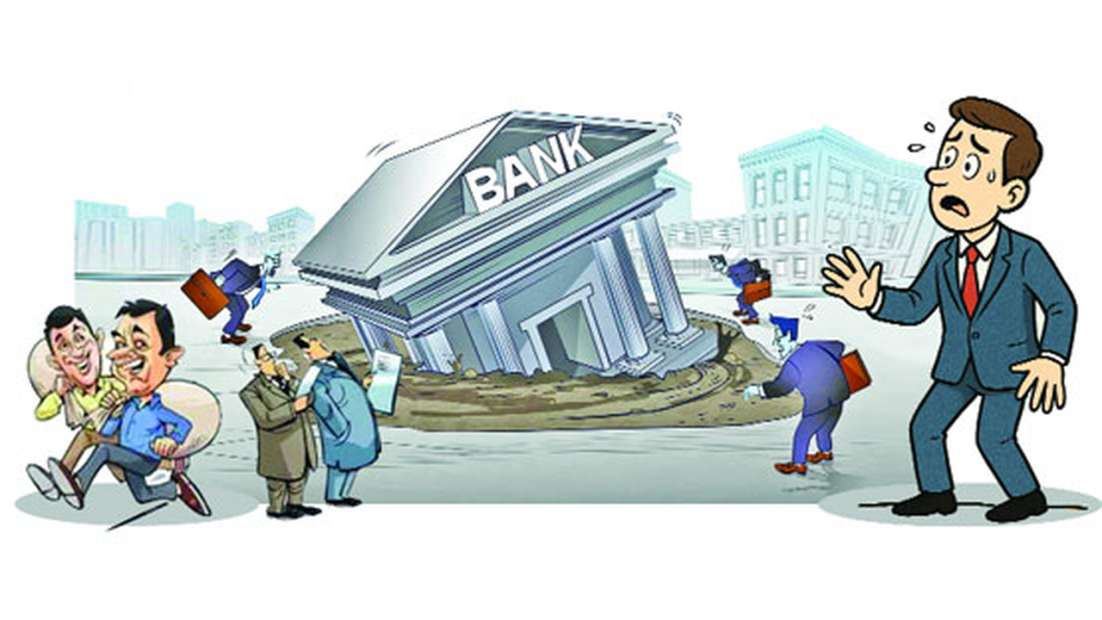
The banking sector is growing weaker because of loan defaults, and a crisis of trust has started. Depositors go from bank to bank to take out their own savings. Meanwhile, loan defaulters send the country’s money abroad and live a luxurious life at home and abroad. Even when they stay in the country, they remain out of reach. They do not face punishment or blame. Instead, they get rewarded again and again.
Approval for rescheduling defaulted loans is given again and again, and more time is allowed. So borrowers do not want to repay their loans. They take the chance and waste time.
According to a list based on International Monetary Fund (IMF) statistics, Bangladesh ranks 35th among the 50 largest economies in the world. But sources from the World Bank and the central banks of the countries concerned, using data from 2019 and 2020, give a different picture. They say the GDP of Bangladesh was $323 billion, India $2,660 billion, Thailand $500 billion and Malaysia $337 billion. The number of licensed local banks in these countries was 52 in Bangladesh, 34 in India, 18 in Thailand and eight in Malaysia.
Even China, a huge economy, has only 12 state owned commercial banks. In Bangladesh, people have set up banks when needed, when not needed and to gain political benefit. The American magazine Forbes published a list titled “World’s Top Performing Banks 2026” for the first time. It ranks banks by their financial strength and activities. Forbes made the list in partnership with the market research firm Statista. The list includes 500 banks from 89 countries. Only one bank from Bangladesh made the list, which is very disappointing.
Bangladesh now has 61 banks in total. On the other hand, a large part of the adult population in the world that has no banking service lives in just eight countries. Bangladesh is one of them. This comes from the latest World Bank report, the Global Findex Database 2025. According to the report, about 1.3 billion people in the world have no account in any bank or financial institution. Of this huge number, 53 percent, about 650 million people, live in only eight countries, including Bangladesh.
Yet many countries are ahead of Bangladesh in economy and population, and they have fewer banks than Bangladesh. So why does Bangladesh need so many banks? Banks in our country were supposed to bring people in remote and marginal areas into banking service. Agent banking began with this aim. But how much has it worked? If the authorities had forced banks to open more branches instead of adding more banks, branches would exist in marginal areas. Then people at the margins of the country would also get mainstream banking service.
More banks have mostly added branches in cities. Most cities have an area known as a bank para. Every building in those areas holds a bank branch. Yet most upazilas still have no more than five or six bank branches. If banks worked directly in retail banking at the upazila level, rural life and the rural economy would see a huge positive change. Corporate sector risk would also not grow so much. The economy of the country could also grow in a balanced way.
But in our country, the opposite has happened. Although the number of banks has grown, only a few private banks, which can be counted on one hand, have more than 200 branches. On the other hand, 40 to 50 percent of all bank branches sit in just two cities, Dhaka and Chattogram.
A recent report in a newspaper says that 22 of the 61 banks in the country are running with accumulated losses. Up to last March, the accumulated losses of the banks stood at Tk 254,000 crore. Tk 85,000 crore in liquidity support has been given to 15 banks. Another report says Bangladesh Bank Governor Mr. Md. Mostaqur Rahman has said the national budget will need Tk 60,000 crore every year for the next five to eight years to recover from the losses of the banking sector.
A banker may find this hopeful. But for an ordinary citizen, it is just as disappointing. People who looted money from the banking sector and sent it abroad did not spend that money on people’s development. Helping them with money from the VAT or taxes of the public will never feel good. People pay income tax for the development of the state. We must think about how fair it is to use that money to subsidize the banking sector so it can stand again.
The main goal should be to develop the banking sector by recovering loans or bringing back the money sent abroad. The process of recovering loans from defaulters should be stricter. If the authorities keep giving chances by rescheduling loans again and again, those loans will never be recovered.
Every decision of the state deserves respect. But if decisions give benefits to the upper class of society, it is a big disappointment for taxpayers and ordinary people. Tax and VAT are collected for the development of the state. But we see that, because of state decisions or by using gaps in the law, big fish take benefits again and again. That is not right for the state.
So the state should look at the macro economy. It should cut the number of banks. It should make banks spread to the village level by adding branches. It should bring every citizen under banking service and make the banking sector richer. Then everyone will come under banking service on their own will, and pay tax when needed for the development of the state. What everyone wants is that the banking sector overcomes its losses and plays its full role in the macro economy of the country.