The ‘Indigenous’ Identity Is Irrelevant in the Context of Bangladesh
Dr Abdullah Al Yusuf
Indigenous Peoples Day was observed worldwide on August 9, including in Bangladesh. Some members of Bangladesh’s small ethnic communities held rallies, meetings and seminars and raised various demands. In recent years, they have organised similar events almost every year. The word “indigenous” has recently entered the vocabulary of certain special-interest groups and sections of the intelligentsia. Whether they use it knowingly or without understanding it, its growing use has created confusion among ordinary people and even informed sections of society. We therefore need to examine the issue. First, we need to define “indigenous”. The English words “native”, “aboriginal” and “indigenous” have no exact Bengali equivalents, and we need research into the origin of the Bengali word “adibasi”.
The terms themselves have no universally accepted definition. The United Nations Permanent Forum on Indigenous Issues says no official definition of “indigenous” exists, although it identifies parameters including historical continuity with pre-colonial societies and a strong relationship with land and the surrounding environment. In simple terms, indigenous peoples lived in a region before it became a colony and maintained close ties with its natural resources and livelihoods. We cannot establish who lived in a region before colonisation through mythology, oral chronicles or manuscripts alone. We need archaeological evidence, inscriptions and recorded history. Modern science also offers genetic and DNA analysis. Many ethnic groups lived in this region before British colonisation. Some had ancient roots, while others arrived through successive migrations. DNA analysis can therefore help identify the earliest inhabitants.
Genetic analysis of Bengalis has identified DNA from three ancient populations. Forty-five percent comes from a mixture involving the first Homo sapiens group that migrated from Africa to southern India 10,000 years ago and agricultural populations from Persia. Sediment began forming the Ganges delta 7,000 years ago, and we can assume that the ancestors of Bengalis established themselves through agriculture on ancient Bengal’s fertile lands. Another 15 percent comes from an ancient Austroasiatic population that arrived 4,000 years ago and introduced irrigation-based farming. A further 40 percent comes from Indo-Aryan populations that arrived from the Eurasian Steppe 3,500 years ago. Now let us examine when and from where the small ethnic communities that today claim to be indigenous came to this region.
Two major migration waves came from Arakan. The first occurred in 1403, when Burmese forces crossed the Arakan Mountains from the Irrawaddy Valley and attacked Arakan. King Narammeikhla fled to Bengal with Rohingya, Rakhine, Chakma and Marma people and sought refuge from Sultan Jalaluddin Muhammad Shah, who granted them asylum. In 1430, Narammeikhla regained his kingdom with the Sultan’s military assistance. Most migrants returned, although some Chakmas, known as “Dainet” in Arakanese, Marmas, known as “Mramma”, and Rakhines remained. Francis Buchanan encountered them in 1798 while surveying the Chittagong Hill Tracts. William van Schendel’s Francis Buchanan in Southeast Bengal (1798): His Journey to Chittagong, the Chittagong Hill Tracts, Noakhali and Comilla records Buchanan’s April 29, 1798 account: “I observed that everyone here spoke Bengali. They also said they understood no other language.
Ordinary people read books in Bengali, but the priests read books written in the Rakhine language.” This shows that the first Chakma, Marma and Rakhine migrants had become integrated into Bengali society. Another major migration occurred in 1784, when Burmese King Bodawpaya attacked Mrauk-U, or Arakan, again and more than 200,000 migrants sought refuge in Bengal, then part of the British Empire. When the British captured Arakan in 1824, Rohingyas and Rakhines returned, while Chakmas and Marmas remained. This represents the earliest major recorded history of Chakma and Marma migration into this region. Today, when Bengalis who have lived here for 7,000 years hear claims of “indigenous” status from migrants whose major recorded presence dates back about 350 years, it sounds like delirium.
This country’s previous government left behind an agreement that, in my view, absurdly requires Bengalis with thousands of years of roots in the region to obtain permanent-resident certificates from the rulers of an external population. I am waiting for the Supreme Court to issue a show-cause notice to the government asking why this agreement should not be declared illegal. They speak of discrimination and demand rights. Rights to what? Who suffers discrimination? More than 50 percent of the Chittagong Hill Tracts population consists of indigenous Bengalis, while Chakmas account for less than 25 percent, Marmas 11 percent and Tripuras 7 percent. Yet hill Bengalis have no reasonable representation in Parliament or the regional council. Why should more than 50 percent of the population have only one-third representation? Why is the literacy rate among Chakmas 73 percent while the rate among Bengalis, who make up more than 50 percent, is only 23 percent?
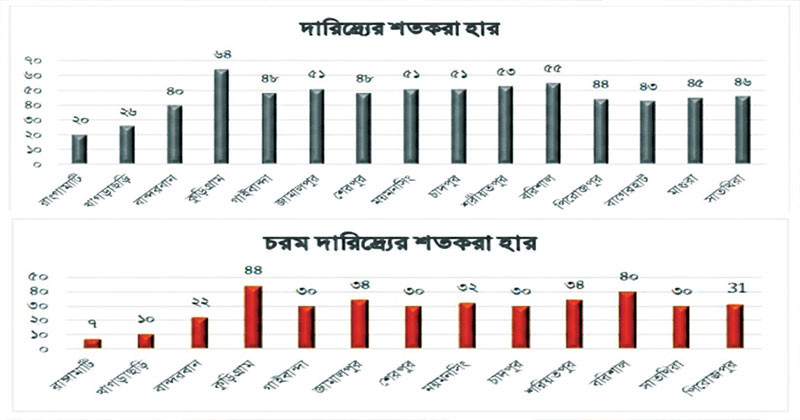
The World Bank’s poverty mapping, updated through 2025, shows Rangamati’s poverty rate at 20 percent and extreme poverty at 7 percent, compared with 64 percent and 44 percent respectively in Kurigram. Every district in Bangladesh’s haor region has much higher poverty and extreme-poverty rates than the three hill districts, with a similar situation in southern districts. Who suffers discrimination? Who is crushed by poverty? Who is deprived of education? For whom did the anti-discrimination movement of 2024 take place? I appeal to representatives of small ethnic communities: “please remove the mask of ‘indigenous’ identity and look in the mirror.” You are not the victims of discrimination. Bengalis are. We must understand that small ethnic communities did not originally demand an indigenous identity or indigenous rights.
Even the Chittagong Hill Tracts accord used “tribal”, not “indigenous”, and the leaders of the Parbatya Chattagram Jana Samhati Samiti did not choose the latter term. Members of royal families imported it. They speak about indigenous culture while giving their children and grandchildren Western education and culture. They do not want grassroots people to become educated, healthy or landowners. When the government seeks to establish universities, medical colleges and technological universities in the hill areas, they obstruct those efforts. They want kings to retain land ownership, while headmen and karbaris determine which land people cultivate. Are these royal families using the “indigenous” narrative to restrict individual rights and freedom? Our so-called friendly(?) state also provides encouragement. Whenever we seek a discrimination-free society based on harmony in the hill region, they try to create instability through armed criminals.
If you want dialogue, debate, equal rights and a discrimination-free society, let us hold constructive discussions. But if you choose violence or seek to create instability in the name of “indigenous” doctrines, I believe the government will take appropriate measures. This country belongs to everyone. Every citizen has equal rights. There is no place here for an elite class with special privileges.
Author: Retired Major General, Bangladesh Army.