Hegemony of Akhand Bharat Must Be Resisted Unitedly
Jamaluddin Bari
The main problem facing Bangladesh is multidimensional Indian aggression and hegemony. Hindutva-oriented Indians believe that because India assisted Bangladesh during its 1971 Liberation War, Bangladesh must accept Indian dominance and remain a vassal state. Patriotic Bangladeshi citizens have been aware of this policy from the beginning. Public opinion and political choices—including how citizens elect their representatives—are shaped by the role leaders play regarding relations with India.
Even before the first government assumed office after 1971, the government-in-exile had signed a seven-point subjugation treaty with India. Various books written about the 1971 Liberation War document this secret agreement. In Mr. Nurul Quadir’s book titled Freedom in Two Hundred Sixty-Six Days, the terms of this secret seven-point treaty were listed as follows:
- Independent Bangladesh would not maintain a regular permanent military force; only a militia force would be kept for internal law and order.
- The overall responsibility for Bangladesh’s defense system would rest with the Indian Armed Forces.
- Indian forces could use Bangladeshi territory for any strategic or military requirements.
- India’s permission would be required to import arms or military equipment, and assistance from third-party nations could not be accepted.
- Joint or coordinated policies with India must be followed regarding natural resources and foreign trade.
- Intelligence and foreign security activities must be conducted jointly with India.
- Decisions regarding international and multilateral relations must be taken in consultation with the Indian Ministry of External Affairs.
Representatives of a freedom-loving people would never enter into such a surrender treaty. What the Awami League did in independent Bangladesh in exchange for the blood of hundreds of thousands of martyrs has no precedent anywhere in the world.
Sheikh Mujibur Rahman was likely not ready to accept all those terms either. For this reason, within a month and a half of returning home, on March 19, 1972, he entered into a new 25-year “Treaty of Friendship, Cooperation, and Peace” framed in diplomatic language. Under this 12-point treaty signed between Prime Minister Sheikh Mujibur Rahman and Indian Prime Minister Indira Gandhi, plans were consolidated to reduce Bangladesh to a vassal state. Although the earlier seven points were not explicitly stated in this treaty, the regimes of Sheikh Mujibur Rahman and Sheikh Hasina effectively implemented them in practice, using superficial gestures only to manage public anger. Notably, under Chinese influence, Sheikh Hasina was unable to reject rational decisions like acquiring submarines for Bay of Bengal security.
External Control and the July Uprising
During Sheikh Hasina’s tenure, despite growing inequality, lack of democracy, poor governance, human rights abuses, and the absence of political rights, a terrifying environment of enforced disappearances and extrajudicial killings maintained an artificial stability. In contrast, non-Awami League periods—such as the Jatiya Party’s military rule and the entire administration of the Bangladesh Nationalist Party (BNP)—were destabilized so Bangladesh could not achieve its political and economic goals.
To promote the narrative that Bangladesh could only remain stable and prosperous under a subservient government, Bangladesh was turned into an experimental soft-power incubator under Indian control for fifteen years. The primary objective was to undermine from within the nation’s economy, banking sector, education system, law enforcement, administration, and democratic institutions, with the ultimate goal of absorbing Bangladesh into India, similar to Hyderabad or Sikkim.
Following the July Uprising, these intentions became evident through various actions. When the Western world extended support to Bangladesh’s interim government to facilitate a democratic transition, BJP leaders in India escalated anti-Bangladesh threats, provocative hate speech, and propaganda. India mobilized both its public and secret soft-power fronts in Bangladesh in an attempt to destabilize the interim government.
The core spirit of the July Revolution is consistent with that of the 1971 Liberation War, despite ongoing attempts to create division between the two. Although the Indian government assisted in 1971, its subsequent actions worked against Bangladesh’s independence goals. When Indian forces entered Bangladesh as an allied force in mid-December 1971, they looted assets worth millions of dollars upon withdrawal, including tanks, aircraft, armored vehicles, weapons, military equipment, cantonment valuables, factory machinery, and currency.
The Aftermath of the 2024 Mass Movement
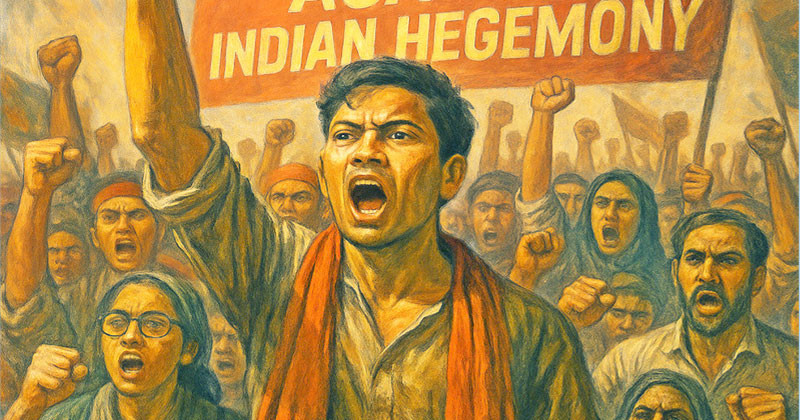
Students and general citizens played the primary role in the July 2024 mass movement, which was a revolution against Indian hegemony masked by Sheikh Hasina’s authoritarian rule. The aspirations of the Bangladeshi people are well known to the Indian ruling class. However, prioritizing their relationship with Sheikh Hasina over bilateral ties with 180 million people, India granted her refuge in Delhi.
Despite formal requests and reminders from the interim government to extradite Sheikh Hasina as a condition for normalizing relations, Delhi has ignored official communications and continues to covertly support political activities by Sheikh Hasina and the Awami League. Actions such as suspending Indian visas for Bangladeshis, attacks on Bangladeshi embassies and consulates by BJP activists, and stopping exports of various goods have inflicted far greater economic damage on India than on Bangladesh.
Indian political maneuvers using Sheikh Hasina have continued uninterrupted. On August 5, the anniversary of the July Mass Uprising, Prime Minister Mr. Narendra Modi’s government facilitated media access for Sheikh Hasina in Delhi, signaling an unwillingness to align with the new priorities of Bangladesh. Following the uprising, attempts were made to exploit minority issues through ISKCON-led protests, but general Hindu citizens refrained from joining, and the effort failed due to firm stances by student leaders, the interim government, and political parties. Having failed on multiple fronts, India now seeks normal diplomatic ties with Bangladesh while simultaneously harboring thousands of Awami League leaders to maintain pressure on Mr. Tarique Rahman and the interim government. Following Mr. Tarique Rahman’s visit to China, Indian aggressive rhetoric cooled somewhat, leading to attempts to involve American mediation.
Invitations and honors were extended to Mr. Tarique Rahman to visit Delhi as part of India’s soft-power approach. However, Mr. Tarique Rahman, the son of former President Ziaur Rahman and former Prime Minister Khaleda Zia, firmly rejected these hegemonist policies and declined to visit India at this time. Recently, leaders in Nepal, Sri Lanka, and the Maldives have similarly rejected Indian dominance. In remarks regarding Middle Eastern conflicts, Indian Prime Minister Mr. Narendra Modi referenced plans regarding an “Akhand Bharat” (Undivided India) encompassing Bangladesh, Pakistan, Afghanistan, and Nepal, while supporting Israeli actions in Gaza, Lebanon, and Iran.
Domestically in India, young people inspired by Bangladesh’s Gen-Z movements have organized protests against discrimination. Just as Bangladeshi anti-discrimination protesters reclaimed the streets after being labeled Razakars by Sheikh Hasina, Indian youth formed the “Cockroach Janta” party and took to the streets after being called “cockroaches” by the Chief Justice of India, forcing the BJP government to yield to their initial demands. While exercising democratic tolerance at home, India previously extended maximum support to maintain control over Bangladesh through Sheikh Hasina’s administration.
Border and Security Challenges
Tensions in the Chittagong Hill Tracts (CHT) have escalated into new dimensions. As the Bangladesh Army curtailed the separatist activities of armed groups, certain Indian agents posing as Chakma representatives publicly expressed desires to merge the CHT with India. Simultaneously, attempts are being made to revive the decades-old “Bongobhumi” project targeting Southwestern Bangladesh.
These projects failed even when Bangladesh was politically and economically fragile and lacked strong regional alliances. Today, Bangladesh stands united, supported by military powers such as Pakistan, China, and Türkiye. Attempts to intimidate the new Bangladeshi leadership with old strategies are counterproductive; almost every measure taken by Delhi over the past two years to pressure Bangladesh has backfired.
Efforts by self-proclaimed leaders to take the CHT annexation demand to international courts lack legal foundation. Territorial sovereignty over the CHT was settled in 1947 through legal framework and popular mandate, establishing it as an integral part of Bangladesh. While future integration of neighboring Indian states like Tripura, Meghalaya, Assam, or West Bengal into Bangladesh remains a theoretical possibility if regional dynamics shift voluntarily, the CHT will never become part of India.
Amid current global fuel shortages, certain fringe leaders called for stopping diesel and electricity supplies to Bangladesh. These demands hold no widespread support among the local Chakma population in the CHT and further indicate that such actors operate as external agents. This situation underscores the necessity for Bangladesh to achieve complete self-reliance in energy and food security. Sanctions and restrictions imposed under the BJP-led government aimed at pressuring Bangladesh have ultimately encouraged self-sufficiency. Bangladesh has consistently sought stable, respectful bilateral relations and continues trade despite significant trade deficits. However, no leader will emerge in Bangladesh to compromise the nation’s independence, sovereignty, stability, or security.